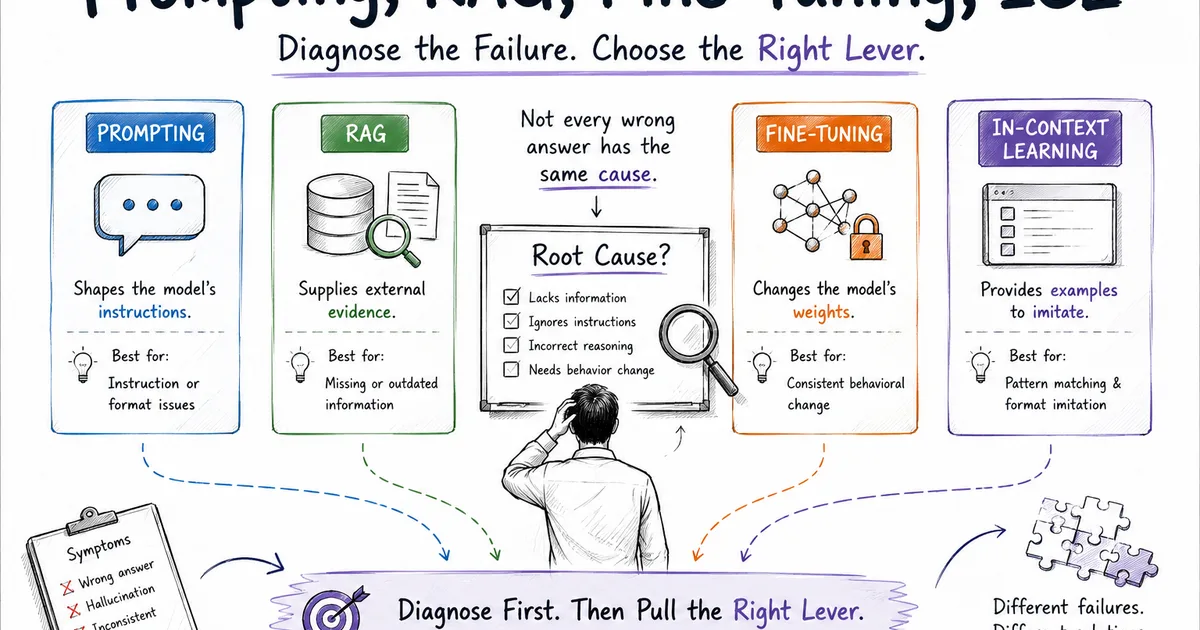
This article explores the distinctions and appropriate uses of prompt engineering, retrieval-augmented generation (RAG), and fine-tuning in the context of large language models. It emphasizes the importance of diagnosing the root cause of an AI failure before selecting a technique, rather than resorting to trial and error. The piece uses a hypothetical example of an insurance company's chatbot providing incorrect information to illustrate how different approaches, like fine-tuning or RAG, can be applied to address specific issues. AI
IMPACT Provides guidance on selecting appropriate LLM techniques for specific problems, aiding developers in more effective model implementation.
RANK_REASON The cluster discusses different techniques for working with LLMs, offering guidance rather than announcing a new development.
AI-generated summary · Google Gemini · from 2 sources. How we write summaries →