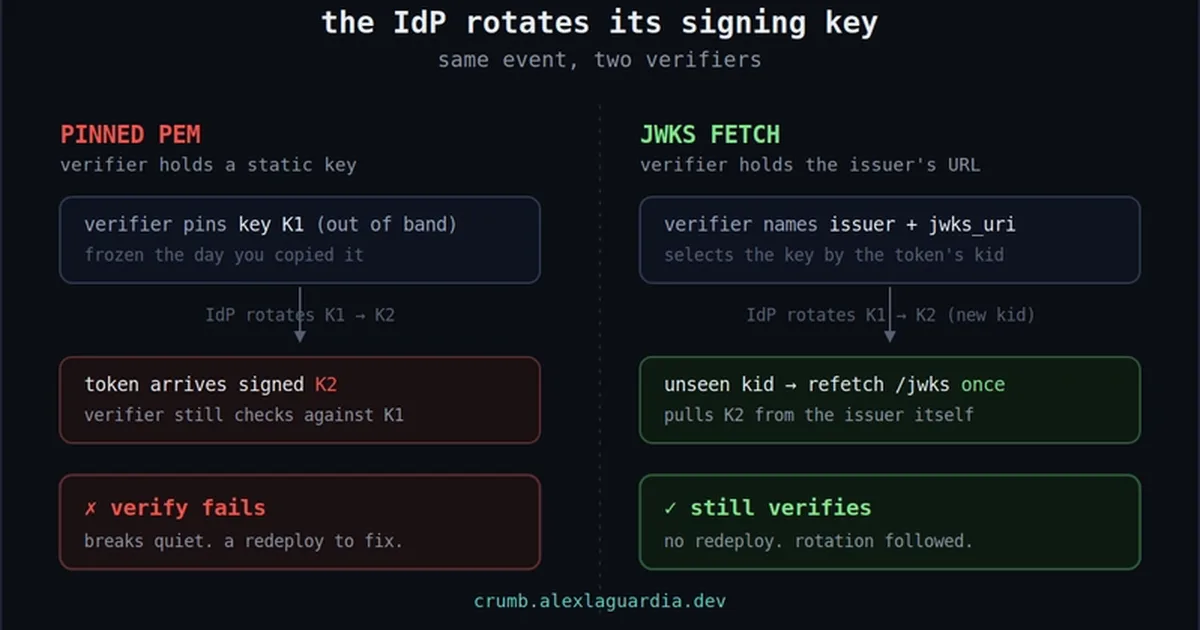
The author discusses a challenge in verifying digital identity tokens, specifically when the signing keys of identity providers (IdPs) are rotated. Initially, the author manually pinned static public keys, but this approach failed when IdPs like Okta, Keycloak, and Auth0 updated their keys. The standard OpenID Connect (OIDC) protocol offers a solution by allowing verifiers to fetch keys dynamically from a JWKS (JSON Web Key Set) endpoint published by the issuer. This method, instead of pinning static keys, involves pinning trusted issuers and fetching their current keys as needed, with a caching mechanism to avoid excessive network requests. AI
IMPACT This technical discussion on identity verification and key management is relevant for developers building secure, decentralized, or federated systems.
RANK_REASON The article discusses a technical challenge and solution related to digital identity verification protocols and practices, rather than a new release or significant industry event.
AI-generated summary · Google Gemini · from 1 sources. How we write summaries →