New autoregressive models tackle video generation challenges · 8 sources tracked
ByPulseAugur Editorial·[16 sources]·
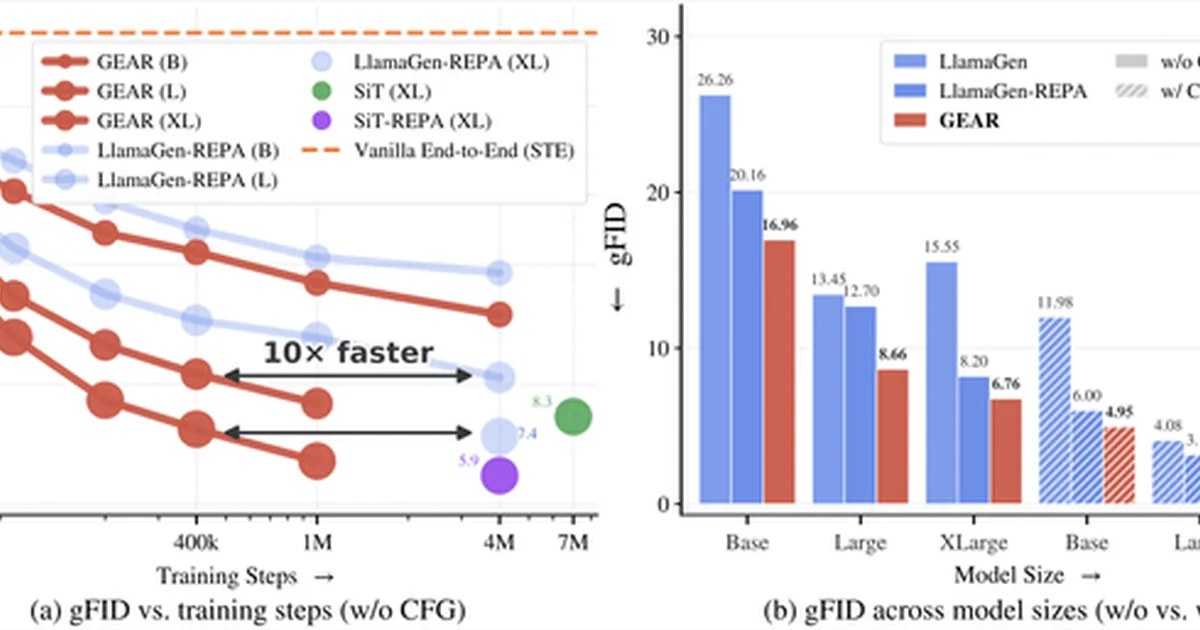
Researchers are developing new methods to improve autoregressive video generation, addressing issues like temporal inconsistency and interaction failures. Event-Driven Video Generation (EVD) introduces an explicit event signal to guide the sampler, improving dynamics and spatial accuracy. GEAR (Guided End-to-end AutoRegression) jointly trains a tokenizer and generator for faster convergence and better feature coherence. Drift-AR focuses on accelerating both autoregressive and diffusion stages by leveraging prediction entropy, enabling single-step decoding. TempAct uses a planner-executor RL framework to enhance temporal plausibility and instruction following, while "Directing the World" focuses on compositional human-motion and camera-trajectory control for interactive world models.
AI
IMPACT
These advancements aim to improve the realism, controllability, and efficiency of video generation models, potentially impacting content creation and interactive world modeling.
RANK_REASON
Multiple research papers introducing novel methods for autoregressive video generation.
arXiv:2511.17089v2 Announce Type: replace-cross Abstract: We present Spanning Tree Autoregressive (STAR) modeling, which can incorporate prior knowledge of images, such as center bias and locality, to maintain sampling performance while also providing sufficiently flexible sequen…
arXiv:2603.13402v3 Announce Type: replace-cross Abstract: Current text-to-video models can make individual frames look convincing while still getting simple interactions wrong: objects move before contact, an intended action is skipped, a placed object keeps drifting, or a suppor…
GEAR trains a vector-quantized tokenizer and autoregressive generator jointly end-to-end using representation alignment, overcoming non-differentiability issues through a dual read-out approach that improves convergence speed and feature quality.
arXiv cs.CV
TIER_1English(EN)·Xingtong Ge, Yi Zhang, Yushi Huang, Dailan He, Xiahong Wang, Bingqi Ma, Guanglu Song, Yu Liu, Jun Zhang·
arXiv:2607.00712v1 Announce Type: new Abstract: Autoregressive (AR) streaming models have emerged as a powerful paradigm for long video generation. However, the linearly growing Key-Value (KV) cache poses a significant bottleneck, leading to memory overload and degraded inference…
arXiv:2603.26661v2 Announce Type: replace Abstract: Most recent advances in 3D generative modeling rely on diffusion or flow-matching formulations. We instead explore a fully autoregressive alternative and introduce GaussianGPT, a transformer-based model that directly generates 3…
Autoregressive (AR) streaming models have emerged as a powerful paradigm for long video generation. However, the linearly growing Key-Value (KV) cache poses a significant bottleneck, leading to memory overload and degraded inference throughput. A common compression method is to d…
Visual generative models are typically trained in two stages. A tokenizer is first trained for reconstruction and then frozen, after which a generator is trained on its discrete indices or continuous latents. This decoupling leaves the tokenizer unaware of what the generator find…
arXiv:2603.28049v3 Announce Type: replace Abstract: Autoregressive (AR)-Diffusion hybrid paradigms combine AR's structured semantic modeling with diffusion's high-fidelity synthesis, yet suffer from a dual speed bottleneck: the sequential AR stage and the iterative multi-step den…
arXiv:2605.14382v4 Announce Type: replace Abstract: Interactive real-time autoregressive video generation is essential for applications such as content creation and world modeling, where visual content must adapt to dynamically evolving event conditions. A fundamental challenge l…
arXiv:2606.28016v1 Announce Type: new Abstract: Autoregressive (AR) video diffusion models enable low-latency streaming generation by synthesizing videos chunk by chunk with cached visual context, but this chunk-wise formulation makes temporal instruction following ambiguous. A s…
arXiv:2606.27964v1 Announce Type: new Abstract: Building interactive world models requires generating realistic videos while maintaining controllable dynamics over long horizons. Autoregressive video generation offers a scalable foundation, but suffers from error accumulation and…
Autoregressive (AR) video diffusion models enable low-latency streaming generation by synthesizing videos chunk by chunk with cached visual context, but this chunk-wise formulation makes temporal instruction following ambiguous. A single global prompt does not specify which sub-e…
Building interactive world models requires generating realistic videos while maintaining controllable dynamics over long horizons. Autoregressive video generation offers a scalable foundation, but suffers from error accumulation and temporal degradation during extended rollouts. …