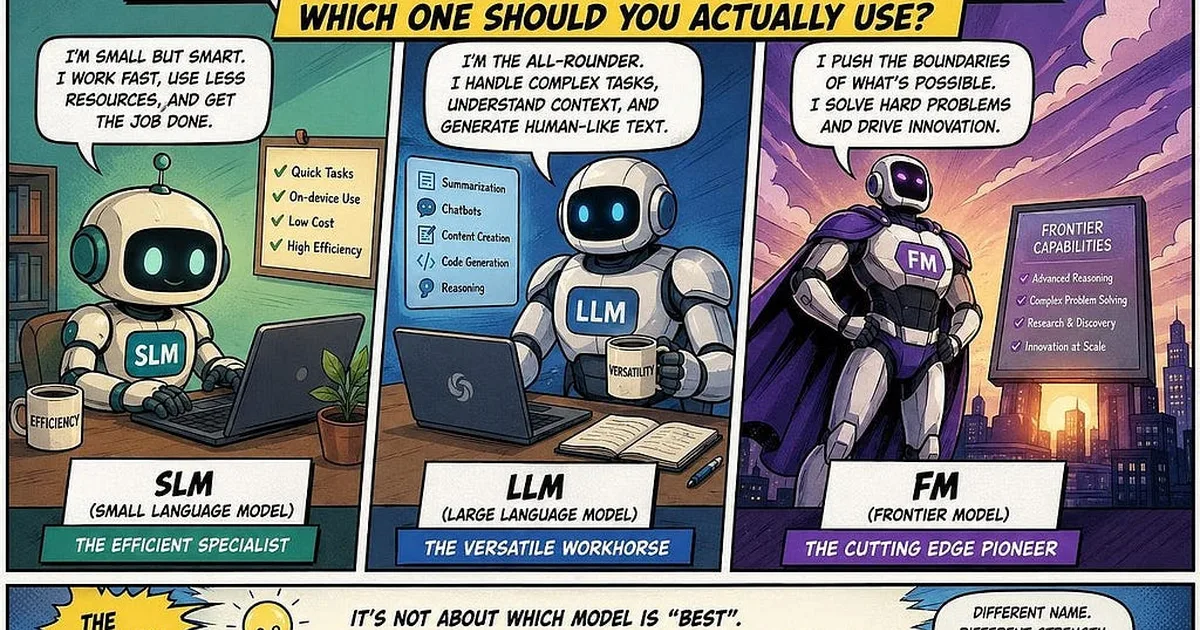
The article distinguishes between Small Language Models (SLMs), Large Language Models (LLMs), and Frontier Models (FMs), clarifying their roles and applications. LLMs are described as generalists with broad knowledge and sophisticated conversational abilities, typically requiring significant computational resources. SLMs are presented as efficient specialists, capable of matching or exceeding LLMs in focused tasks like document classification or summarization, often at a lower cost. Frontier Models represent the most advanced and capable category, characterized by massive parameter counts and superior reasoning for complex tasks, with examples including Claude Sonnet and Opus, GPT-5, and Gemini Pro. AI
IMPACT Clarifies the distinctions and use cases for SLMs, LLMs, and Frontier Models, aiding in the selection of appropriate AI tools.
RANK_REASON The article provides an explanatory overview and comparison of different types of language models, rather than announcing a new release or significant industry event.
- Claude Sonnet
- frontier models
- Gemini Pro
- GPT-5
- Granite 4.0
- IBM
- large language model
- OpenAI
- Opus
- small language model
AI-generated summary · Google Gemini · from 1 sources. How we write summaries →