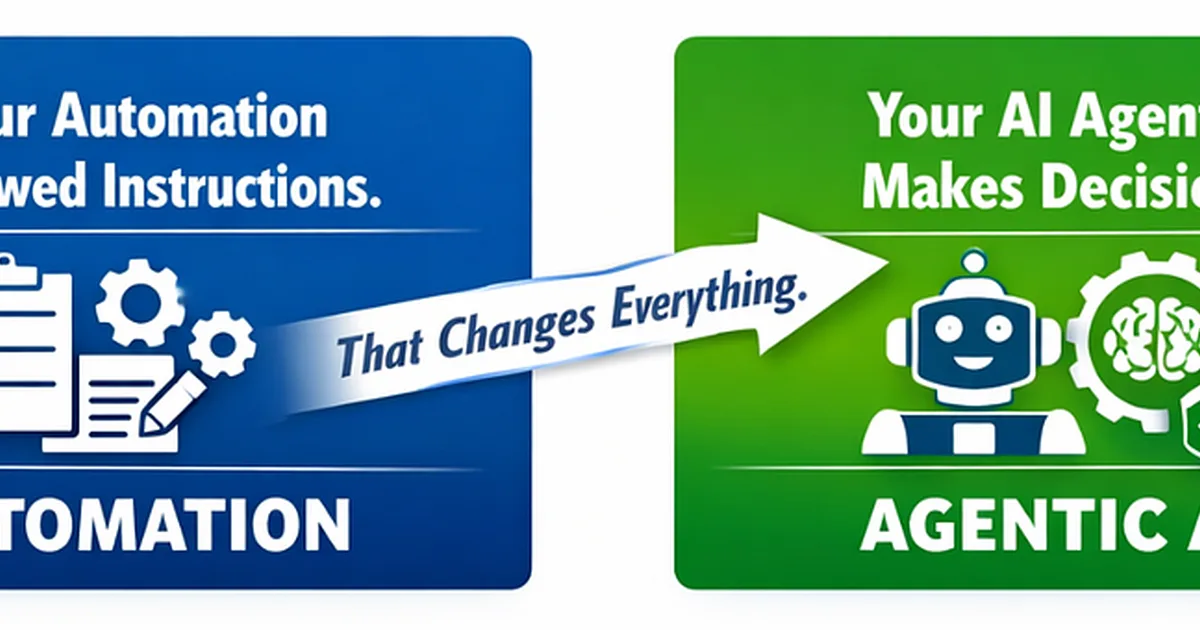
The article distinguishes between traditional automation and agentic AI, highlighting that automation follows explicit instructions while agentic AI makes decisions based on reasoning and evaluation of potential outcomes. It outlines four stages of enterprise intelligence, starting with rules-based automation (RPA) where systems execute predefined scripts and are brittle to environmental changes. The next stage, ML-augmented automation, incorporates machine learning models for specific decision points within a workflow, increasing intelligence at that step but maintaining a deterministic overall structure. AI
IMPACT This conceptual shift suggests a move towards more autonomous AI systems that can reason and make decisions, impacting how businesses approach AI implementation and trust.
RANK_REASON The article discusses the conceptual shift from automation to agentic AI, providing a framework for understanding this evolution rather than announcing a new product or research finding.
AI-generated summary · Google Gemini · from 1 sources. How we write summaries →