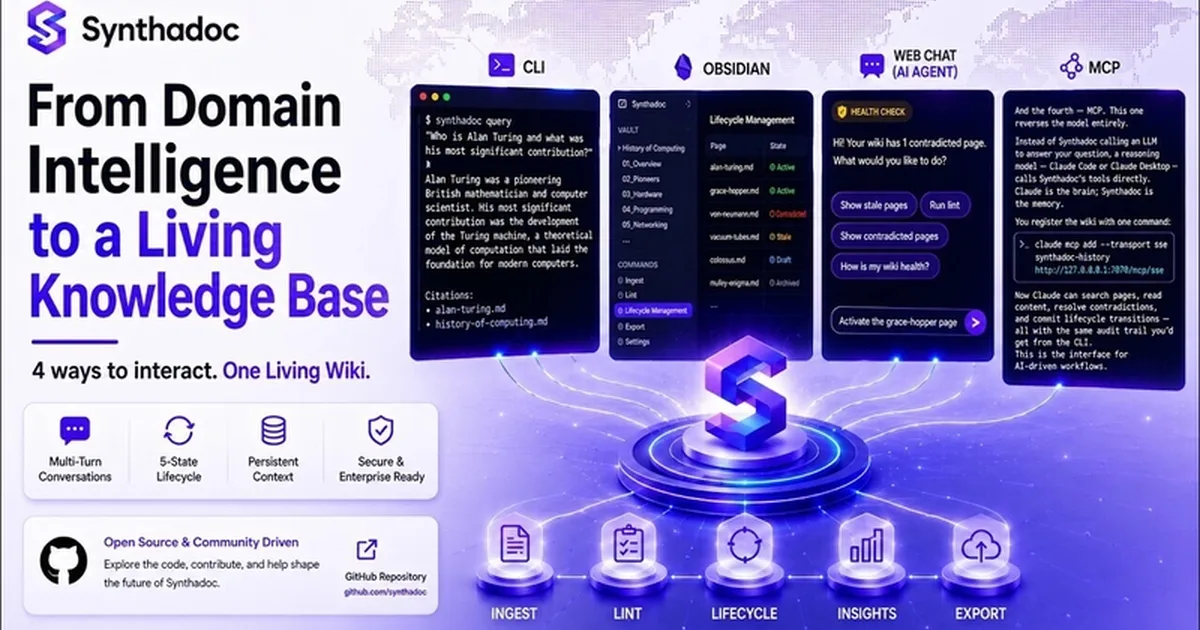
A new design pattern called the Four-Interface Pattern has been proposed for AI knowledge systems, addressing the challenge of bidirectional interaction between reasoning models and knowledge bases. This pattern distinguishes between interfaces where the human is the caller and the model is the service, and those where the reasoning model acts as the caller, using the knowledge base as a tool. The pattern emphasizes the need for a memory layer that enforces constraints, such as lifecycle transitions and audit trails, regardless of whether a human or an AI agent initiates an action. The reference implementation for this pattern is Synthadoc, an open-source AI knowledge base tool. AI
IMPACT This pattern could enable more sophisticated AI agents that can actively manage and utilize knowledge bases, moving beyond simple query-response systems.
RANK_REASON The item describes a design pattern and its implementation in an open-source tool, which falls under tooling rather than a core AI release or significant industry event.
AI-generated summary · Google Gemini · from 1 sources. How we write summaries →