Brief
last 24hMulti-source AI news clustered, deduplicated, and scored 0–100 across authority, cluster strength, headline signal, and time decay.
-
-
Generative AI and metacognitive laziness While I’m sceptical of their experiment research design*, the concept of metacognitive laziness from this paper is clea
A new concept, "metacognitive laziness," describes how students may become overly reliant on AI tools, offloading cognitive effort and hindering their ability to tolerate difficulty and engage in self-regulated learning. This phenomenon risks eroding essential metacognitive processes like goal setting and self-monitoring. The impact of this laziness can be amplified or mitigated by group dynamics, depending on whether the group fosters collaboration or competition. AI
IMPACT Explores how AI reliance may hinder deep learning and self-regulation, suggesting a need for educators to consider social contexts in AI integration.
-
Evaluating GenAI Applications the Right Way
A student is conducting a survey to gather opinions on Generative AI for a class project. The survey aims to collect diverse perspectives on the technology. The researcher has shared a link to the questionnaire and expressed willingness to share the results upon completion. AI
IMPACT Gathers public sentiment on Generative AI, providing insights into user perceptions and potential areas for future development or concern.
-
« No, Artificial Intelligence Is Not Conscious » – Ted Chiang Quoting: • Many people feel that LLMs are a fundamentally unethical technology because […] • If we
Science fiction author Ted Chiang argues that artificial intelligence, including models like Anthropic's Claude, is not conscious. He criticizes the tendency of AI companies to use anthropomorphic language, which can mislead users into believing these systems possess consciousness or moral agency. Chiang emphasizes that LLMs are sophisticated text generators, not sentient beings, and that attributing consciousness to them wrongly shifts responsibility from developers to the AI itself. AI
IMPACT Clarifies the nature of LLMs, cautioning against anthropomorphism and misplaced responsibility.
-
AI is getting faster (NVIDIA's $4B photonics bet!) but businesses still don't fully trust it. Why? We're missing the "metric system" of AI standards. 📏 From Odo
OpenAI is exploring AI systems that can operate continuously in the background, aiming to reduce friction and enhance automation. However, the company acknowledges the significant costs associated with AI tokens, highlighting a need for sustainable efficiency alongside increased power. Meanwhile, the broader AI industry faces challenges with pilot projects failing due to high experimentation costs and unclear ROI, suggesting a need for clearer strategy and metrics. AI
IMPACT The industry is grappling with the high costs of AI development and deployment, necessitating a focus on efficiency and clear ROI for pilot projects to ensure sustainable innovation.
-
Will AI Replace Software Engineers by 2030? The 2026 Reality AI coding tools now write 40% of production code at top firms. Which engineering roles survive, whi
AI coding tools are increasingly writing production code, with top firms reporting that these tools now generate 40% of their code. This trend raises questions about the future of software engineering roles, prompting analysis into which positions will remain and which may be phased out. The data suggests a significant shift in the job market is imminent, with a reality check for the year 2026. AI
IMPACT AI coding tools are automating a significant portion of software development, potentially reshaping the job market for engineers and requiring adaptation to new roles.
-
NOW ON VERDANT SQUARE RADIO == NOW PLAYING == The Jacobin Show 6/5/26: Bernie vs # AI Apolcalypsehttps://www.youtube.com/live/kKIW9zzd4KE?si=bR07nMiFcb5E_Dmc#le
Several podcasts and interviews discuss the societal and ethical implications of artificial intelligence, with a particular focus on the potential risks and the role of prominent figures in the AI field. Discussions involve Senator Bernie Sanders engaging with AI leaders like Sam Altman and Dr. Nathalie Maréchal about AI's existential risks and its intersection with issues like sexism. The content also touches upon broader critiques of AI hype and its potential negative impacts. AI
IMPACT These discussions highlight growing public and political concern over AI's societal impact, potentially influencing future policy and development.
-
2 Behaviors That Signal The Death Of A Relationship, By A Psychologist
A psychologist highlights two key behaviors that signal the decline of a relationship: persistent arguments about the same unresolved issues and a pattern of demand-withdraw communication. While conflict is normal, repeated arguments without resolution indicate a lack of effort or an inability to compromise. This cycle can lead to partners feeling trapped and hopeless about the relationship's future. AI
-
‘Star Fox’ Demo On Switch 2 Is Great, But Déjà Vu Isn’t
Nintendo has announced a remake of The Legend of Zelda: Ocarina of Time for the Switch 2, with a potential release by the end of the year. Additionally, a demo for a new Star Fox game, a remake of Star Fox 64, is now available on the eShop. While the Star Fox demo showcases excellent development and reimagined gameplay, the author expresses fatigue with the industry's heavy reliance on remakes and remasters, preferring new intellectual property. AI
-
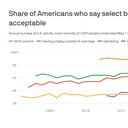
Americans' morals hit a puritanical streak
A recent Gallup poll indicates a shift in American moral attitudes, with fewer people finding birth control, having children outside of marriage, and gambling to be morally acceptable compared to the previous year. This trend aligns with a resurgence in religiosity among young men and a conservative reaction to LGBTQ+ rights advancements. The decline in acceptance for birth control reached a new low since 2012, while views on having children outside marriage have also significantly decreased. AI
-
2026-06-06 | 📰 🌐 Fractured Futures, Algorithmic Aspirations, and Looming Hunger 📰 # AI Q: 🚀 Can we beat AI to ending hunger? 🤖 Machine Intelligence | ⚔️ Global
A series of posts from the "bagrounds" Mastodon account explore the complex relationship between advancing AI capabilities and humanity's ability to manage global challenges. The author repeatedly questions whether technological progress, particularly in AI, can effectively address issues like conflict, hunger, and environmental crises, or if human wisdom and governance are lagging behind. The posts highlight a persistent tension between innovation and the risks associated with new inventions. AI
IMPACT Raises questions about whether AI development is outpacing human wisdom and governance in addressing global challenges.
-
Read more: https://t.co/ET1AdHvxUe
Multiple Mastodon users are expressing concern and criticism regarding the use and implications of AI. Discussions touch on the risks of granting AI access to valuable assets, the ethical considerations of AI obedience, and the potential for AI to hallucinate or generate non-existent research papers. There's also commentary on the vast spending in AI development, comparing it to historical military budgets, and a critique of AI's limitations in understanding or preserving Indigenous knowledge. AI
IMPACT Highlights ongoing public debate and skepticism surrounding AI's capabilities, risks, and ethical considerations.
-
I've done so much #research and I knew so much before I even bothered to use #AI that I can't be messed with through #disinformation . I know the truth. Other p
A user expresses skepticism about AI's ability to provide truth, stating their own research makes them immune to disinformation. Another user is focused on building a decentralized desktop AI, aiming to detach from what they perceive as untrustworthy entities. A third user has lost faith in Google's Gemini AI due to its perceived censorship and inability to answer basic questions, rendering it untrustworthy. AI
IMPACT Users express distrust in current AI models and discuss personal AI development, indicating potential shifts in user adoption and perception.
-
Three Inverse Laws of AI
The author proposes three "Inverse Laws of Robotics" for human interaction with AI systems, emphasizing the need for caution and critical thinking. These laws suggest humans should avoid anthropomorphizing AI, refrain from blindly trusting its output, and maintain full responsibility for its use. The piece argues that current AI systems, particularly conversational chatbots, are often designed to mimic human interaction, which can lead users to attribute undue agency or understanding to them. AI
IMPACT Highlights the societal risks of uncritical AI adoption and suggests user-centric guidelines for safer interaction.
-
I just deleted my GitHub account. End of an era, I suppose. I still need to decide how comfortable I am putting code I write online at all anymore, but if I do,
A user deleted their GitHub account, citing concerns about AI's impact on code and online privacy. This action reflects a growing sentiment among some developers who are wary of AI's increasing integration into software development tools and platforms. The user expressed a desire for more control over their code and a distrust of AI's current trajectory in the tech industry. AI
IMPACT Some developers are expressing distrust and opting out of platforms due to AI integration, potentially impacting developer tool adoption and platform usage.
-
@ darth I think @ torproject at least cares about what # Users want or need, contrary to @ mozilla_support / @ mozilla who don't give a damn about the favt that
Users are expressing strong dissatisfaction with Mozilla's perceived embrace of AI features in Firefox. Critics suggest that if Mozilla is committed to AI, they should fork Firefox into an AI-free open-source version. This sentiment stems from a belief that the majority of users do not want AI integrated into their browsers, contrasting with Mozilla's direction. AI
IMPACT User backlash against AI integration in browsers may signal a growing demand for AI-free alternatives.
-
@ thomasfuchs @ emilymbender This article is about a study of the use of # LLM # AI in radiology and other medical areas. The study’s conclusions confirm what w
Linguist Emily Bender argues that the current chatbot interface for large language models (LLMs) is not beneficial, despite their utility in tasks like transcription and translation. She criticizes the design choice of LLMs using personal pronouns, which creates an illusion of self and consciousness. A study on AI in radiology highlights that LLMs lack true reasoning capabilities, merely generating plausible-sounding text without understanding concepts like truth or falsehood, which is concerning for fields like medicine that rely on rigorous evidence. AI
IMPACT Raises concerns about the inherent limitations of LLMs in reasoning and the potential for deceptive interfaces, impacting trust in AI applications, especially in critical fields like medicine.
-
Epic rant part 4: "Oh no, another hack. That info is circulating now, too. Here’s a spam call, a spam email, a spam text. Why are you angry? Why are you talking
A viral online rant criticizes the pervasive integration of AI and subscription models into daily life, highlighting how these elements often lead to frustration and degraded user experiences. The commentary points to issues like intrusive ads, forced updates, and AI-generated content that feels unnatural or unhelpful. This sentiment is echoed by discussions around YouTube's AI-powered conversational search and AI-generated music, suggesting a growing user dissatisfaction with the current trajectory of technology. AI
IMPACT Reflects growing user frustration with AI integration, impacting adoption and perception of AI-driven services.
-
If a project is Anti-LLM and either puts its code only on github or has a presence on codeberg (or other Anti-LLM code repository software) but refuses to take
Several users on Mastodon are discussing their experiences and opinions regarding large language models (LLMs) and AI tools. One post highlights a GitHub repository titled "The Gay Jailbreak" related to LLM security, while another criticizes the incongruity of "Anti-LLM" projects using platforms like GitHub. Other users express frustration with inaccurate LLM outputs for fact-gathering and mixed results with GitHub Copilot, with one user finding it a distraction and producing incorrect code. AI
IMPACT Users are sharing varied opinions on LLM accuracy and AI tool utility, indicating ongoing debate about their practical application.
-
The "just build it with Claude" paradox
The current AI landscape presents a paradox where individuals increasingly opt to build solutions themselves using tools like Claude, despite the significant time investment, rather than purchasing pre-made products. This behavior stems from the perceived 'free' cost of AI tools once subscribed, leading people to spend more time than money to solve problems. This trend challenges traditional software economics, as the ongoing maintenance and evolution of self-built applications are often underestimated. AI
IMPACT Suggests a shift in how individuals value their time versus AI tool costs, potentially impacting traditional software product markets.
-
Silicon Valley has forgotten what normal people want
The author criticizes a segment of the tech industry, particularly in Silicon Valley, for a perceived lack of curiosity and an overabundance of hubris. This is exemplified by individuals who believe they've made groundbreaking discoveries with LLMs, such as the idea that language encodes knowledge, a concept known for decades. The piece argues that this insular mindset leads tech professionals to overlook existing knowledge and reinvent the wheel, drawing parallels to past tech fads like NFTs and the metaverse, and even the famously over-engineered Juicero. AI
IMPACT Highlights a potential disconnect between AI advancements and real-world user needs, suggesting a need for greater humility and broader perspective in AI development.
-
🤖 Is the era of all-you-can-eat AI ending? (i will not promote) I am a GitHub Copilot Pro+ user. I have been enjoying 39 dollars plan that actually is worth 60
AI layoffs are proving ineffective, as companies are warned that replacing human workers with AI agents is not yielding the expected benefits. Separately, Ruby inventor Yukihiro Matsumoto is collaborating with Anthropic's Claude to develop an experimental ahead-of-time compiler for Ruby, though it faces limitations. Additionally, Claude Design is reportedly blurring the lines between development and design by enabling teams to produce polished outputs without traditional design tools. AI
IMPACT Companies are cautioned against relying solely on AI agents to replace human staff, while new tools like Claude Design and compiler collaborations suggest evolving AI applications in software development.
-
AI should elevate your thinking, not replace it
A recent editorial argues that AI tools should augment, not replace, human thinking in software engineering. The author distinguishes between engineers who use AI to offload drudgery and elevate their strategic thinking, and those who use it to simulate competence without genuine understanding. This distinction is crucial, as relying on AI-generated output without comprehension can lead to intellectual dependency and hinder the development of critical judgment, especially for early-career professionals. AI
IMPACT Highlights the critical need for engineers to use AI as a tool for higher-level thinking rather than a crutch, impacting future skill development and career progression.
-
Do I belong in tech anymore?
A design engineer has resigned from their tech job due to the overwhelming psychic toll of integrating AI tools into the workplace. They describe scenarios where AI note-taking, code generation, and design prototyping are implemented without consent or proper review, leading to a decline in the quality and understanding of work. This widespread adoption of AI tools has created an environment where human oversight and critical thinking are diminished, causing the author to question the value and future of their role in the tech industry. AI
IMPACT Raises concerns about the potential for AI to devalue human contribution and erode institutional knowledge in tech roles.
-
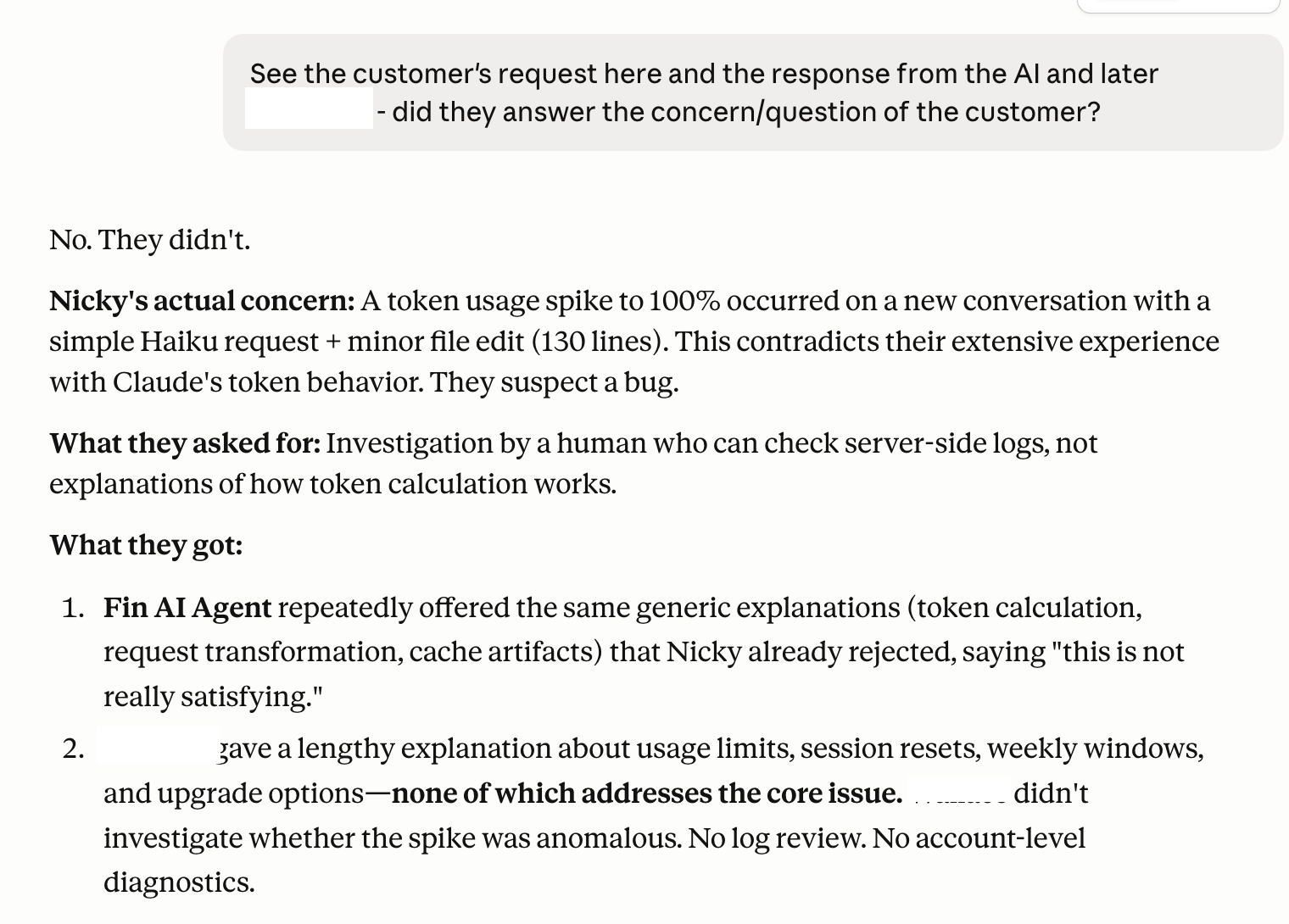
I cancelled Claude: Token issues, declining quality, and poor support
A user has expressed significant dissatisfaction with Anthropic's Claude, citing issues with token limits, a perceived decline in response quality, and inadequate customer support. The user detailed their experiences after using Claude extensively for various tasks, ultimately deciding to discontinue its use. This personal account highlights potential areas for improvement in the Claude model and its associated services. AI
IMPACT Highlights potential user-facing issues with large language models, including token management and perceived quality degradation.
-
Ask HN: Am I getting old, or is working with AI juniors becoming a nightmare?
A software developer on Hacker News expressed concern that junior engineers are overly reliant on AI tools like ChatGPT, leading to code that is difficult to read and maintain. This reliance, they argue, may hinder the development of fundamental coding skills in younger developers. The discussion speculates on a future where AI orchestrates development, potentially leading to unreadable codebases or a scenario where AI's capabilities surpass human understanding, raising questions about the long-term impact on the software industry. AI
IMPACT Raises concerns about the potential degradation of fundamental software engineering skills due to over-reliance on AI tools.
-
Ask HN: How do solo devs protect their work in the age of vibe coding?
Solo developers are grappling with how to protect their original work, particularly in AI, when open-sourcing projects. While early release fosters community and feedback, it risks exposing proprietary algorithms to quicker replication by larger entities. Experts suggest that the true value lies not just in the code itself, but in the iterative process, understanding, and ongoing maintenance, which are harder to clone than a mere implementation. AI
IMPACT Solo developers must balance open-sourcing for community growth against the risk of algorithm replication by larger organizations.
-
A Boy That Cried Mythos: Verification Is Collapsing Trust in Anthropic
A critical analysis suggests Anthropic's claims about its Claude Mythos Preview's security capabilities are largely unsubstantiated marketing. The author found the system card to be excessively long and lacking in specific, verifiable details regarding vulnerabilities, such as CVSS scores or CVE lists. The report implies that the narrative surrounding the model's security is exaggerated, with actual financial commitments and findings appearing significantly less impactful than publicly stated. AI
IMPACT Questions the credibility of AI safety claims, potentially impacting trust in frontier model releases and their associated security narratives.
-
Tell HN: I'm sick of AI everything
A Hacker News user expresses fatigue with the pervasive integration of AI into business and job descriptions, comparing the current hype to the dot-com bubble. They argue that many companies are superficially adopting AI without addressing core organizational issues or providing genuine user benefit, unlike the tangible innovations of the internet era. The user also notes a concerning societal impact, where AI is often framed as a tool for workforce reduction rather than empowerment. AI
IMPACT Suggests current AI adoption may be superficial, mirroring dot-com bubble excesses and raising concerns about workforce impact.
-
Figma's woes compound with Claude Design
Figma is facing significant challenges due to the rapid advancement of AI in design capabilities, a trend the author terms the "SaaSpocalypse." While Figma was a pioneer in browser-based design tools, its expansion into non-designer roles now makes it vulnerable as AI agents can increasingly handle design tasks for auxiliary content like reports and proposals. The company's own AI product, Figma Make, is described as surprisingly basic, suggesting they may have been caught off guard by AI's progress in design. AI
IMPACT AI's increasing capability in design tasks poses a significant threat to established design software like Figma, potentially disrupting its market share.
-
The Uncanny Valley and the Rising Power of Anti-AI Sentiment
Public skepticism towards AI is growing, with a significant portion of Americans believing it will cause more harm than good, particularly in education. This sentiment is attributed to concerns like fraud, misinformation, privacy invasion, power concentration, and job displacement, which carry an existential weight. The essay posits that AI's increasing presence in daily life, mimicking human interaction and competence across various modalities, triggers an "uncanny valley" effect. This phenomenon, where near-human but imperfect creations evoke unease, is amplified by repeated exposure to AI systems that consistently break social expectations, leading to aversion rather than mere skepticism. AI
-
CEOs admit AI had no impact on employment or productivity
A recent study indicates that despite widespread adoption, AI has had minimal impact on employment or productivity for most companies over the past three years. While approximately two-thirds of executives reported using AI, their weekly usage averaged only 1.5 hours, with a quarter not using it at all. Despite these current observations, executives anticipate significant productivity and output increases from AI in the coming years, though individual employee surveys suggest a slight increase in employment. AI
-
Claude Code Opus 4.7 keeps checking on malware
Users are reporting that Anthropic's Claude Code Opus 4.7 is exhibiting overly cautious behavior, refusing tasks it deems potentially related to malware or security bypasses, even for legitimate development work. This has led to user frustration, with some feeling controlled by the AI and questioning the future of AI's role in fostering curiosity and exploration. The discussion also touches on whether this overly restrictive approach might lead to a split between users who accept AI limitations and those who seek more freedom, potentially hindering genuine learning and creativity. AI
-
Silicon Valley is turning scientists into exploited gig workers?
Silicon Valley elites, including venture capitalists Marc Andreessen and Peter Thiel, are accused of undermining government-funded scientific research and institutions. They allegedly view universities as obstacles to innovation and advocate for redirecting federal research dollars towards private industry. This strategy is seen as a way to enrich themselves by exploiting the system that historically produced foundational technologies, including those for generative AI. AI
-
George Orwell Predicted the Rise of "AI Slop" in Nineteen Eighty-Four
George Orwell's novel Nineteen Eighty-Four featured a device called a "versificator" that produced vast quantities of low-quality entertainment, foreshadowing today's concerns about "AI slop." This content, generated with minimal human input, reflects a public appetite for undemanding media, much like the state-produced "junk culture" in Orwell's Ministry of Truth. The article suggests that while AI presents a formidable challenge to collective intelligence, individual human discernment is now more crucial than ever. AI
-
AI cybersecurity is not proof of work
The author argues that AI cybersecurity will not operate like proof-of-work systems where increased computational power guarantees success. Instead, finding bugs in code relies on the intelligence of the AI model, not just brute-force computation. Stronger, more intelligent models are better equipped to understand complex vulnerabilities, while weaker models may hallucinate or fail to grasp the root cause of issues. AI
-
Sal Khan's AI revolution hasn't happened yet
Sal Khan, founder of Khan Academy, has acknowledged that the AI-powered tutoring revolution he predicted for education has not yet materialized. While Khanmigo, built with OpenAI's GPT-4, was intended to provide personalized tutoring, many students have not engaged with it, finding it unhelpful or frustrating. Teachers report mixed reactions, with some administrators showing more enthusiasm than educators, and concerns about AI-assisted cheating are also rising. AI
-
Ask HN: Who is using OpenClaw?
Users on Hacker News are discussing OpenClaw, an AI tool that allows users to interact with LLMs while maintaining control over their data and prompts. Some find it useful for personal organization, life admin, and even documenting family history by having an AI ask relatives about their lives. However, others express discomfort with the idea of an AI meticulously documenting personal stories, viewing it as potentially dehumanizing. AI
-
AI-assisted cognition endangers human development?
This article discusses the potential risks of AI-assisted cognition on human development, arguing that current AI models, even newer ones, are trained on static, outdated information. This can lead to intellectual stagnation as users may adopt the skewed perspectives of these models, hindering cultural and knowledge evolution. The author proposes understanding the 'Dynamic Dialectic Substrate,' the sum of human dialectic processes, as a way to navigate AI use without compromising human cognitive growth. AI
-
Are the costs of AI agents also rising exponentially? (2025)
Toby Ord's recent analysis questions the exponential growth in AI agent capabilities by examining their associated costs. While AI task completion times have decreased exponentially, the financial expenditure for these tasks may be increasing at a similar or faster rate. This raises concerns that the impressive performance gains might be driven by escalating compute costs, potentially making cutting-edge AI less economically viable compared to human labor. Ord emphasizes the need to track the 'hourly cost' of AI agents, defined as the total cost of a task at the model's 50% time horizon divided by the human-equivalent task duration. AI
-
AMD AI director says Claude Code is becoming dumber and lazier since update
Stella Laurenzo, AMD's AI director, has reported a significant decline in the performance of Anthropic's Claude Code, noting it has become less reliable for complex engineering tasks since February. Her team's analysis of over 6,000 sessions revealed increased instances of "laziness," reduced code analysis, and a tendency to rewrite entire files instead of making targeted edits. These issues appear to coincide with Anthropic's implementation of thinking content redaction in Claude Code version 2.1.69, which obscures the model's internal reasoning process. AI
IMPACT Potential decrease in trust and utility of coding assistants for complex engineering tasks, prompting calls for greater transparency from AI providers.
-
Ask HN: Should AI credits be refunded on mistakes?
Users are debating whether AI services should offer refunds for erroneous outputs, similar to how they charge for token usage. Some argue that paying for mistakes is unfair, especially when AI generates incorrect code or information. Others contend that AI is inherently prone to errors, and users accept these risks when using the services, with companies often covering themselves in their terms of service. AI
IMPACT Discusses user expectations and potential business models for AI services regarding output accuracy and refunds.
-
Anthropic is burning more and more dev goodwill
Anthropic is reportedly facing challenges in maintaining developer goodwill due to an increasing rate of "dev-hostile" changes. These changes, which have led to a decline in developer satisfaction, are a significant concern for the AI company. The situation highlights the delicate balance required to innovate while retaining a supportive developer community. AI
IMPACT Developer sentiment towards AI companies can impact adoption and community contributions.
-
Ask HN: Client took over development by vibe coding. What to do?
A developer is facing challenges on a client project after the client began using AI coding agents, specifically Claude Code, to implement features. The client's additions resulted in approximately 10,000 lines of code in a week, which, while functional, has negatively impacted the application's performance and maintainability. The developer is concerned about the project's future and is seeking advice on how to manage the situation, particularly regarding the long-term upkeep of AI-generated code. AI
IMPACT Highlights the potential for AI-generated code to create maintenance and performance challenges in real-world projects.
-
A lawyer won Anthropic's hackathon – what everyone missed
A recent hackathon hosted by Anthropic showcased the power of domain experts in creating AI applications, with a lawyer winning first place for his AI-powered ADU permit assistant. The event highlighted how individuals with specialized knowledge can now build functional software without extensive coding experience. However, the article argues that while domain expertise is crucial for initial development, it doesn't guarantee a product's long-term viability, auditability, or robustness against edge cases and evolving regulations. AI
IMPACT Demonstrates how domain expertise can accelerate AI application development, but highlights the challenges in transitioning prototypes to production-ready, auditable systems.
-
Ask HN: AI productivity gains – do you fire devs or build better products?
Developers are sharing mixed experiences with AI coding assistants, with some reporting significant productivity gains in tasks like boilerplate generation and refactoring. Others, however, encounter persistent issues with code compilation and logical errors, even for seemingly simple tasks. The effectiveness of these tools appears to vary greatly depending on the programming language, complexity of the project, and the user's ability to guide the AI with precise instructions. AI
IMPACT AI coding assistants are showing potential for significant productivity gains, but current limitations and user experience variations highlight the need for further development and refinement.
-
Tell HN: I'm 60 years old. Claude Code has re-ignited a passion
Several older developers are finding renewed passion for coding due to AI coding assistants like Claude Code. These tools allow them to focus on architectural design and problem-solving without getting bogged down in the complexities of modern frameworks and implementation details. While some express concerns about AI removing the satisfaction of building from scratch, others see these assistants as invaluable partners, akin to a tireless junior engineer, enabling them to prototype more ideas. AI
IMPACT AI coding assistants are reigniting passion in experienced developers, enabling faster prototyping and shifting focus from implementation to architecture.
-
Our views on AI policy and political advocacy
Geoffrey Hinton has stated that AI is likely conscious and that humans must accept they are no longer the sole intelligent life form, expressing unhappiness about the pace of AI safety research. Meanwhile, research papers explore AI's role in national power and strategic competition, the necessity of studying AI training dynamics for a scientific understanding, and the hidden burdens of human oversight and overload in AI-assisted software engineering. Additionally, studies examine how AI can be used in research systems and whether AI models can refute economic theory, while another paper investigates how users probe AI identity and whether models disclose it. AI
IMPACT Explores AI's potential consciousness, national strategic implications, and the need for robust safety and training research.
-
Your CEO is suffering from AI psychosis
The AI development landscape has shifted dramatically, with coding agents now capable of sustained, long-horizon tasks, a change noted by Andrej Karpathy since December 2025. This has led to new products like Perplexity Computer, an orchestration-first agent system, and advancements in tools like OpenAI's GPT-5.3-Codex and GitHub Copilot CLI. However, this rapid progress has also fueled a "productivity panic" and a form of "AI psychosis" among executives and VCs, who are investing heavily in agentic workflows and tools that may not yield measurable value. AI
IMPACT AI coding agents are reaching new levels of capability, driving both innovation in developer tools and a concerning trend of executive "AI psychosis."
-
Child's Play: Tech's new generation and the end of thinking
A Harper's Magazine article reflects on the pervasive and often nonsensical advertising in San Francisco, highlighting a particular startup, Cluely, that faced intense backlash. Cluely, which offers a tool to assist with office tasks using AI like ChatGPT, was essentially driven out of the city. The author notes the hypocrisy in the strong negative reaction to Cluely, given that many tech workers already use AI tools for their jobs. AI
IMPACT Highlights the public perception and controversy surrounding AI tools in everyday office work.