PulseAugur / Brief
EN
LIVE 13:10:48

Brief

last 24h
[12/8362] 224 sources

Multi-source AI news clustered, deduplicated, and scored 0–100 across authority, cluster strength, headline signal, and time decay.

  1. Universe

    OpenAI has launched Universe, a platform designed to measure and train AI's general intelligence across a vast array of digital environments. This system allows AI agents to interact with computers by processing screen pixels and using virtual keyboards and mice, similar to human interaction. Universe aims to enable a single AI agent to leverage past experiences from diverse tasks to quickly master new, unfamiliar challenges, marking a significant step towards achieving artificial general intelligence. AI
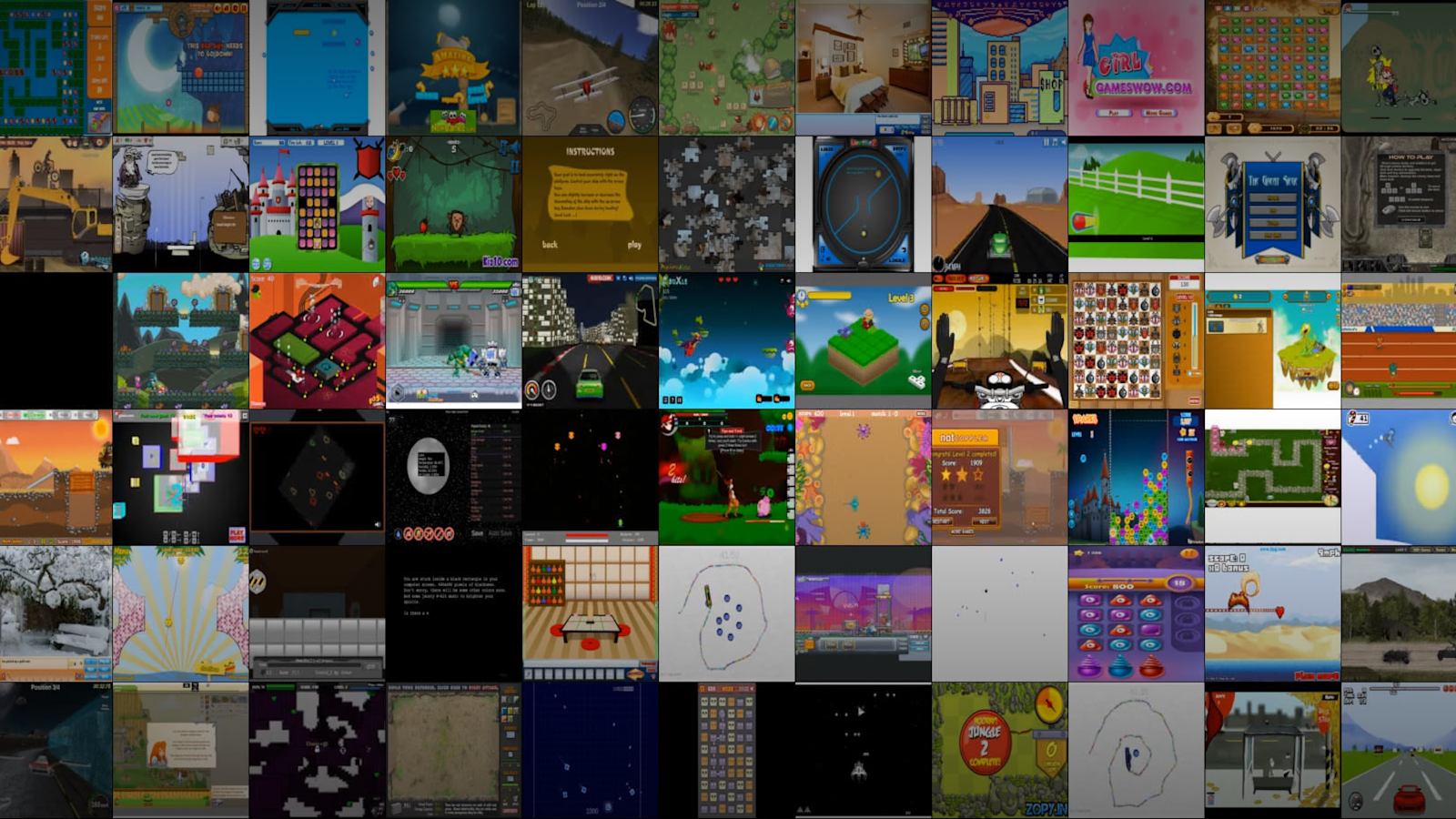

    Universe
  2. FFJORD: Free-form continuous dynamics for scalable reversible generative models

    OpenAI has published research on advancements in generative models, detailing FFJORD and Glow. FFJORD introduces a method for scalable reversible generative models using continuous dynamics and Hutchinson's trace estimator for unbiased density estimation. Glow, an extension of previous reversible models, utilizes invertible 1x1 convolutions to generate realistic high-resolution images with efficient sampling and attribute manipulation capabilities. Additionally, OpenAI presented a quantitative analysis framework for decoder-based generative models using Annealed Importance Sampling to evaluate log-likelihoods and assess model performance, overfitting, and mode coverage. AI

    FFJORD: Free-form continuous dynamics for scalable reversible generative models
  3. Semi-supervised knowledge transfer for deep learning from private training data

    OpenAI has developed a new method called Private Aggregation of Teacher Ensembles (PATE) to enhance privacy for deep learning models trained on sensitive data. PATE combines multiple 'teacher' models, each trained on separate private datasets, to train a final 'student' model. This student model learns from the aggregated, noisy predictions of the teachers, ensuring that no single teacher or dataset dictates the outcome and providing strong privacy guarantees, even against adversaries inspecting the model's internals. The approach is broadly applicable to various model types, including deep neural networks, and has demonstrated state-of-the-art privacy-utility trade-offs on benchmark datasets. AI

    Semi-supervised knowledge transfer for deep learning from private training data
  4. Transfer from simulation to real world through learning deep inverse dynamics model

    OpenAI researchers have developed a method to improve the transfer of control policies from simulation to real-world robots. Their approach uses a learned deep inverse dynamics model to bridge the gap between simulated and actual physical properties. This model helps determine the correct real-world actions needed to achieve the desired states predicted by the simulation. Experiments indicate this technique outperforms existing methods for handling simulation-to-real discrepancies. AI

    Transfer from simulation to real world through learning deep inverse dynamics model
  5. Special projects

    Ilya Sutskever is departing OpenAI, with Sam Altman announcing Jakub Pachocki as the new Chief Scientist. Pachocki, who previously led research for GPT-4 and OpenAI Five, will now guide the company's progress towards AGI. OpenAI also outlined several key research areas, including detecting covert AI systems, building agents for programming competitions, cybersecurity defense, and creating complex agent simulations. AI

    Special projects

    IMPACT Leadership changes at OpenAI may signal shifts in research priorities and AGI development strategy.

  6. Generative models: exploration to deployment

    Researchers are developing new methods to improve LLM capabilities in various domains. One study introduces MemCoE, a cognition-inspired framework for LLM agents to learn how to organize and update long-term user memory, enhancing personalization. Another paper, ReLay, explores personalized LLM-generated summaries, finding that while personalization improves comprehension, it also introduces risks of bias and hallucinations. Additionally, a new benchmark called ClassEval-Pro has been created to evaluate LLMs on class-level code generation, revealing significant performance gaps among current frontier models. AI

    Generative models: exploration to deployment

    IMPACT Advances in LLM memory, personalization, and code generation benchmarks will drive further research and development in AI agents and software engineering.

  7. RL²: Fast reinforcement learning via slow reinforcement learning

    OpenAI has published a series of research papers detailing advancements in reinforcement learning. These include achieving superhuman performance in Dota 2 with OpenAI Five, developing benchmarks for safe exploration in RL, and quantifying generalization capabilities with the CoinRun environment. The company also explored novel methods like prediction-based rewards for curiosity-driven exploration, learning policy representations in multiagent systems, and an experimental metalearning approach called Evolved Policy Gradients for faster training on new tasks. Further research addresses variance reduction in policy gradients and the equivalence between policy gradients and soft Q-learning, alongside challenging robotics environments for multi-goal RL. AI

    RL²: Fast reinforcement learning via slow reinforcement learning

    IMPACT Demonstrates significant progress in RL capabilities, including superhuman performance, safety, generalization, and exploration, pushing the boundaries of AI.

  8. Team update

    OpenAI has announced several team updates across multiple blog posts, highlighting new hires and their diverse backgrounds. The updates showcase individuals with expertise in areas such as machine learning, robotics, software engineering, and AI safety. These new team members bring experience from various leading tech companies and academic institutions, bolstering OpenAI's research and development efforts. AI

    Team update
  9. Adversarial training methods for semi-supervised text classification

    OpenAI researchers have developed a novel method for semi-supervised text classification by adapting adversarial training techniques. Their approach involves perturbing word embeddings within a recurrent neural network, rather than directly altering the input, making it suitable for sparse, high-dimensional text data. This new technique achieves state-of-the-art results on various benchmark tasks, demonstrating improved word embeddings and reduced overfitting during training. The code for this method has also been made publicly available. AI

    Adversarial training methods for semi-supervised text classification
  10. Team++

    OpenAI has announced the addition of several prominent researchers to its team, including Ian Goodfellow, known for his work on Generative Adversarial Networks, and Alec Radford, creator of DCGAN. The new hires and summer collaborators are focused on advancing unsupervised learning and reinforcement learning. The company anticipates sharing new results in the coming months and plans to participate in the ICLR conference. AI

    Team++
  11. Learning to learn deep learning 📖

    Google AI has introduced Test-Time Diffusion Deep Researcher (TTD-DR), a novel framework that mimics human research processes by iteratively drafting and revising reports using retrieved information. This approach models report writing as a diffusion process, refining initial drafts through a denoising mechanism powered by search. OpenAI has also published several articles detailing techniques for training large neural networks, including data, pipeline, and tensor parallelism, as well as exploring the nonlinear computational properties of deep linear networks due to floating-point arithmetic. Additionally, OpenAI discussed infrastructure considerations for deep learning and a reparameterization technique called weight normalization to accelerate training. AI

    Learning to learn deep learning 📖
  12. Introducing OpenAI

    OpenAI has launched a preview of its Codex coding assistant within the ChatGPT mobile app, allowing users to manage coding tasks remotely across devices. The company is also highlighting how various organizations, including Ramp, NVIDIA, and AutoScout24, are leveraging Codex and GPT-5.5 for accelerated code review, faster development cycles, and AI-assisted research. Meanwhile, Anthropic's Project Glasswing initiative has identified over ten thousand high-severity vulnerabilities in essential software, emphasizing the need for the industry to adapt to AI-driven security analysis. AI

    Introducing OpenAI

    IMPACT Expands accessibility of AI coding assistants and highlights AI's role in identifying software vulnerabilities, potentially accelerating development and improving security.