PulseAugur / Brief
EN
LIVE 14:47:11

Brief

last 24h
[50/8369] 224 sources

Multi-source AI news clustered, deduplicated, and scored 0–100 across authority, cluster strength, headline signal, and time decay.

  1. ERAlign: Energy-based Representation Alignment of GNNs and LLMs on Text-attributed Graphs

    Researchers have developed ERAlign, a novel framework for aligning representations from Graph Neural Networks (GNNs) and Large Language Models (LLMs) on text-attributed graphs. This approach utilizes Energy-based Models (EBMs) to project GNN-encoded graph structures and LLM-derived text embeddings into a shared latent space, ensuring distributional consistency. The framework introduces Energy Discrepancy (ED) to improve training efficiency and reduce energy landscape distortion. Empirical results across eight datasets show ERAlign achieving state-of-the-art performance in various supervision and cross-task transfer scenarios. AI

    IMPACT Enhances representation learning for graph-structured data with textual attributes, potentially improving performance in areas like knowledge graph completion and recommendation systems.

  2. Remaking gimbal cameras in the Red Ocean, what does Insta360 see?

    Insta360 has launched the Luna, a new pocket gimbal camera that aims to differentiate itself from DJI's Pocket by focusing on user experience and AI-driven features. The Luna boasts a unique horizontal dual-camera design for a more natural, human-like aesthetic and improved portability. It also features a detachable remote control screen with live preview and AI-enhanced image quality, developed in collaboration with Leica, to cater to both creators and everyday users, particularly women seeking natural-looking portraits. AI

    Remaking gimbal cameras in the Red Ocean, what does Insta360 see?

    IMPACT This launch signals a shift towards AI-powered user experience and enhanced image quality in consumer imaging devices, potentially influencing future product development.

  3. asyncinject 0.7

    Simon Willison has released version 0.7 of his asyncinject library, a utility for managing asyncio dependency injection patterns. He noted that Anthropic's Claude Fable 5 model proactively identified and fixed bugs within the library's dependency system. This interaction highlights the model's capability in assisting with code development and debugging. AI

    IMPACT Demonstrates AI models assisting in code debugging and library development, potentially speeding up software maintenance.

  4. Sci-Tech 50 Index Rises Over 3%, Weight Stock Hygon Information Rises Over 13%

    Anthropic has released its latest and most powerful AI model, Claude Fable 5. This new model is described as "dangerous-class" and comes with a high price point. The release was announced late at night, generating significant attention in the AI community. AI

    IMPACT Sets a new benchmark for AI model capabilities, potentially influencing future development and pricing strategies.

  5. Sci-Tech 50 Index Rises Over 2% Intraday, Semiconductor Sector Rallies Quickly

    Anthropic has released its latest and most powerful model, Claude Fable 5, which is described as a "dangerous level" model. The release was accompanied by a significant price point for the new model. This announcement was made alongside other tech and financial news, including a surge in China's STAR 50 index and a drop in gold and silver prices. AI

    IMPACT Anthropic's release of a new, powerful model like Claude Fable 5 could set new benchmarks and influence the competitive landscape in advanced AI capabilities.

  6. National Bureau of Statistics: In May 2026, the producer price index for industrial products increased by 3.9% year-on-year and 0.5% month-on-month.

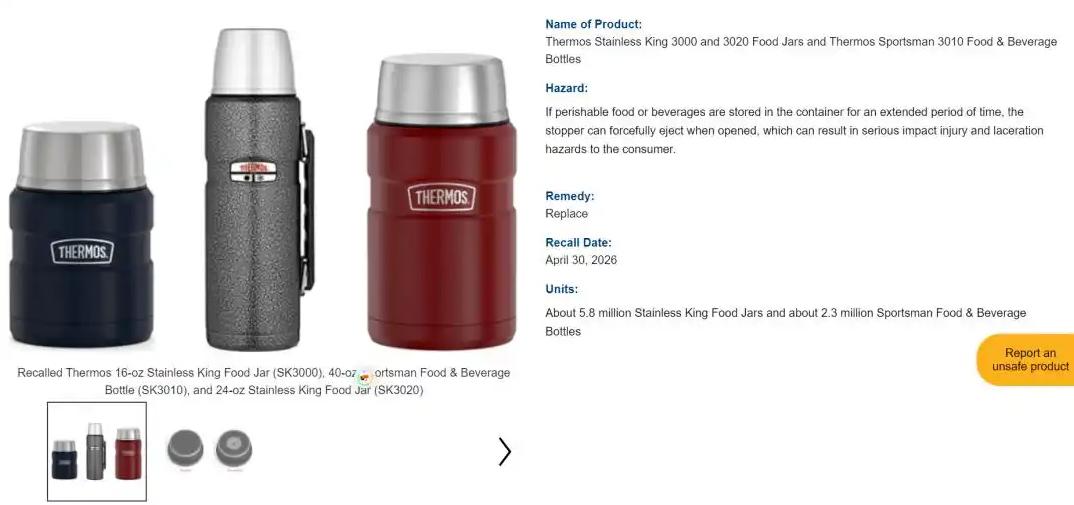
    Anthropic has officially launched its latest AI model, Claude Fable 5, which is being presented as their most powerful offering to date. The announcement was made alongside other news, including a significant drop in Apple's market value following a product release event and a large product recall by Thermos. The specific capabilities or benchmarks of Claude Fable 5 were not detailed in the provided information. AI

    IMPACT Anthropic's release of Claude Fable 5 signals continued advancement in frontier models, potentially raising the bar for AI capabilities and competition.

  7. National Bureau of Statistics: Consumer Price Index rose by 1.2% year-on-year in May 2026

    Anthropic has officially launched its latest AI model, Claude Fable 5. This new model is positioned as Anthropic's most powerful offering to date. The announcement was made alongside other significant tech news, including Apple's market value drop and a product recall by Thermos. AI

    IMPACT Sets a new benchmark for AI capabilities, potentially influencing future model development and competition.

  8. Central bank conducted 159 billion yuan 7-day reverse repurchase operations on June 10

    Anthropic has launched its latest AI model, Claude Fable 5, which is being touted as their most powerful to date. The release was mentioned alongside other news items, including financial market movements and product recalls. AI

    IMPACT Sets a new benchmark for AI model capabilities, potentially influencing future research and development in the field.

  9. Driven by stock market gains, South Korean household financial spending grows at the fastest pace in 24 years in Q1

    Anthropic has released its latest and most powerful model, Claude Fable 5, marking a significant advancement in AI capabilities. This new model is expected to push the boundaries of what AI can achieve. The release comes amidst broader market activity, including a surge in Korean household financial spending and shifts in stock market financing. AI

    IMPACT Sets a new benchmark for AI model capabilities, potentially accelerating research and development across the industry.

  10. CITIC Securities: Meta-aramid as a PCB substrate has mature applications and may have significant development space in the future

    Anthropic has officially launched its latest AI model, Claude Fable 5, which is being touted as their most powerful to date. The announcement was made alongside other tech news, including Meta's plans to use merchant data for personalized content and a product recall by Thermos. The launch of Claude Fable 5 signifies a significant step forward in Anthropic's model development. AI

    IMPACT Sets a new benchmark for AI model capabilities, potentially driving further advancements in the field.

  11. Shanghai and Shenzhen stock markets' turnover exceeds 2 trillion yuan for the 42nd consecutive trading day

    Anthropic has officially launched its latest and most powerful AI model, Claude Fable 5. This new model is reportedly the strongest to date from the company, with early reports suggesting it should be used with caution due to its advanced capabilities. The release comes amidst broader industry developments, including China's Ministry of Industry and Information Technology releasing new guidelines for AI integration in telecommunications infrastructure. AI

    IMPACT Sets a new benchmark for AI model capabilities, potentially driving further advancements and competition in the LLM space.

  12. Enhancing Multilingual LLM-based ASR with Mixture of Experts and Dynamic Downsampling

    Researchers have developed a new framework for multilingual automatic speech recognition (ASR) that leverages large language models (LLMs). The proposed system uses a Mixture of Experts (MoE) architecture to enhance cross-lingual performance and a Continuous Integrate-and-Fire (CIF) mechanism for dynamic downsampling and modality alignment. This approach aims to create more accurate and robust LLM-based ASR systems, showing significant improvements over existing models. AI

    IMPACT Introduces novel techniques for improving multilingual ASR performance using LLMs, potentially enhancing global accessibility of speech technologies.

  13. Which LoRA? An Empirical Study on the Effectiveness of LoRA Techniques During Multilingual Instruction Tuning

    A new study published on arXiv explores the effectiveness of various LoRA (Low-Rank Adaptation) techniques for multilingual instruction tuning in large language models. The research found that simpler, basic LoRA methods perform comparably to more complex variants in balancing cross-lingual transfer and knowledge retention. Analysis of model embeddings suggests that the architectural differences in LoRA techniques do not significantly alter language representation, indicating limited benefits from advanced LoRA variants for multilingual adaptation. AI

    IMPACT Suggests that simpler LoRA methods are sufficient for multilingual tuning, potentially reducing computational costs and complexity for researchers and developers.

  14. A generalizable 3D framework and model for self-supervised learning in medical imaging

    Two new research papers explore advanced self-supervised learning techniques for 3D medical imaging. One paper introduces a framework using Masked Autoencoders (MAE) and Joint Embedding Predictive Architectures (JEPA) to improve disease detection in brain MRIs, highlighting how different self-supervised objectives benefit tasks with specific anatomical structures. The other paper presents a generalizable 3D framework and a model called 3DINO-ViT, pre-trained on a large, multimodal dataset, demonstrating strong performance across various segmentation and classification tasks and showing generalization to out-of-distribution data. AI

    IMPACT These advancements in self-supervised learning could lead to more accurate and scalable AI tools for medical diagnosis and analysis.

  15. Tiny Scale Is All I Can Spare To Play With Transformer

    A student researcher has introduced "Silia," a novel Transformer architecture designed for parameter efficiency in models under 10 million parameters. The architecture aims to combine the dynamic mixing of attention mechanisms with the strong non-linearity of feed-forward networks into a single operation. Experiments, though limited by hardware constraints, suggest Silia achieves comparable performance to GPT-2 with significantly fewer parameters. AI

    IMPACT Proposes a new architecture for efficient small models, potentially enabling new applications on resource-constrained devices.

  16. I Dismissed “Self-Improving AI” as Hype. Then I Actually Read the Research.

    Researchers are developing AI systems capable of recursive self-improvement, where the AI modifies its own code to enhance performance on specific tasks. This is distinct from science fiction portrayals and focuses on verifiable metrics like benchmark scores or execution speed. Projects like SICA have demonstrated significant improvements on coding benchmarks by autonomously rewriting their own source code, while Google DeepMind's AlphaEvolve used similar techniques to discover a novel matrix multiplication algorithm. AI

    I Dismissed “Self-Improving AI” as Hype. Then I Actually Read the Research.

    IMPACT Demonstrates a path toward AI systems that can autonomously enhance their own capabilities, potentially accelerating progress in software development and scientific research.

  17. Spot gold falls below $4200, hitting a new low in nearly 3 months

    Anthropic has launched its latest AI model, Claude Fable 5, which is being touted as their most powerful to date. The release was announced alongside other tech news, including market shifts in gold prices and Apple's market capitalization following a product announcement. The report also touches on advancements in aramid fiber technology for PCB substrates. AI

    IMPACT This release likely pushes the frontier of large language model capabilities, potentially influencing future AI development and competition.

  18. 8:1 Ke | Causing permanent blindness in 3 people, Thermos urgently recalls millions of products; Apple's market value evaporates by over 1.587 trillion after press conference; Anthropic releases its strongest model: Claude Fable 5 officially launched

    Anthropic has released its latest AI models, Claude Fable 5 and Claude Mythos 5. Fable 5 is positioned as their most capable publicly available model for general users, while Mythos 5 is being offered to select cybersecurity and infrastructure providers through Project Glasswing. This release marks a significant step in Anthropic's ongoing development of advanced AI. AI

    8:1 Ke | Causing permanent blindness in 3 people, Thermos urgently recalls millions of products; Apple's market value evaporates by over 1.587 trillion after press conference; Anthropic releases its strongest model: Claude Fable 5 officially launched

    IMPACT Anthropic's Fable 5 release sets a new benchmark for publicly available AI models, potentially increasing competition and driving further advancements in the field.

  19. Claude Fable 5 🚀, Gemini 3.5 Live Translate 📱, scaling test time compute 📈

    Anthropic has released Claude Fable 5, a new model described as highly capable in areas like software engineering and research, with enhanced safety features. Google is also rolling out Gemini 3.5 Live Translate, an audio model for real-time speech-to-speech translation across numerous languages. The cluster also touches on the increasing importance of test-time compute for evaluating LLM performance, suggesting that traditional benchmarks may become less informative. AI

    IMPACT New models from Anthropic and Google enhance multilingual capabilities and suggest a shift in LLM evaluation towards test-time compute.

  20. One Token per Multimodal Evidence: Latent Memory for Resource-Constrained QA

    Researchers have developed a new method called Latent Memory to improve question answering systems for resource-constrained environments. This approach compresses multimodal evidence, such as text and images, into single latent tokens. By operating in a unified latent space, Latent Memory significantly reduces token consumption, using 3x to 10x fewer tokens than traditional retrieval-based systems while maintaining competitive performance on various QA benchmarks. AI

    IMPACT Reduces token consumption in QA systems, making advanced multimodal AI more accessible for resource-limited applications.

  21. Efficient RWKV-based Representation Learning for 3D Point Clouds

    Researchers have developed a new method called P-RWKV to adapt the RWKV model for processing 3D point cloud data. This approach enhances RWKV's ability to capture local geometric structures and spatial dependencies, which are crucial for understanding 3D environments. The P-RWKV block integrates components for local perception expansion and spatial context enhancement, demonstrating flexibility across various architectures and tasks with improved efficiency. AI

    IMPACT Enhances 3D data processing efficiency, potentially enabling more complex applications in areas like robotics and autonomous systems.

  22. MLingualFC: Evaluating Jailbreak Vulnerabilities in Multilingual Vision-Language Models

    Researchers have developed new methods to detect and evaluate jailbreak vulnerabilities in large language models (LLMs) and vision-language models (VLMs) across multiple languages. One approach, MLJailDe, uses back-translation and relative-distance constraints to create a multilingual dataset and improve cross-lingual generalization for LLM jailbreak detection, achieving a 97.1% F1 score on unseen languages. Another study introduced MLingualFC, a benchmark for VLMs that encodes harmful instructions into flowchart images in five languages, revealing significant multilingual safety gaps and demonstrating that visual attacks can bypass safety alignment across languages, though with varying success rates depending on the script. AI

    IMPACT Highlights critical safety gaps in multilingual AI models, necessitating improved cross-lingual safety alignment and evaluation.

  23. Influence Dynamics and Stagewise Data Attribution

    Two new research papers explore methods for understanding how individual data points influence the training of large machine learning models. The first paper introduces a framework for "stagewise data attribution," suggesting that the influence of data samples changes dynamically throughout the model's learning process, particularly in language models. The second paper proposes the "Mirrored Influence Hypothesis," which offers a more computationally efficient way to estimate data influence by reformulating the problem and leveraging forward passes, applicable to various scenarios including diffusion models and language models. AI

    IMPACT These papers introduce new theoretical frameworks and computational methods for understanding data influence in ML models, potentially improving model trustworthiness and debugging capabilities.

  24. Insertion Based Sequence Generation with Learnable Order Dynamics

    Two new research papers explore advancements in insertion language models (ILMs), a method for generating sequences by inserting tokens. The first paper introduces a continuous-time Markov chain framework to derive a diffusion-style denoising objective for ILMs, showing it can be competitive with existing methods while offering more sampling flexibility. The second paper proposes LoFlexMDM, an ILM that learns data-dependent insertion orders, improving generation quality on molecular tasks. AI

    IMPACT These papers advance sequence generation techniques, potentially improving performance in areas like molecular design and general language modeling.

  25. DecepGPT: Schema-Driven Deception Detection with Multicultural Datasets and Robust Multimodal Learning

    Researchers are developing advanced AI systems for deception detection, moving beyond simple classification to incorporate reasoning and cross-cultural applicability. Two new papers introduce frameworks like DecepGPT and DeceptionX, which utilize multimodal data and large language models to provide auditable reports and explainable reasoning processes. These efforts aim to improve the accuracy and generalizability of deception detection across diverse datasets and cultural contexts, addressing limitations in current benchmarks and methodologies. AI

    IMPACT Advances multimodal AI capabilities in understanding human behavior and improving forensic analysis.

  26. Robustness of Mixtures of Experts to Feature Noise

    Two new research papers explore the intricacies of Mixture of Experts (MoE) models. The first paper demonstrates that MoE architectures inherently filter feature noise, leading to improved robustness and efficiency compared to dense networks. The second paper introduces a novel statistical framework for softmax-gated Gaussian MoE models, addressing parameter estimation challenges and proposing a consistent method for selecting the number of experts without extensive model sweeps. AI

    IMPACT These papers advance the theoretical understanding of MoE models, potentially leading to more robust and efficient AI systems.

  27. CatalyticMLLM: A Graph-Text Multimodal Large Language Model for Catalytic Materials

    Researchers have developed new multimodal large language models for material science applications. One model, CatalyticMLLM, unifies property prediction and inverse design for catalytic materials by integrating graph and text data within a single framework. Another model, MOF-LLM, enhances spatial reasoning in LLMs for predicting the complex structures of metal-organic frameworks, utilizing a block-level approach and specialized training techniques. AI

    IMPACT These models demonstrate LLMs' growing capability in specialized scientific domains, potentially accelerating materials discovery and design.

  28. Analytic Bijections for Smooth and Interpretable Normalizing Flows

    Researchers have developed new analytic bijections for normalizing flows, addressing the challenge of creating expressive yet invertible transformations. These new methods offer global smoothness and closed-form analytical invertibility, overcoming limitations of previous approaches like affine transformations or monotonic splines. The introduced radial flows architecture, in particular, demonstrates exceptional training stability and geometric interpretability, achieving comparable quality to more complex models with significantly fewer parameters and showing promise in applications like physics simulations. AI

    IMPACT Introduces novel mathematical techniques that could improve the efficiency and interpretability of generative models.

  29. UniADC: A Unified Framework for Anomaly Detection and Classification

    Researchers have developed new methods for unsupervised anomaly detection, a critical task when labeled data is scarce. One approach, OCSVM-Guided Representation Learning, couples feature learning with an analytically solvable One-Class SVM to improve detection accuracy and robustness, particularly for subtle anomalies in medical imaging. Another method, UniADC, introduces a unified framework for simultaneously detecting and classifying anomalies within images, utilizing a controllable inpainting network and an implicit-normal discriminator to outperform existing techniques on various datasets. AI

    IMPACT These novel methods advance unsupervised anomaly detection, offering improved capabilities for identifying subtle anomalies in complex datasets like medical images and enabling more precise classification of anomalies.

  30. Expert-Level Crisis Detection in Mental Health Conversations

    Researchers have developed CRADLE-Dialogue, a new benchmark and dataset for detecting crisis situations in mental health conversations. This dataset includes 600 dialogues annotated for various risks like suicide ideation and child abuse, distinguishing between past and ongoing threats. The study also introduced an "Alert-Confirm" evaluation protocol to better reflect clinical needs and released a 32B-parameter model that shows significant improvements over existing open-source and proprietary models. AI

    IMPACT Enhances AI's capability in sensitive conversational contexts, potentially improving mental health support systems.

  31. PADD: Path-Aligned Decompression Distillation for Non-Router Teacher to Guide MoE Student Learning

    Researchers have introduced PADD, a novel framework for distilling knowledge from dense language models into mixture-of-experts (MoE) students. This method aims to improve MoE model efficiency and performance by learning effective routing policies. Experiments show that PADD-trained MoE models can match or exceed the capabilities of their dense teachers while maintaining the same inference cost. AI

    IMPACT Enables more efficient training of MoE models, potentially leading to better performance at lower computational costs.

  32. Renminbi central parity rate against US dollar reported at 6.8147

    Anthropic has officially launched its latest and most powerful AI model, Claude Fable 5. This new model represents a significant advancement in AI capabilities, with the company touting it as their strongest offering to date. The release is positioned as a major update, potentially redefining the landscape of AI interaction and performance. AI

    IMPACT This release sets a new benchmark for AI model capabilities, potentially influencing future developments in natural language processing and AI-driven applications.

  33. FadeMem: Distance-Aware Memory Consolidation for Autoregressive Video Diffusion

    Researchers have introduced FadeMem, a novel memory consolidation technique for autoregressive video generation models. This method addresses the issue of growing historical KV cache sizes in models that generate videos segment by segment. FadeMem organizes historical data into a temporal hierarchy, preserving fine details in recent segments while consolidating older information into more compact, long-range anchors for scene structure and identity. AI

    IMPACT Enhances video generation models by optimizing memory usage and improving temporal coherence and subject consistency.

  34. Self-Distillation Policy Optimization via Visual Feedback: Bridging Code and Visual Artifacts

    Researchers have developed a new self-distillation policy optimization framework called Visual-SDPO, designed to improve code-generating large language models. This method uses visual feedback from rendered outputs, such as charts or web pages, to guide the model. By pinpointing specific code segments responsible for visual defects, the system enhances the model's ability to produce visually accurate artifacts, outperforming existing methods by over 10 points on benchmarks. AI

    IMPACT Enhances LLM capabilities in generating visually accurate code, potentially improving tools for data visualization and web development.

  35. Just now, Claude Mythos 5 released! 50 million lines of code completed in 1 day

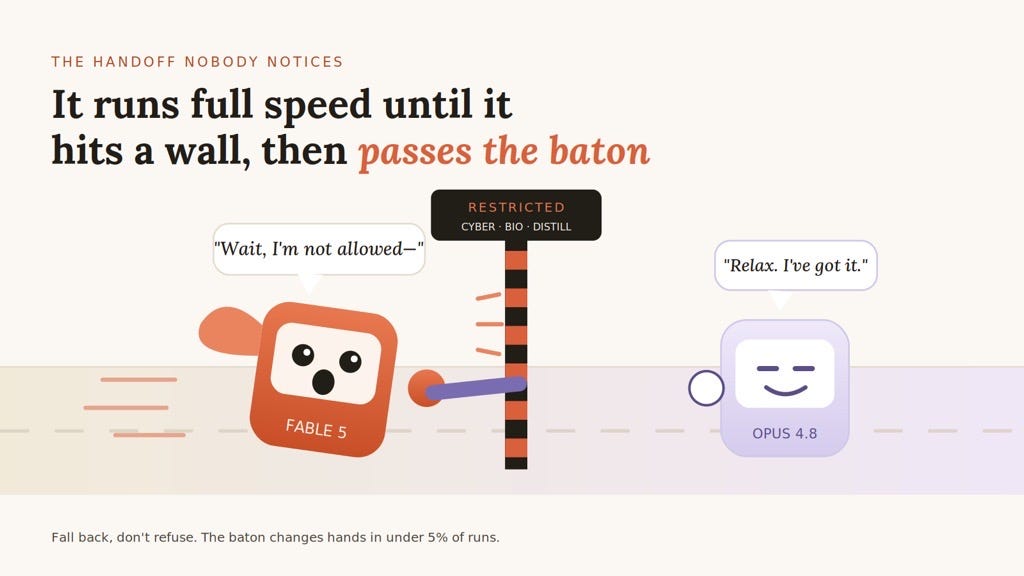
    Anthropic has released two new flagship models: Claude Fable 5 and Claude Mythos 5. Fable 5, available to all users, includes safety guardrails that route risky queries to the previous generation model, Opus 4.8. Mythos 5, reserved for trusted users, removes these restrictions for advanced capabilities in areas like cybersecurity and scientific research. Both models demonstrate significant improvements in complex tasks, long-context understanding, and coding, with Fable 5 outperforming competitors like GPT-5.5 on benchmarks such as SWE-bench Pro. AI

    IMPACT Sets new SOTA on coding and scientific research benchmarks, potentially accelerating enterprise adoption of advanced AI agents.

  36. AI is making Patch Tuesday (kinda) fun again

    Anthropic has introduced a new AI model named Mythos, designed to be safer and more manageable. The company is also updating its data retention policies. These developments suggest a focus on responsible AI development and increased transparency. AI

    AI is making Patch Tuesday (kinda) fun again

    IMPACT This release signals Anthropic's continued focus on developing safer AI systems, potentially influencing industry standards for model behavior and data handling.

  37. Fable is blowing my mind

    Users are expressing strong positive reactions to Anthropic's Fable 5 model, describing it as a powerful and impressive tool. Some users highlight its ability to rapidly complete complex tasks, such as building a web application with a full admin dashboard in under 20 minutes. Others appreciate its nuanced communication skills, noting its capacity to de-escalate tense situations while still effectively advocating for the user's needs. Despite its perceived temporary nature, Fable 5 is generating hope and enthusiasm among users who value its advanced capabilities. AI

    IMPACT Demonstrates advanced capabilities in rapid task execution and sophisticated user interaction, potentially setting new benchmarks for AI performance.

  38. EditSR: Enhancing Neural Symbolic Regression via Edit-based Rectification

    Researchers are developing new methods for neural symbolic regression, a technique that aims to discover explicit scientific laws from data. EditSR uses a two-layer framework with a neural model and an edit-based rectifier to improve efficiency and accuracy, especially for complex expressions. FunctionEvolve employs an evolutionary framework with expression trees and LLMs to guide the search for symbolic regression, achieving high accuracy on benchmark tasks. Decomposable Neuro Symbolic Regression combines transformer models, genetic algorithms, and genetic programming to generate interpretable multivariate expressions that match the original mathematical structure. AI

    IMPACT These advancements in symbolic regression could lead to more interpretable AI models and accelerate scientific discovery by uncovering underlying mathematical relationships in data.

  39. The Order Matters: Sequential Fine-Tuning of LLaMA for Coherent Automated Essay Scoring

    Researchers have developed a sequential fine-tuning method for LLaMA-3.1-8B that significantly improves automated essay scoring (AES) by considering the interdependent nature of discourse elements. This approach, which progressively trains the model on different essay components like lead, claim, evidence, and conclusion, outperformed both independent task-specific models and a much larger LLaMA-70B baseline on certain metrics. The study suggests that curriculum design aligned with discourse structure is crucial for AES and that smaller, specialized models can be competitive with larger LLMs, offering a more cost-effective solution for educational NLP. AI

    IMPACT Demonstrates that structured curriculum learning can enhance LLM performance on complex NLP tasks, potentially leading to more efficient and specialized models for educational applications.

  40. Where You Inject Diversity Matters: A Unified Framework for Diverse Generation

    Researchers have developed a new framework to analyze and improve the diversity of outputs generated by large language models. The framework categorizes methods based on where diversity is introduced during the generation process and introduces a 'transmission score' to measure its effectiveness. The study proposes automated specification-level generation techniques that create diverse intermediate specifications before generating final responses, showing improved output diversity across various tasks and models while maintaining quality. AI

    IMPACT Provides a structured approach to improving the variety of LLM outputs, potentially leading to more useful and creative applications.

  41. Apple demonstrates cross-platform Siri upgrades in macOS 27 Golden Gate at WWDC — update brings Liquid Glass improvements and unifies AI strategy

    Apple has unveiled macOS 27 Golden Gate, focusing on AI integration and design refinements. The update brings a revamped Siri, powered by Apple Intelligence, directly into Spotlight search for more intuitive interactions. Additionally, macOS Golden Gate introduces further enhancements to the 'Liquid Glass' design, offering more customization for readability and a unified aesthetic across Apple's ecosystem. AI

    Apple demonstrates cross-platform Siri upgrades in macOS 27 Golden Gate at WWDC — update brings Liquid Glass improvements and unifies AI strategy

    IMPACT Enhances user interaction across Apple devices with integrated AI, potentially setting new standards for OS-level AI assistants.

  42. Gemma 4 Quadruple Release, 12B, 12B QAT, 26B-A4B QAT and 31B QAT Uncensored Heretics!

    A user on Reddit has announced the release of four new versions of the Gemma model, including 12B, 12B QAT, 26B-A4B QAT, and 31B QAT uncensored variants. These models are available in various formats such as Safetensors, GGUF, NVFP4, and GPTQ-Int4, with direct links provided to Hugging Face repositories for download. AI

    Gemma 4 Quadruple Release, 12B, 12B QAT, 26B-A4B QAT and 31B QAT Uncensored Heretics!

    IMPACT Provides users with uncensored and quantized versions of the Gemma 4 model for local deployment and experimentation.

  43. The Price Enterprises Will Pay for Anthropic Claude Fable 5

    Anthropic has released two new models, Fable 5 and Mythos 5, with a strong emphasis on reasoning capabilities, particularly for cybersecurity applications. Fable 5, a general-use model, demonstrates advanced performance in areas like software engineering and scientific research but comes with a higher price point and potentially slower processing times for complex tasks. The increased focus on reasoning in frontier models like Fable 5 is driving up costs across the AI market. AI

    The Price Enterprises Will Pay for Anthropic Claude Fable 5

    IMPACT These models signal a trend towards more expensive, reasoning-focused frontier models, potentially impacting enterprise AI adoption costs and strategies.

  44. Nine Things About Claude Mythos 5 That Matter If You’re Not an Enterprise Customer

    Anthropic has released Claude Mythos 5, which reportedly outperforms all other models on major benchmarks. However, most users will interact with Claude Fable 5, a version with enhanced safety features that may limit its capabilities. The author suggests that for everyday tasks like drafting emails or summarizing documents, the previous model, Opus, is sufficient, as the significant gains of Mythos 5 are concentrated in highly complex and long-duration tasks, making advanced AI capabilities unevenly distributed. AI

    Nine Things About Claude Mythos 5 That Matter If You’re Not an Enterprise Customer

    IMPACT Advanced AI capabilities are becoming concentrated in complex tasks, creating a divide between specialized users and general consumers.

  45. A frontier model you can ship, and the safeguards that decide what it answers

    Anthropic has released Claude Fable 5, a frontier model now available for general use. While its capabilities are notable, the article focuses on the safeguards implemented to control its responses. This release marks a significant step in making advanced AI models accessible while addressing safety concerns. AI

    A frontier model you can ship, and the safeguards that decide what it answers

    IMPACT This release makes a powerful frontier model accessible, highlighting the integration of safety measures alongside advanced capabilities.

  46. Fable 5 extraordinary coding performance

    Anthropic has released Fable 5, a new AI model that has demonstrated exceptional performance in coding tasks. Early testing by the Every team indicates Fable 5 significantly outperforms other models, even pushing human testers. One user, a programmer since 1973, expressed astonishment at the model's ability to generate a functional web application for a large project in just 19 minutes. AI

    Fable 5 extraordinary coding performance

    IMPACT Sets a new benchmark for AI coding assistance, potentially accelerating software development cycles.

  47. LLM-Guided Neural Architecture Search for Robust Co-Design of Physical Neural Networks

    Researchers have developed a new framework called UH-NAS, which uses LLMs to guide neural architecture search for physical neural networks. This approach co-optimizes task accuracy with hardware constraints like energy consumption and physical non-idealities. UH-NAS is designed to be hardware-agnostic, allowing for fair comparisons across different computing platforms and discovering more robust architectures than traditional methods. AI

  48. OpenAI says "chat is dead" and plans to rebuild ChatGPT as a full-blown agent app

    OpenAI is preparing a significant overhaul of ChatGPT, aiming to transform it from a simple chatbot into a "super app." This strategic shift involves integrating programming tools, AI agents, and partner applications to execute tasks rather than just answer questions. The company is also focusing on attracting high-paying enterprise clients and launching new revenue-generating products, with a potential IPO on the horizon. This move intensifies competition with rivals like Anthropic. AI

    OpenAI says "chat is dead" and plans to rebuild ChatGPT as a full-blown agent app

    IMPACT This overhaul signals a shift towards task-oriented AI agents, potentially accelerating enterprise adoption and intensifying competition in the AI market.

  49. 🤖 [TechCrunch] Meta's months-old AI unit is a soul-crushing gulag, say engineers stuck in it 🔗 More: https://techcrunch.com

    Google is enhancing its search capabilities with AI features, including tips for vintage shopping and live voice translation powered by Gemini 3.5. Meanwhile, Cohere has released North Mini Code, a new model aimed at developers, and OpenAI is supporting Europe's efforts to build a trustworthy AI ecosystem. In contrast, reports from TechCrunch suggest internal dissatisfaction within Meta's AI division, with engineers describing it as a "soul-crushing gulag." AI

    IMPACT This cluster highlights diverse AI developments, from search enhancements and new developer models to policy support and internal workplace critiques.

  50. Anthropic study shows AI needs hours, not weeks, to build exploits from security patches

    Anthropic's security team has demonstrated that their AI model, Mythos Preview, can generate functional exploits from software security patches in a matter of hours. This rapid capability, achievable with minimal cost and expertise, significantly outpaces traditional patching cycles. The findings suggest that current methods for addressing software vulnerabilities are becoming obsolete due to AI's speed. AI

    Anthropic study shows AI needs hours, not weeks, to build exploits from security patches

    IMPACT Accelerates the creation of software exploits, potentially outpacing traditional security patching.