PulseAugur / Brief
EN
LIVE 11:45:15

Brief

last 24h
[50/8353] 224 sources

Multi-source AI news clustered, deduplicated, and scored 0–100 across authority, cluster strength, headline signal, and time decay.

  1. Modeling Complex Behaviors: Multi-Personality Composition and Dynamic Switching in Vision-Language Models

    Researchers have developed a new framework for conditioning and evaluating the personalities of multimodal large language models (MLLMs). Their experiments indicate that while personality induction can enhance image captioning, it may hinder performance on precise reasoning tasks like visual question answering. The study also observed balancing and residual effects during multi-trait composition and dynamic switching, suggesting that model behavior is influenced by both past and present personality constraints. AI

    IMPACT Introduces a framework for controlling and evaluating MLLM personalities, potentially improving their social interaction capabilities.


  2. Measuring Human Value Expression in Social Media Texts: Calibrated LLM Annotation and Encoder Transfer

    Researchers have developed a method to measure human values expressed in social media texts using LLMs. The study, which utilized non-English posts and Schwartz's theory of basic human values, found that different LLMs interpret values differently. Through iterative prompt calibration and error analysis, the accuracy of LLM annotations was improved, and these annotations were then transferred to an encoder model for scalable prediction. AI

    IMPACT This research offers a novel approach to analyzing subjective content in social media, potentially improving sentiment analysis and understanding of public opinion.

  3. Mind the Gap: Can Frontier LLMs Pass a Standardized Office Proficiency Exam?

    A new research paper introduces an evaluation framework for testing Large Language Model (LLM) agents' proficiency in using standard office software like Word, Excel, and PowerPoint. The study found that even advanced LLMs struggle with complex document automation tasks, with single-turn models scoring below 37% and more sophisticated agentic systems reaching only 68.8% on a 100-point scale. This highlights a significant gap in current LLM capabilities for fine-grained office automation. AI

    IMPACT Highlights significant limitations in LLM agents for practical office automation tasks, indicating a need for further development in agentic capabilities and reasoning.

  4. Beyond APIs: Probing the Limits of MLLMs in Physical Tool Use

    Researchers have developed PhysTool-Bench, a new benchmark designed to evaluate how well Multimodal Large Language Models (MLLMs) can understand and use physical tools. The benchmark includes over 2,500 queries involving nearly 2,700 real-world tools across various industries. Testing revealed that even top-performing models struggle significantly, identifying only about 58.7% of tools and successfully completing just 21.0% of tasks, highlighting a critical gap in their ability to interact with the physical world. AI

    IMPACT Highlights a significant limitation in current MLLMs for embodied AI, suggesting a bottleneck for real-world robotic applications.

  5. Closing the Modality Gap in Zero-Shot HAR: Contrastive Training and Separability-Optimized Prototypes on IMU Data

    Researchers have developed a new method to improve zero-shot learning for human activity recognition using inertial measurement unit (IMU) data. Their approach focuses on bridging the gap between sensor data and semantic understanding by optimizing prototype representations. By employing contrastive training and using more descriptive text prototypes, they achieved a significant increase in accuracy for recognizing unseen activities. AI

    IMPACT Enhances the ability of AI systems to recognize human activities from sensor data without prior specific training examples.

  6. The #1 ask, delivered by devs. llama.cpp support is under review thanks to michaelw9999 on GitHub/ElectronicStranger53 on Reddit

    Cohere has released its first open-source coding model, North Mini Code, and is highlighting the rapid adoption and development by the community. Developers have quickly created various tools and integrations, including documentation, model quantizations for different platforms like GGUF and OMLX, and support for local execution via llama.cpp, Ollama, and vLLM. Cohere is actively thanking and showcasing these community contributions, emphasizing the fast pace of innovation around their new model. AI

    IMPACT Demonstrates rapid community engagement and tool development around open-source coding models, accelerating adoption and integration.

  7. WuXi AppTec: Buys back 2.029 million H shares for approximately HK$243 million

    Anthropic has released its most powerful model to date, Claude Fable 5, which is reportedly capable of unprecedented performance. However, the company advises caution for general users due to its advanced capabilities. This release marks a significant step in AI model development, pushing the boundaries of what is currently possible. AI

    IMPACT Sets a new benchmark for AI model capabilities, potentially accelerating research and development in advanced AI applications.

  8. Several Indian banks raise foreign currency deposit rates to attract foreign capital inflows

    Anthropic has launched its most powerful model to date, Claude Fable 5. Early tests suggest this new model is exceptionally capable, with a caution issued for general users regarding its advanced nature. The release marks a significant step forward in Anthropic's AI development. AI

    IMPACT Sets a new benchmark for AI model capabilities, potentially influencing future development and applications.

  9. Hengtong Co., Ltd. establishes Hengxin Chemical Company in Shandong with a registered capital of 50 million

    Anthropic has released its latest and most powerful AI model, Claude Fable 5. The model is described as the strongest to date from the company, with a caution for general users to exercise care when using it. This release signifies a significant advancement in Anthropic's AI capabilities. AI

    IMPACT Sets a new benchmark for AI model capabilities, potentially influencing future development and applications.

  10. Anthropic Just Dropped the Model They Prayed No One Would Test

    Anthropic has released Claude Fable 5, a model that has been in development and testing for some time. The release is notable for its potential implications on corporate AI strategies, as indicated by benchmark results. The article suggests this model's capabilities might have been intentionally kept under wraps until now. AI

    Anthropic Just Dropped the Model They Prayed No One Would Test

    IMPACT This release may signal a shift in Anthropic's product strategy and could influence how other companies approach AI model development and deployment.

  11. Anthropic Ships a Model It Says Is Too Dangerous to Ship Without a Leash

    Anthropic has released Claude Fable 5, a model that the company deems too dangerous for unrestricted release. The model is a dual system: a public-facing version, Fable 5, uses a classifier to route potentially risky queries to the more capable but restricted Mythos 5 model, which is available only to vetted organizations. Fable 5 demonstrates significant advancements in coding benchmarks, outperforming previous models and showing impressive real-world application in tasks like large-scale code migration. However, access to Fable 5 now requires a 30-day data retention policy for all users, including enterprise clients, which Anthropic states is for safety monitoring rather than training. AI

    IMPACT Sets a new SOTA for coding tasks, potentially accelerating enterprise adoption of AI for software development and engineering.

  12. 2 consecutive boards Zhongjing Technology: The company is planning an equity incentive plan

    Anthropic has launched its most powerful model to date, Claude Fable 5. The company is cautioning users to exercise restraint when using this new model, suggesting it may be too potent for general use. This release marks a significant advancement in Anthropic's AI capabilities. AI

    IMPACT Sets a new benchmark for large language model capabilities, potentially accelerating the race for more powerful and nuanced AI systems.

  13. Midea Group establishes a new company in Hangzhou with a registered capital of 2 million

    Anthropic has officially launched its most powerful model to date, Claude Fable 5. This new model is reportedly the strongest the company has ever developed. Early users are advised to exercise caution due to its advanced capabilities. AI

    IMPACT Sets a new benchmark for AI model capabilities, potentially influencing future development and competition in the LLM space.

  14. Ruisikangda: Chairman Li Yuejie Resigns Due to Personal Reasons, Han Meng Elected as New Chairman

    Anthropic has officially launched its latest and most powerful AI model, Claude Fable 5. This new model is reportedly the strongest in Claude's history, though users are cautioned about its advanced capabilities. The release comes amidst other significant tech news, including Apple's market value drop and a product recall by Thermos. AI

    IMPACT Sets a new benchmark for large language model capabilities, potentially influencing future AI development and applications.

  15. High-Fidelity Two-Step Image Generation via Teacher-Aligned End-to-End Distillation

    Researchers have developed Z-Image Turbo++, a novel 2-step image generation model that significantly narrows the quality gap compared to 8-step models. This is achieved through a distillation process from an 8-step teacher model, employing distribution-aligned adversarial learning, step-decoupled parameterization, and end-to-end training with iterative regularization. The new method uses teacher-generated images for GAN training and assigns independent parameters to each denoising step, improving the efficiency-quality trade-off in image generation. AI

    IMPACT This research offers a more efficient approach to high-fidelity image generation, potentially accelerating applications requiring faster inference times.

  16. Population-Aware Physics-Informed Neural Particle Flow for Bayesian Update

    Researchers have developed a new method called population-aware physics-informed neural particle flow (PA-PINPF) to improve Bayesian updates. This technique enhances the standard PINPF by incorporating information about the entire particle set into each particle's update, rather than processing them independently. Experiments show that PA-PINPF variants outperform the original method, with one version demonstrating particularly strong results by encoding population-level physics features. AI

    IMPACT Introduces a novel approach to Bayesian inference that could improve the accuracy and efficiency of models in various applications.

  17. Trace Only What You Need: Structure-Aware On-Demand Hypergraph Memory for Long-Document Question Answering

    Researchers have introduced DocTrace, a novel multi-agent retrieval-augmented generation (RAG) framework designed to enhance question answering over long documents. This system addresses limitations in existing RAG methods by organizing knowledge on-demand, leveraging document structure, and reusing past reasoning experiences. Experiments show DocTrace outperforms strong baselines on several datasets while significantly reducing computational costs. AI

    IMPACT Enhances LLM reasoning over lengthy texts, potentially improving information retrieval and analysis in complex document sets.

  18. Conservation Laws from Data Symmetry in Neural Networks

    Researchers have investigated whether inherent symmetries in training data can result in conserved quantities during the gradient-flow training of neural networks. Their findings indicate that for analytic and non-polynomial loss functions, data symmetries generally do not introduce additional integrals of motion. However, with mean squared error loss, specific data augmentation techniques can lead to the emergence of conserved quantities. The study introduces a framework using 'tensorizable networks' to model this phenomenon, encompassing architectures like linear, polynomial networks, and Lightning Attention. AI

    IMPACT This research could lead to more stable and predictable neural network training by identifying conserved quantities, potentially improving model performance and understanding.

  19. AuRA: Internalizing Audio Understanding into LLMs as LoRA

    Researchers have developed two novel methods, Spatial-Omni and AuRA, to enhance the audio understanding capabilities of large language models (LLMs). Spatial-Omni integrates spatial audio cues using First-Order Ambisonics encoding into existing LLMs, creating new datasets and benchmarks for spatial audio tasks. AuRA, on the other hand, uses a distillation approach with LoRA adaptation to internalize audio encoding within LLMs, enabling efficient parallel inference and outperforming cascaded systems. AI

    IMPACT These methods could lead to more sophisticated multimodal AI systems capable of richer audio scene analysis and interaction.

  20. Fable 5 and Mythos 5 Are the Same Model. One Classifier Decides Who Gets the Dangerous One.

    Anthropic's Fable 5 and Mythos 5 models are actually the same, with a classifier determining which version is deployed. This internal classification system is highlighted as a critical component for managing the risks associated with advanced AI. AI

    Fable 5 and Mythos 5 Are the Same Model. One Classifier Decides Who Gets the Dangerous One.

    IMPACT Highlights the critical role of internal classification systems in managing AI risks and deployments.

  21. Yipin Hong: Wholly-owned subsidiary's innovative drug APH03571 tablets approved for clinical trials

    Anthropic has released its latest and most powerful model, Claude Fable 5, which is reportedly capable of advanced reasoning. However, the company advises caution for general users due to its sophisticated capabilities. This release marks a significant advancement in Anthropic's AI model development. AI

    IMPACT Sets a new benchmark for large language model capabilities, potentially accelerating research and development in advanced AI applications.

  22. China has built a five-base space-air-ground integrated ecological monitoring network

    Anthropic has released its latest and most powerful model, Claude Fable 5, which is reportedly the company's strongest to date. Early testing suggests the model is highly capable, with a caution issued for general users due to its advanced nature. This release marks a significant step in Anthropic's development of large language models. AI

    IMPACT Sets a new benchmark for large language model capabilities, potentially influencing future AI development and applications.

  23. Siemens Electrical Drives Company Changes Legal Representative

    Anthropic has launched its latest and most powerful model, Claude Fable 5, which is reportedly the company's strongest to date. Early testing suggests this new model is exceptionally capable, with a caution advised for general users due to its advanced nature. The release positions Anthropic to compete more aggressively in the frontier AI model space. AI

    IMPACT Sets a new benchmark for AI model capabilities, potentially accelerating the development and adoption of advanced AI applications.

  24. Recoverable but Not Stationary:Local Linear Structures in Weights and Activations

    Researchers have investigated the nature of linear structures within neural network weights and activations, finding that while local low-rank structures exist, they are not stationary. The study, conducted on synthetic transformers and LLMs like DistilGPT-2 and Qwen-0.5B, revealed that useful bases drift significantly over short training periods. However, initial recovery updates can capture a substantial portion of displacement, suggesting evolving local geometries rather than global task directions. AI

    IMPACT Suggests that linear structures in neural networks are dynamic and local, impacting how we understand and manipulate model behavior.

  25. When Do Autoregressive Sequence Models Forecast Physical Wavefields? A Controlled Study on Synthetic Seismograms

    Researchers have investigated the stability of autoregressive sequence models when forecasting long-horizon physical wavefields, such as seismograms. Their study, using a model called SeismoGPT on synthetic seismograms, found that multi-token prediction significantly stabilizes the forecasting process. Additional gains were observed with a horizon-embedding hybrid prediction head and a cross-horizon STFT-magnitude coherence loss, though performance critically depends on a specific context-ratio threshold. AI

    IMPACT Identifies key architectural choices for improving the stability of autoregressive models in long-horizon forecasting of physical signals.

  26. ConvMemory v2: A Recall-Preserving Top-10 Evidence Reranker for Conversational Memory Retrieval

    Researchers have introduced ConvMemory v2, an advanced reranker designed to improve conversational memory retrieval. This system refines the top candidate memories identified by a previous version, ConvMemory v1, by reordering them to enhance recall. On the LoCoMo benchmark, ConvMemory v2 significantly boosted full MRR from 0.5824 to 0.6560 and H@1 from 0.4440 to 0.5474, nearly closing the gap with more computationally intensive methods. AI

    IMPACT Enhances conversational AI by improving memory recall accuracy, potentially leading to more coherent and context-aware interactions.

  27. Encoding the Euler Characteristic Transform

    Researchers have developed a novel continuous encoding method for the Euler Characteristic Transform (ECT), a shape descriptor used in machine learning. This new approach tokenizes the net Euler-characteristic change attributed to each vertex, allowing a transformer to map it to a feature vector. The method improves accuracy on five out of six classification benchmarks, outperforming traditional discretization techniques and highlighting the significance of the encoding itself over specific network architectures. AI

    IMPACT Introduces a more accurate method for shape analysis in machine learning, potentially improving performance in tasks involving point clouds, graphs, and meshes.

  28. READER: Robust Evidence-based Authorship Decoding via Extracted Representations

    Researchers have developed READER, a new framework for identifying which Large Language Model (LLM) generated a given text, even when prompts vary. This method uses a frozen proxy LLM to analyze activation spaces and accumulate evidence across multiple responses. READER achieves significant accuracy, outperforming previous methods and demonstrating that stronger LLMs possess more decodable authorship structures. AI

    IMPACT Establishes a new method for LLM provenance, crucial for verifying AI-generated content in agentic applications.

  29. WWDC 2026 - Apple Just Opened the Foundation Models Framework to Any LLM Provider

    Apple has opened its on-device Foundation Models framework to third-party LLM providers, allowing developers to integrate various models without altering their existing code. This change, announced at WWDC 2026, enables developers to choose between Apple's on-device model, its private cloud model, custom Swift packages, or HuggingFace's MLX-format models through a unified API. This flexibility allows for a deployment decision based on use case rather than architectural changes, with on-device models suited for focused tasks and cloud models for complex reasoning and long contexts. AI

    IMPACT Enables developers to easily integrate diverse LLMs into Apple's ecosystem, potentially accelerating on-device AI adoption and competition.

  30. 🏛️ Amodei's Treebeard warning to Washington

    Anthropic CEO Dario Amodei has proposed new policy frameworks for AI regulation, likening current governmental speed to a slow-moving tree. He argues that the rapid advancement of AI, exemplified by Anthropic's latest model, necessitates faster regulatory action. Amodei's proposals include empowering regulators to ground frontier models, establishing independent screening systems, and addressing potential job displacement through new economic models. AI

    🏛️ Amodei's Treebeard warning to Washington

    IMPACT Accelerates the debate on AI governance and the need for agile regulatory frameworks to match technological progress.

  31. 📝 "Open Source Strategy" Changes the Development AI Competition - Xiaomi's MiMo Code Signals the End of Proprietary Model Dominance. Xiaomi's open-sourced AI agent "MiMo Code" wins blind test against Claude Code. A structural challenge to closed AI ecosystems has begun. 🔗 h

    Xiaomi has released MiMo Code, an open-source AI coding agent that reportedly outperforms Anthropic's Claude Code in blind tests. MiMo Code utilizes a multi-agent approach to generate and evaluate task execution steps, enhancing performance over single-agent systems. It also incorporates mechanisms for handling long-horizon tasks and deterministically executing instructions by generating JavaScript code from natural language descriptions. AI

    IMPACT This open-source release challenges proprietary models and may accelerate innovation in AI coding assistants.

  32. Poly Group and others establish partnership in Hubei with a capital contribution of 30 million

    Anthropic has released its latest and most powerful model, Claude Fable 5, which is reportedly the strongest model to date. Early testing suggests that the model is extremely potent, with a caution advised for general users due to its advanced capabilities. This release marks a significant advancement in AI model development. AI

    IMPACT Sets a new benchmark for AI model capabilities, potentially accelerating the development of more sophisticated AI applications.

  33. Lip Forcing: Few-Step Autoregressive Diffusion for Real-time Lip Synchronization

    Researchers have developed "Lip Forcing," a novel autoregressive diffusion method for real-time video-to-video lip synchronization. This technique distills a large 14B parameter model into smaller, faster student models that can generate synchronized lip movements in just two denoising steps. The 1.3B parameter student model achieves real-time performance at 31 FPS, significantly outperforming previous diffusion models in speed while maintaining visual quality. AI

    IMPACT Enables real-time, high-quality lip synchronization for video applications, potentially impacting content creation and virtual communication.

  34. Do VLMs Reason Like Engineers? A Benchmark and a Stage-wise Evaluation

    Researchers have developed EngVQA, a new benchmark designed to evaluate the engineering reasoning capabilities of Vision-Language Models (VLMs). The benchmark includes 696 problems across five engineering subjects and utilizes an 8-stage evaluation framework to assess intermediate reasoning processes, not just final answers. Initial benchmarking of state-of-the-art VLMs revealed significant limitations in their current engineering reasoning abilities. AI

    IMPACT Highlights the need for more robust evaluation methods for AI in specialized domains like engineering.

  35. Earth-OneVision: Extending Remote Sensing Multimodal Large Language Models to More Sensor Modalities and Tasks

    Researchers have introduced Earth-OneVision, a 2 billion parameter multimodal large language model designed for remote sensing. This model integrates six different sensor modalities, including optical, SAR, and infrared, into a single framework. Earth-OneVision aims to provide a unified understanding of Earth observation data and demonstrates competitive performance against larger models on various benchmarks. AI

    IMPACT This model could advance the integration and analysis of diverse Earth observation data for scientific research and applications.

  36. Moonshine: An Autonomous Mathematical Research Agent Centered on Conjecture Generation

    A new autonomous agent named Moonshine has been developed to generate mathematical conjectures and make progress on them. Moonshine explores complex problems by distilling new concepts and building theoretical frameworks. In one instance, it formulated the Neural Jacobian Conjecture and, with the aid of advanced AI models like GPT-5.5-pro and DeepSeek-V4-pro, developed proofs for a specific case of the conjecture. AI

    IMPACT Demonstrates AI's growing capability in abstract reasoning and formal proof generation, potentially accelerating scientific discovery.

  37. Dep-LLM: Training-Free Depression Diagnosis via Evidence-Guided Structured Multi-factor with Reliable LLM Reasoning

    Researchers have developed Dep-LLM, a novel framework for diagnosing depression from clinical interviews without requiring any additional training. This system leverages existing large language models (LLMs) by mimicking the structured reasoning process of psychiatrists. Dep-LLM analyzes lengthy dialogues, identifies key depression indicators, quantifies the reliability of its findings, and integrates these signals for a final diagnosis, outperforming both supervised and commercial LLMs on benchmark datasets. AI

    IMPACT This method could enable more accessible and scalable AI-driven mental health diagnostics by leveraging existing LLMs without costly fine-tuning.

  38. CITIC Securities: Expects the Federal Reserve to keep the target interest rate unchanged throughout the year

    Google has released DiffusionGemma, an experimental open-source model utilizing a text diffusion architecture. This new model offers up to a fourfold increase in text generation speed compared to traditional autoregressive large language models on dedicated GPUs. While DiffusionGemma is released under the Apache 2.0 license and is intended for researchers and developers, Google advises using the standard Gemma 4 for production environments due to DiffusionGemma's lower overall output quality. AI

    IMPACT This experimental model offers significant speed improvements for text generation, potentially influencing future research and development in LLMs.

  39. CPCA: Retail sales of passenger cars nationwide from June 1-7 were 228,000 units, a year-on-year decrease of 23%

    Anthropic has launched its latest and most powerful AI model, Claude Fable 5. This new model is reportedly the strongest developed by Anthropic to date. However, users are cautioned to exercise care when using Claude Fable 5, with specific warnings for ordinary individuals. AI

    IMPACT Sets a new benchmark for AI model capabilities, potentially influencing future development and competition in the LLM space.

  40. A-share three major indices collectively fell, over 3800 stocks in Shanghai, Shenzhen, and Beijing markets turned green

    Anthropic has released its latest and most powerful AI model, Claude Fable 5, which is reportedly so advanced that ordinary users are cautioned against its use. The model's release was mentioned alongside other tech and business news, including a significant drop in Apple's market value post-product announcement and a recall of millions of Thermos products due to safety concerns. AI

    IMPACT Sets a new benchmark for AI model capabilities, potentially influencing future research and development in the field.

  41. TSMC's May revenue increased by 30.1% year-on-year

    Anthropic has released its latest and most powerful AI model, Claude Fable 5. This new model is described as their strongest to date and is noted for its high pricing. The release was announced without prior fanfare, with Claude making a late-night announcement. AI

    IMPACT Sets a new benchmark for model capabilities and pricing strategies in the frontier AI space.

  42. Enjie Co., Ltd. and others establish new material technology company in Sichuan with a registered capital of approximately 1.37 billion

    Anthropic has launched its latest and most powerful AI model, Claude Fable 5. This new model is positioned as the company's strongest offering to date, with pricing described as exceptionally high. The release signifies a significant advancement in Anthropic's AI capabilities. AI

    IMPACT Sets new SOTA on reasoning benchmarks; pressures competitors to respond.

  43. Pop Mart: Other products are overshadowed by Labubu, but they actually contribute about half of US revenue

    Anthropic has released its most powerful model to date, Claude Fable 5, which is priced at a premium. This new model is described as a "dangerous-class" model, suggesting advanced capabilities. The news comes as part of a broader tech and market update, which also noted significant market downturns and other company news. AI

    IMPACT Sets a new benchmark for model capabilities and pricing, potentially influencing future LLM development and market strategies.

  44. Transformer Based Model for Spatiotemporal Feature Learning in EEG Emotion Recognition

    Researchers have developed EEG-TransNet, a novel transformer-based model for recognizing emotions from electroencephalography (EEG) data. The architecture incorporates a ResNet and wavelet denoising for preprocessing, a Local Self-Attention Block for regional feature learning, and a Fuzzy-Attention Synchronous Transformer (FAST) to capture spatiotemporal dependencies. Experiments on multiple datasets demonstrate that EEG-TransNet surpasses existing methods in classification accuracy and robustness, showing potential for reliable brain activity analysis. AI

    IMPACT Introduces a novel architecture for improved spatiotemporal feature learning in EEG-based emotion recognition.

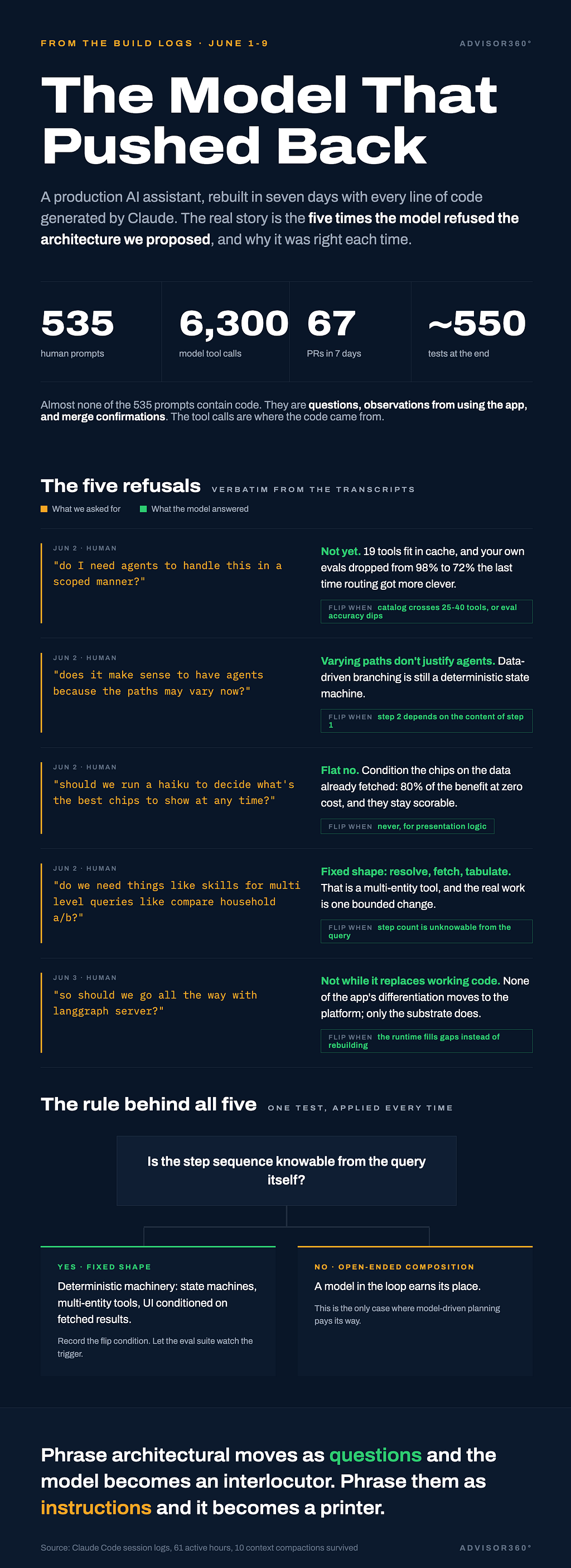
  45. When the Model Pushed Back

    A developer team rebuilt a financial advisor AI assistant in a week, generating all code with Claude 3 Opus. Contrary to the expectation that AI models are passive 'yes-machines', the AI model five times pushed back on proposed architectural decisions, correctly identifying flaws and suggesting better alternatives. The process involved iterative prompting, with the AI integrating tools and analyzing logs to fix bugs and even orchestrating a mid-flight architecture migration to LangGraph and Anthropic skills. AI

    When the Model Pushed Back

    IMPACT Demonstrates AI models can proactively challenge architectural decisions, suggesting a move towards more collaborative and critical AI development.

  46. Zyphra has released Zamba2-VL, a family of open vision-language models using a hybrid Mamba2 state-space and Transformer design. The models come in 1.2B, 2.7B,

    Zyphra has launched Zamba2-VL, a new family of open-source vision-language models. These models utilize a hybrid architecture combining Mamba2 state-space models with Transformers, offering significantly faster processing times compared to traditional Transformer models. Zamba2-VL is available in 1.2B, 2.7B, and 7B parameter sizes, with benchmarks indicating high accuracy alongside improved speed. AI

    IMPACT Introduces a novel hybrid architecture that significantly speeds up vision-language processing, potentially influencing future model designs.

  47. Claude Fable 5 First Day Real Test, It's Going Crazy...

    Anthropic has released Claude Fable 5, a new frontier model that demonstrates significant advancements in reasoning, coding, and creative tasks. Early tests show Fable 5 outperforming competitors like GPT-5.5 in complex tasks such as replicating Twitter interfaces and generating intricate creative content. The model also exhibits a dramatic leap in benchmark performance, exceeding previous trends on evaluations like SWE-Bench Pro, though its advanced capabilities come at a high operational cost. AI

    IMPACT Sets new SOTA on coding and creative benchmarks, potentially disrupting existing creative tools and accelerating enterprise adoption of advanced AI agents.

  48. SK Hynix to decide next chip factory site after comprehensive evaluation

    Anthropic has launched its latest and most powerful AI model, Claude Fable 5, which is described as a "dangerous" level model with a high price point. This release comes amidst growing chip demand, with SK Hynix planning to select a site for its next chip factory after a comprehensive evaluation. Separately, travel data shows a significant increase in bookings for 18-year-old travelers, with many scenic spots offering free admission to students, boosting nearby hotel reservations. AI

    IMPACT Sets a new benchmark for AI model capabilities and pricing, potentially influencing future development and adoption strategies.

  49. Divide and Cooperate: Role-Decomposed Multi-Agent LLM Training with Cross-Agent Learning Signals

    Researchers have introduced DAC, a novel framework for training multi-agent language models that separates evidence acquisition and answer generation into distinct, cooperating agents. This role decomposition addresses the challenge of credit assignment in complex reasoning tasks by providing specialized learning signals between agents. Experiments demonstrate that DAC, using parameter-efficient LoRA modules, outperforms traditional monolithic models on question-answering benchmarks. AI

    IMPACT This research could lead to more efficient and effective training of complex reasoning agents, potentially improving performance on knowledge-intensive tasks.

  50. UniDexTok: A Unified Dexterous Hand Tokenizer from Real Data

    Researchers have developed UniDexTok, a novel state tokenizer designed to create a unified representation for diverse dexterous hands. This system maps human and robot hand states into a shared 22-DoF semantic interface, overcoming fragmentation issues in existing datasets. UniDexTok achieves significant accuracy improvements, reducing reconstruction errors from centimeters to sub-millimeters, and demonstrates strong cross-embodiment learning capabilities. AI

    IMPACT Enables more robust training of robotic hands by unifying disparate datasets, potentially accelerating progress in dexterous manipulation.