PulseAugur / Brief
EN
LIVE 22:58:17

Brief

last 24h
[7/7] 221 sources

Multi-source AI news clustered, deduplicated, and scored 0–100 across authority, cluster strength, headline signal, and time decay.

  1. SVM : 40 Must Visit Interview Questions (Part 1)

    This article series delves into Support Vector Machines (SVMs), a popular machine learning algorithm, by presenting a comprehensive list of interview-style questions. Part 1 covers foundational concepts like decision boundaries, hyperplanes, and the intuition behind maximizing margins, along with distinctions between hard-margin and soft-margin classifiers. Part 2 builds on this by exploring the kernel trick, its power, different kernel types, and challenges, as well as how SVMs handle multi-class problems and compare to other algorithms like Logistic Regression. AI
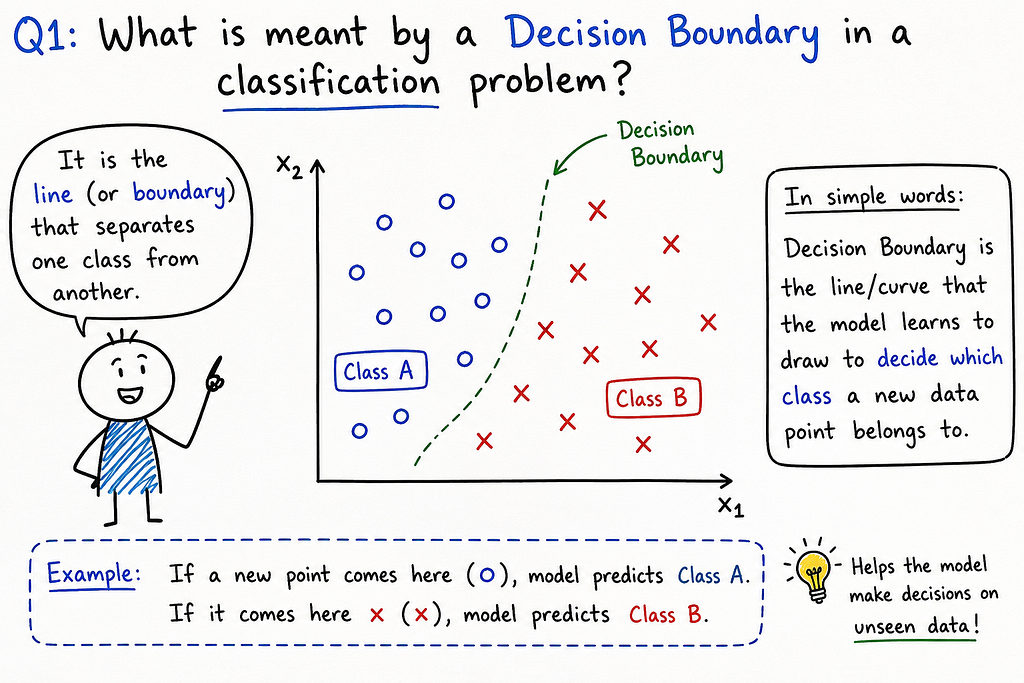
    SVM : 40 Must Visit Interview Questions (Part 1)

    IMPACT Provides foundational knowledge for machine learning practitioners and students preparing for interviews on core algorithms.


  2. Kernel SVMs Are the Most Underrated Algorithm

    Support Vector Machines (SVMs) are a powerful classification algorithm that finds the optimal boundary between data groups. The core concept, known as the 'kernel trick,' allows for complex, non-linear separations by mapping data into a higher dimension where it becomes linearly separable. SVMs aim to maximize the margin, or gap, between the closest data points of different classes, known as support vectors, which are crucial in defining this optimal boundary. AI

    Kernel SVMs Are the Most Underrated Algorithm

    IMPACT Explains the foundational principles of Support Vector Machines, a key algorithm in machine learning for classification tasks.

  3. Ensemble RL through Classifier Models: Enhancing Risk-Return Trade-offs in Trading Strategies

    Researchers have developed an ensemble reinforcement learning (RL) approach for financial trading, integrating RL algorithms like A2C, PPO, and SAC with traditional classifiers such as SVM, Decision Trees, and Logistic Regression. This hybrid method aims to improve risk-return trade-offs and reduce drawdowns compared to standalone RL models. The study found that ensemble strategies consistently outperformed individual models, though performance was sensitive to the variance threshold parameter \(\tau\), suggesting a need for dynamic adjustment. AI

    IMPACT Introduces a novel ensemble approach for financial trading that improves risk-adjusted returns and stability.

  4. A Reproducible Log-Driven AutoML Framework for Interpretable Pipeline Optimization in Healthcare Risk Prediction

    Researchers have developed a new automated machine learning framework called yvsoucom-iterkit, designed for reproducible pipeline optimization in healthcare risk prediction. This framework encodes each pipeline as a traceable log, allowing for detailed analysis of component interactions and their impact on performance. Experiments on diabetes and stroke datasets demonstrated that a small subset of components, such as data augmentation and imbalance handling, significantly drives performance, suggesting that AutoML optimization can be focused on these key areas. AI

    IMPACT Introduces a framework for more efficient and interpretable AI model development in healthcare, potentially improving diagnostic accuracy.

  5. From TF-IDF to Transformers: A Comparative and Ensemble Approach to Sentiment Classification

    This paper explores sentiment classification using various machine learning models, including traditional methods like Naive Bayes and SVM, alongside transformer-based models such as RoBERTa and DistilBERT. The study evaluated these models on the IMDb dataset for categorizing movie reviews into positive and negative sentiments. RoBERTa achieved the highest accuracy at 93.02%, and an ensemble approach combining multiple models further enhanced classification performance. AI

    IMPACT This research highlights RoBERTa's effectiveness in sentiment analysis and demonstrates the benefits of model ensembling for improved accuracy.

  6. How Reading Papers Helps You Be a More Effective Data Scientist

    A new arXiv paper details a study comparing BERT and T5 models for Named Entity Recognition (NER), analyzing their performance with different tag schemes and hyperparameters. The research aims to provide insights into common errors and compare the architectures for practical applications. Separately, an article discusses the benefits of reading research papers for data scientists, highlighting how it can improve effectiveness by learning from existing work and staying updated on advancements. AI

    How Reading Papers Helps You Be a More Effective Data Scientist

    IMPACT Research papers offer valuable insights and practical applications for AI professionals, helping them stay updated and avoid reinventing the wheel.