PulseAugur / Brief
EN
LIVE 13:56:59

Brief

last 24h
[4/4] 221 sources

Multi-source AI news clustered, deduplicated, and scored 0–100 across authority, cluster strength, headline signal, and time decay.

  1. ASR Models Collapse in the Real World

    A new study highlights a significant performance drop in Automatic Speech Recognition (ASR) models when they encounter real-world audio data, a stark contrast to their success in controlled environments. The research indicates that these models struggle with the complexities and variations present in natural speech, leading to a collapse in accuracy. To address this, the study proposes training ASR models on a vast dataset of simulated, challenging audio scenarios to improve their robustness and reliability in practical applications. AI
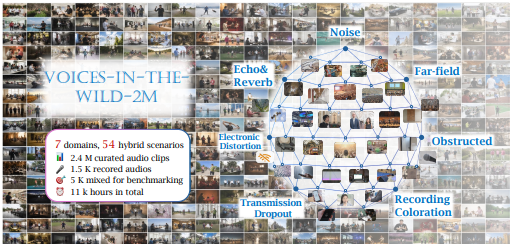
    ASR Models Collapse in the Real World

    IMPACT ASR models need robust training on diverse, real-world audio to be reliable in practical applications, impacting user experience across many AI-driven services.


  2. Can Large Language Models Reliably Correct Errors in Low-Resource ASR? A Contamination-Aware Case Study on West Frisian

    Researchers explored the effectiveness of large language models (LLMs) in correcting errors for low-resource automatic speech recognition (ASR) systems, specifically focusing on West Frisian. Their study introduced a contamination-aware methodology using both public and a custom offline dataset to ensure the observed improvements were genuine. The findings indicate that LLM-based error correction generally enhances ASR performance, with one model even outperforming oracle word error rates, suggesting a true correction capability. AI

    Can Large Language Models Reliably Correct Errors in Low-Resource ASR? A Contamination-Aware Case Study on West Frisian

    IMPACT Demonstrates LLMs' potential to improve speech recognition for under-resourced languages, opening new avenues for accessibility and data collection.

  3. AI Security Research Should Better Incentivize Defense Research

    A recent paper published on arXiv highlights a significant imbalance in AI security research, with a disproportionate focus on attack methodologies over defensive strategies. The research indicates that attack papers are often evaluated under conditions that exaggerate threat severity, while defenses face much higher scrutiny. This disparity results in a field with abundant vulnerability disclosures but a scarcity of practical, deployable protections, leading the authors to advocate for greater incentives for defense-oriented research. AI

    IMPACT Highlights a critical need for more practical AI defense mechanisms to complement existing vulnerability research.

  4. Announcing the fastest inference for realtime voice AI agents

    Together AI has launched a unified platform for building real-time voice agents, integrating speech-to-text (STT), large language models (LLM), and text-to-speech (TTS) within a single cloud environment. This co-location aims to reduce latency to under 500ms and simplify deployment by eliminating inter-vendor network hops. The platform now natively hosts models like Deepgram for STT and Cartesia Sonic-3 for TTS, offering developers more choice and a streamlined experience for production-ready voice applications. AI

    Announcing the fastest inference for realtime voice AI agents

    IMPACT Accelerates development of real-time conversational AI applications by simplifying infrastructure and reducing latency.