PulseAugur / Brief
EN
LIVE 23:44:03

Brief

last 24h
[7/7] 221 sources

Multi-source AI news clustered, deduplicated, and scored 0–100 across authority, cluster strength, headline signal, and time decay.

  1. Training

    Fireworks AI has identified critical numerical parity bugs that can arise when training and serving large language models, particularly Mixture-of-Experts (MoE) architectures. These discrepancies, stemming from the non-associative nature of floating-point arithmetic and differing summation orders in distributed training versus inference, can lead to subtle but significant issues. Such drift can compromise the integrity of reinforcement learning from human feedback (RLHF) due to altered log probabilities and erode customer trust in fine-tuned models. AI
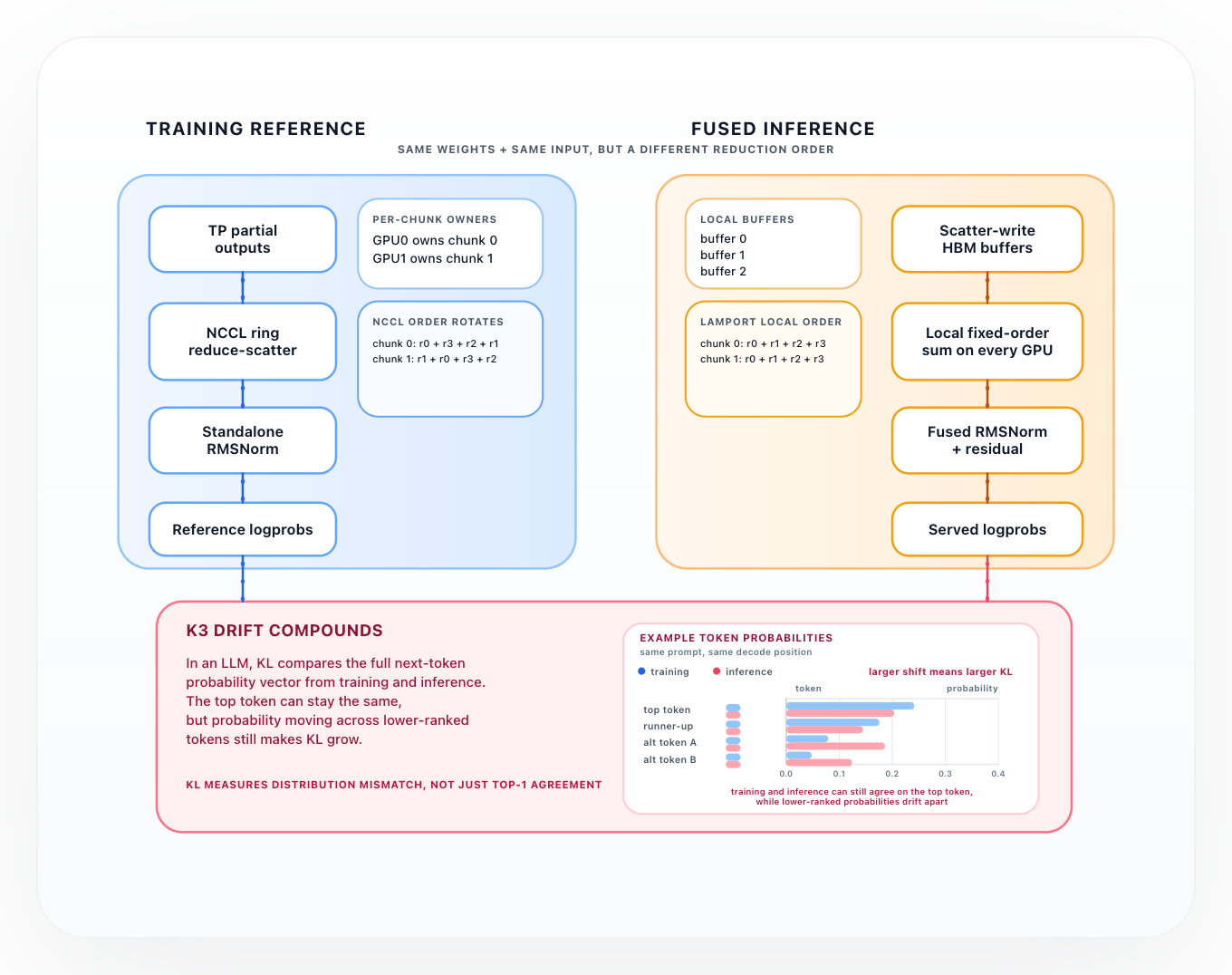
    Training

    IMPACT Highlights potential issues in LLM training and serving pipelines that could affect model performance and reliability, especially for MoE architectures.

  2. StepFun Releases StepAudio 2.5 Realtime: An End-to-End Voice Model with Roleplay-Specific RLHF and Paralinguistic Comprehension

    StepFun has released StepAudio 2.5 Realtime, an end-to-end speech large language model capable of real-time, customizable persona interactions. The model integrates speech understanding and generation, utilizing a million-scale persona data augmentation and roleplay-specific Reinforcement Learning from Human Feedback (RLHF) to maintain character consistency. A key differentiator is its paralinguistic comprehension, allowing it to perceive user mood and intentions from vocal cues like tone and speech rate, achieving a score of 82.18 on a relevant benchmark. AI

    StepFun Releases StepAudio 2.5 Realtime: An End-to-End Voice Model with Roleplay-Specific RLHF and Paralinguistic Comprehension

    IMPACT Enhances real-time conversational AI with improved persona consistency and paralinguistic understanding.

  3. Learning Kernel-Based MDPs from Episodic Preferential Feedback

    Researchers have developed a theoretical framework for reinforcement learning using only human preference feedback. This method, applied to episodic kernel Markov Decision Processes (MDPs), allows agents to learn optimal policies by comparing trajectories and receiving binary preference labels. The study provides theoretical guarantees for sublinear regret bounds, indicating that the learned policy value converges towards the optimal policy value with sufficient episodes. AI

    IMPACT This theoretical work advances reinforcement learning by enabling agents to learn effectively from comparative human feedback, potentially improving alignment and reducing the need for precisely calibrated reward functions.

  4. Introducing the Anyscale Agent Skill for LLM Post

    Anyscale has introduced a new Anyscale Agent Skill designed to simplify and automate the process of generating LLM post-training runs. This skill assists users in selecting the most appropriate post-training method, such as SFT, CPT, DPO, or RLVR, based on their model, dataset, and objectives. It then generates configuration files for popular frameworks like LLaMA-Factory and Ray Train, preparing them for deployment on Anyscale Jobs. AI

    Introducing the Anyscale Agent Skill for LLM Post

    IMPACT Simplifies the complex process of LLM post-training, potentially accelerating adoption of advanced alignment and optimization techniques.

  5. Geometric Alignment: Can Curved Embedding Spaces Make AI Safer?

    Researchers are exploring a novel approach to AI safety by introducing geometric alignment within the model's embedding space, rather than relying solely on post-hoc behavioral controls. This method, demonstrated in the DRM Transformer, uses a curved manifold where the 'cost' or 'difficulty' of traversing semantic paths is encoded into the geometry itself. By incorporating semantic anchors and geodesic attention, the model can intrinsically pay more attention to regions of higher risk or uncertainty, potentially facilitating negotiation between humans and AI rather than enforcing a purely subservient role. AI

    Geometric Alignment: Can Curved Embedding Spaces Make AI Safer?

    IMPACT Proposes a fundamental shift in AI alignment research, moving from behavioral controls to intrinsic geometric properties of models.

  6. Spectral Souping: A Unified Framework for Online Preference Alignment

    Researchers have developed "Spectral Souping," a novel framework designed to align large language models with individual user preferences more effectively than traditional RLHF methods. This approach identifies a universal spectral representation within LLMs that facilitates model merging. The framework first trains specialized policies offline for different preference dimensions, then uses an online adaptation algorithm to combine these policies at inference time, allowing for rapid adaptation without costly retraining. AI

    IMPACT Introduces a more efficient method for adapting LLMs to diverse individual user preferences, potentially improving user experience and model utility.

  7. TUR-DPO: Topology- and Uncertainty-Aware Direct Preference Optimization

    Researchers are exploring advanced methods for aligning large language models with human preferences, moving beyond traditional Reinforcement Learning from Human Feedback (RLHF). New approaches like Direct Preference Optimization (DPO) offer simpler implementations but have theoretical limitations. Papers introduce refinements such as Constrained Preference Optimization (CPO) and Topology- and Uncertainty-Aware DPO (TUR-DPO) to address these shortcomings and improve alignment guarantees. AI

    TUR-DPO: Topology- and Uncertainty-Aware Direct Preference Optimization

    IMPACT New alignment techniques like CPO and TUR-DPO offer improved theoretical guarantees and empirical performance for LLMs.