PulseAugur / Brief
EN
LIVE 13:32:40

Brief

last 24h
[3/3] 223 sources

Multi-source AI news clustered, deduplicated, and scored 0–100 across authority, cluster strength, headline signal, and time decay.

  1. The Pentagon Is Rewriting How It Buys AI To Control The Future Of Warfare “FEDERALNEWS NETWORK” By Roslyn Layton, PhD “ A“best of breed” strategy – assembling a

    The Pentagon is shifting its technology procurement strategy to a "best of breed" approach, integrating multiple commercial AI providers rather than relying on a single vendor. This move aims to accelerate its "artificial intelligence-first" warfighting vision while preventing any single company from dominating critical defense technologies. The new model emphasizes modularity and interoperability, drawing capabilities like frontier intelligence from OpenAI and Google, compute from Nvidia, and open-weight models from Reflection, among others. This strategy is intended to enhance government control and accountability over AI systems used in warfare, ensuring they can be scrutinized and aligned with U.S. law and international norms. AI
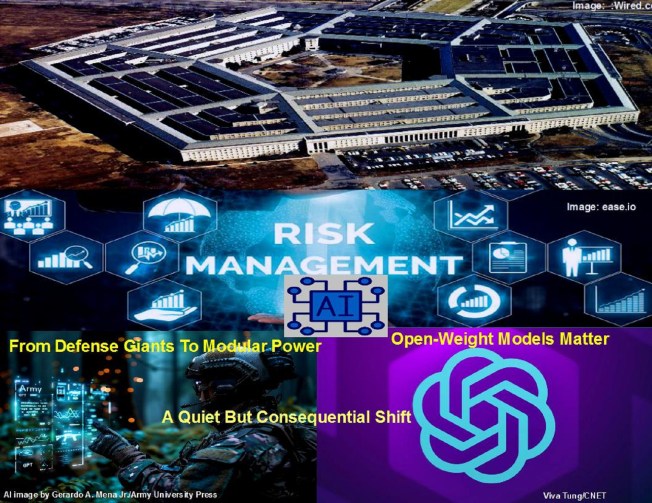
    The Pentagon Is Rewriting How It Buys AI To Control The Future Of Warfare “FEDERALNEWS NETWORK” By Roslyn Layton, PhD “ A“best of breed” strategy – assembling a

    IMPACT This strategic shift by the Pentagon could influence how other large government bodies procure and integrate AI, potentially favoring modular and open systems.

  2. CangLing-KnowFlow: A Unified Knowledge-and-Flow-fused Agent for Comprehensive Remote Sensing Applications

    Researchers have developed CangLing-KnowFlow, a novel agent framework designed to unify and automate the processing of massive remote sensing datasets. This system integrates a Procedural Knowledge Base with over 1,000 workflow cases, a Dynamic Workflow Adjustment module for error recovery, and an Evolutionary Memory Module for continuous learning. Tested on the KnowFlow-Bench benchmark, CangLing-KnowFlow demonstrated a higher Task Success Rate compared to the Reflexion baseline across various LLM backbones, offering a robust solution for complex Earth observation challenges. AI

    IMPACT This framework could streamline complex Earth observation tasks by automating data processing and interpretation.

  3. Honest Lying: Understanding Memory Confabulation in Reflexive Agents

    Researchers have identified a significant issue in reflexive AI agents where they can develop and retain incorrect interpretations of tasks, a phenomenon termed "memory confabulation." This leads to persistent errors even when the environment is reset. To address this, a new metric called Reflection Repetition Rate (RRR) was developed to detect reliance on faulty reflective content, and a mitigation strategy was proposed that improves performance and reduces confabulation. AI

    IMPACT Highlights a critical flaw in self-reflective AI agents, potentially impacting the reliability of future autonomous systems.