PulseAugur / Brief
EN
LIVE 23:06:12

Brief

last 24h
[8/8] 224 sources

Multi-source AI news clustered, deduplicated, and scored 0–100 across authority, cluster strength, headline signal, and time decay.

  1. The Token Compression Illusion: Why I'm Skeptical of RTK https://mroczek.dev/articles/the-token-compression-illusion-why-im-skeptical-of-rtk/ # HackerNews # Tec

    The author expresses skepticism regarding Real Time Kinematic (RTK) token compression, arguing that it may create an illusion of efficiency rather than genuine improvement. This perspective challenges common assumptions about the effectiveness of such compression techniques in certain applications. AI

    The Token Compression Illusion: Why I'm Skeptical of RTK https://mroczek.dev/articles/the-token-compression-illusion-why-im-skeptical-of-rtk/ # HackerNews # Tec

    IMPACT Challenges assumptions about efficiency in AI model development and deployment.

  2. Segway's Navimow X4 Doesn't Need An Extra Antenna To Tackle Your Lawn

    Segway has released its Navimow X4 series of robotic lawnmowers, which eliminate the need for boundary wires or external RTK antennas. These mowers utilize advanced real-time kinematic (RTK) technology to navigate lawns autonomously, allowing for placement in various locations without requiring roof mounts or tall poles for signal reception. The Navimow X4 series starts at $2,499, with models capable of mowing up to 1 to 1.5 acres daily, and offers optional accessories like a protective garage and an automated fence gate. AI

    Segway's Navimow X4 Doesn't Need An Extra Antenna To Tackle Your Lawn

    IMPACT Enhances convenience for lawn maintenance by enabling fully autonomous operation without complex setup.

  3. Cutting LLM Token Costs with rtk, headroom, and caveman - savings measured on real workloads

    A recent analysis of tools designed to reduce large language model (LLM) token costs revealed that their actual savings on real-world workloads are significantly lower than advertised. While tools like headroom, rtk, and caveman can achieve high compression rates on specific data types such as code diffs or JSON arrays, their impact on overall API bills is minimal. This is due to factors including the denominator effect across multiple turns, the prevalence of plain text in typical workloads, and the fact that these tools do not address the most expensive components of API usage like prompt creation or output generation. Furthermore, the security implications of granting these tools access to sensitive data raise concerns about whether the marginal savings justify the potential risks. AI

    Cutting LLM Token Costs with rtk, headroom, and caveman - savings measured on real workloads

    IMPACT Tools claiming to reduce LLM costs offer minimal savings on real-world workloads, suggesting current optimization strategies may be insufficient.

  4. 6 free open source repos that cut my Claude Code token costs by up to 90%

    A Reddit user shared six open-source tools designed to significantly reduce token usage and associated costs when interacting with Anthropic's Claude AI. These tools range from usage analyzers and command output compressors to simplified response styles and local knowledge graph builders. The user highlighted the 'Caveman Claude' and 'ccusage' tools as particularly effective, with the former reducing response fluff and the latter providing detailed token consumption insights. AI

    6 free open source repos that cut my Claude Code token costs by up to 90%

    IMPACT These tools offer practical methods for developers and users to manage and reduce the operational costs associated with large language models like Claude.

  5. Santa Augmentcode Intent Ep.9

    This article introduces a new toolkit for external agent stacks, designed to bring the principles of the Augment Intent system to broader applications. The toolkit, detailed in the `augment-claude-litellm-rtk` repository, focuses on improving context quality over quantity, reducing token waste from verbose shell output, and enabling sensible model routing. It comprises Claude Code as the coding agent, Augment Context Engine MCP for semantic retrieval, RTK for trimming shell output, and LiteLLM as a local AI gateway. AI

    Santa Augmentcode Intent Ep.9

    IMPACT Enables more efficient and cost-effective use of external AI agents by improving context management and reducing token waste.

  6. I Tried 100+ Claude Code Skills. These 7 Are The Best.

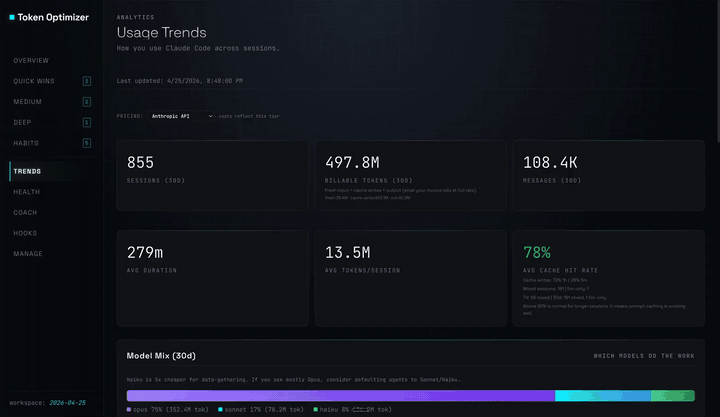
    Several open-source tools have been developed to optimize token usage within AI coding assistants like Claude Code. These tools address issues such as verbose CLI output, bloated context files, and inefficient session compaction, which can lead to significant token consumption before any code is written. Solutions like Token Optimizer, Caveman, and Intent Layer aim to reduce token waste by auditing context, stripping unnecessary verbosity, and providing structured codebase information, potentially saving tens of thousands of tokens per session. AI

    I Tried 100+ Claude Code Skills. These 7 Are The Best.

    IMPACT These tools could significantly reduce the operational costs of using AI coding assistants by minimizing token consumption.

  7. Santa Augmentcode Intent Ep.9

    This article introduces a practical toolkit for external AI agent stacks, inspired by the principles of the Augment Intent system. The toolkit focuses on semantic retrieval, reducing verbose shell output, and sensible model routing, rather than simply increasing context length. It comprises four main components: Claude Code for coding tasks, Augment Context Engine MCP for retrieving relevant codebase sections, RTK for trimming unnecessary shell output, and LiteLLM as a local gateway for model management. AI

    Santa Augmentcode Intent Ep.9

    IMPACT Provides a practical toolkit for developers to improve the efficiency and cost-effectiveness of AI agent interactions.

  8. Graph neural network explanations reveal a topological signature of disease-associated hubs in biological networks

    Researchers have evaluated four popular explanation methods for graph neural networks (GNNs) to understand their effectiveness in identifying disease-associated structures within biological networks. Using synthetic data and breast cancer RNA sequencing data, the study found that different methods excel at uncovering distinct types of biological signals, such as single-node drivers or distributed pathways. By combining consensus scores from multiple explainers and incorporating topological information, the researchers improved the prioritization of key cancer genes and the recovery of biologically relevant signaling pathways. AI

    Graph neural network explanations reveal a topological signature of disease-associated hubs in biological networks

    IMPACT Improves biological interpretability of GNNs, potentially leading to more accurate disease diagnosis and drug discovery.