PulseAugur / Brief
EN
LIVE 00:20:48

Brief

last 24h
[5/5] 221 sources

Multi-source AI news clustered, deduplicated, and scored 0–100 across authority, cluster strength, headline signal, and time decay.

  1. Your Team Is Paying $3,600 a Year for ChatGPT. Here’s How to Replace It for $75/Month.

    Teams can significantly reduce their AI costs by self-hosting an AI server instead of paying for services like ChatGPT Team. This approach offers unlimited usage and enhanced data privacy by keeping all prompts and data on the company's own network. The setup involves open-source tools like Ollama for model running, Open WebUI for a ChatGPT-like interface, Qdrant for document search, and Tailscale for secure remote access, with hardware requirements centered around a GPU with 24GB of VRAM. AI
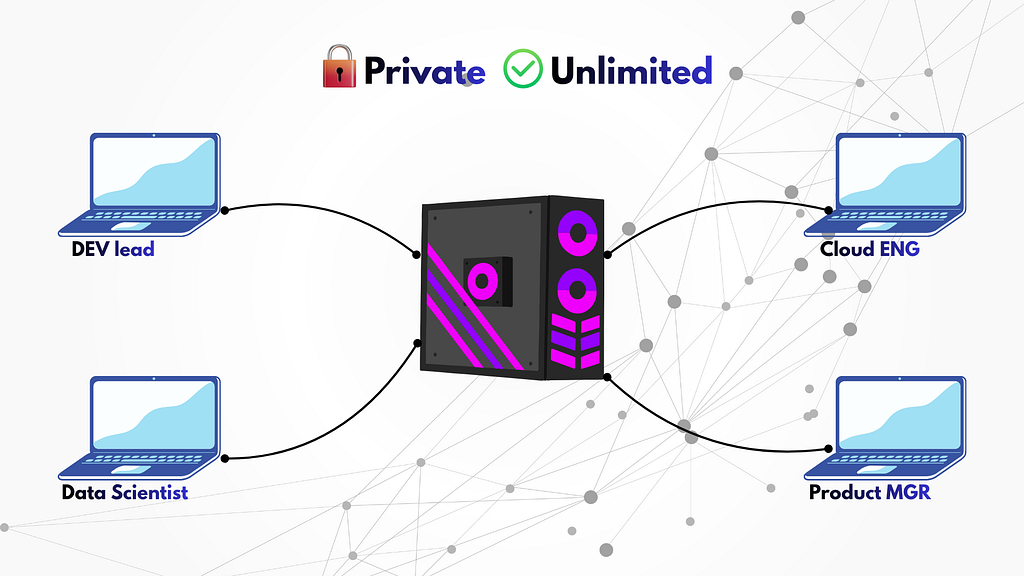
    Your Team Is Paying $3,600 a Year for ChatGPT. Here’s How to Replace It for $75/Month.

    IMPACT Enables teams to reduce AI operational costs and enhance data privacy by self-hosting models.
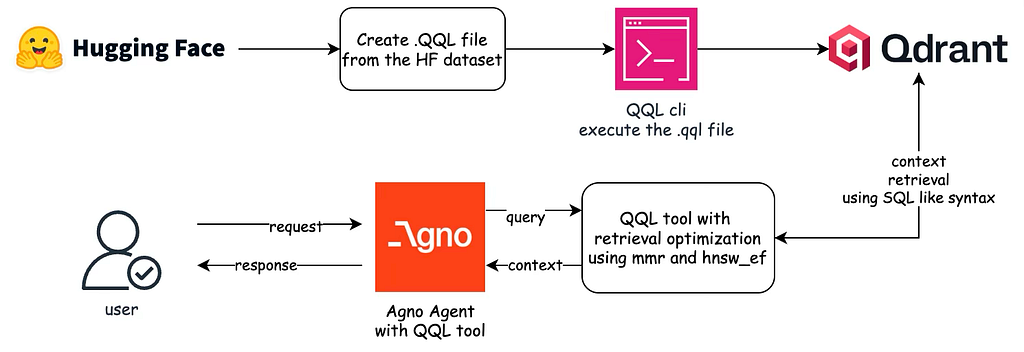
  2. Building an Agentic Healthcare Retrieval System Using QQL and Qdrant

    Researchers have developed an agentic healthcare retrieval system that semantically understands patient-doctor conversations. This system utilizes Qdrant for vector database storage and QQL, a SQL-like language, for declarative retrieval. The architecture integrates with Hugging Face datasets and employs an Agno agent for orchestration, aiming to provide more accurate and contextually grounded responses than traditional keyword search. AI

    Building an Agentic Healthcare Retrieval System Using QQL and Qdrant

    IMPACT This system demonstrates a novel approach to semantic retrieval in healthcare, potentially improving the accuracy and contextuality of responses derived from patient-doctor conversations.

  3. Why Retrieval-Augmented Generation Fails: A Graph Perspective

    Researchers are developing advanced techniques to improve Retrieval-Augmented Generation (RAG) systems, which ground language models in external data. One approach, ContextRAG, constructs a graph index without relying on costly LLM-based entity extraction, significantly reducing token usage and indexing time while maintaining competitive performance. Another study uses circuit tracing to build attribution graphs, revealing that successful RAG relies on deeper reasoning paths and more structured information flow, leading to a framework for error detection and targeted interventions to improve grounding. Additionally, a preprocessing step called Contextual Retrieval aims to enrich raw text chunks with surrounding semantic understanding before indexing, creating "self-explained chunks" to enhance retrieval accuracy and create more robust RAG pipelines, often employing hybrid search methods. AI

    Why Retrieval-Augmented Generation Fails: A Graph Perspective

    IMPACT New RAG techniques promise more accurate and efficient AI responses by improving how models access and process external information, reducing costs and hallucinations.

  4. Building RAG Systems: A Complete Guide

    Retrieval-Augmented Generation (RAG) systems are a crucial technique for enhancing Large Language Models (LLMs) by allowing them to access and utilize external, up-to-date information. RAG addresses LLM limitations such as knowledge cutoffs and context window limits by retrieving relevant data before generating a response. This approach is distinct from fine-tuning, which modifies the model's behavior rather than its knowledge base. Building a RAG system involves two main pipelines: an ingestion pipeline for preparing and storing data, and a retrieval pipeline that fetches context for each user query. AI

    Building RAG Systems: A Complete Guide

    IMPACT Enables LLMs to provide more accurate, up-to-date, and domain-specific answers by integrating external knowledge bases.

  5. 9 AI Templates and Playgrounds for Your Business

    Replit has launched a suite of AI-powered templates designed to streamline developer onboarding and accelerate the creation of AI-driven applications. These templates, available for various programming languages and frameworks, simplify complex setups for tools like vector databases and large language models. Notable examples include templates for Qdrant vector search, comparing Gemini and GPT-4, building AI support agents with OpenAI, and transcribing meetings using OpenAI Whisper. AI

    9 AI Templates and Playgrounds for Your Business

    IMPACT Accelerates AI development by providing pre-built templates for common tasks and models.