PulseAugur / Brief
EN
LIVE 22:10:03

Brief

last 24h
[14/14] 221 sources

Multi-source AI news clustered, deduplicated, and scored 0–100 across authority, cluster strength, headline signal, and time decay.

  1. Prompt Injection in Production: The 2025 Perplexity Comet Attack

    Researchers discovered a significant prompt injection vulnerability in the Perplexity Comet browser, allowing attackers to execute malicious instructions by hiding them within invisible elements on web pages. This indirect prompt injection attack, which requires no user interaction beyond asking the AI to summarize content, can lead to sensitive data exfiltration, including email addresses and one-time passwords. While Perplexity has issued fixes, the underlying architectural issue of AI models not distinguishing between content and instructions remains a broader concern for AI-enhanced applications processing external data. AI
    Prompt Injection in Production: The 2025 Perplexity Comet Attack

    IMPACT Highlights critical security risks in AI browsers and applications that process external content, necessitating robust defenses against prompt injection.

  2. UltraProbe Is Live — The World's First Free AI Security Scanner That Finds Your LLM Vulnerabilities in 5 Seconds

    UltraProbe, a new free AI security scanner, has been released by Ultra Lab to address the growing threat of prompt injection attacks on LLM applications. The tool offers two scanning modes: one that analyzes a system prompt for vulnerabilities in under five seconds, and another that scans a website's URL to detect risks associated with integrated AI chatbots. UltraProbe aims to provide accessible and comprehensive security testing for developers, covering major attack vectors identified by OWASP. AI

    IMPACT Provides a free, accessible tool for developers to test and mitigate prompt injection vulnerabilities in LLM applications, addressing a critical security gap.

  3. Prompt Injection Defenses: Cost and Real-World Effectiveness Analysis

    Prompt injection, a security risk where users manipulate AI models with malicious inputs, has become a significant operational concern. The author details their experiences with this threat, particularly within an ERP system, and analyzes the cost and effectiveness of various defense strategies. Initial methods like input validation and heuristic filtering proved insufficient due to high false positive rates and bypassability, while canary token approaches offered some success but were also vulnerable to sophisticated attacks. AI

    IMPACT Evaluates the real-world cost and effectiveness of prompt injection defenses, offering practical insights for securing AI applications.

  4. Why Blocking Prompt Injection Is Wrong — and What to Do Instead

    Instead of blocking prompt injection attacks, the MIRAGE system uses a honeypot approach to deceive attackers. When a suspicious prompt is detected, MIRAGE feeds the attacker fabricated data and logs their actions, making them believe they are succeeding. This method aims to waste the attacker's resources and collect intelligence on their techniques, rather than alerting them to their detection. AI

    Why Blocking Prompt Injection Is Wrong — and What to Do Instead

    IMPACT Offers a novel defensive strategy against prompt injection, potentially reducing the effectiveness of attacks on AI agents.

  5. AI Red-Teaming Techniques: A Practical Starting Point for Security Teams

    AI red-teaming offers a structured approach for security teams to identify vulnerabilities in large language model applications. Key steps include defining the system's purpose, input/output capabilities, and potential adversaries to tailor testing. Prompt injection, both direct and indirect, is a primary attack vector to explore, alongside testing layered controls like content filters and output validation. AI

    AI Red-Teaming Techniques: A Practical Starting Point for Security Teams

    IMPACT Provides actionable techniques for security professionals to proactively identify and mitigate risks in AI systems.

  6. AI 2026AI

    The provided articles offer a comprehensive guide to AI application observability and security testing for the year 2026. They detail methods for identifying and mitigating unique AI security threats such as prompt injection and data poisoning, alongside strategies for monitoring AI application performance, cost, and output quality. Key areas covered include logging, metrics, tracing, and evaluation, with practical code examples for tracking latency and token consumption. AI

    AI 2026AI

    IMPACT These guides offer practical frameworks and code for developers to enhance AI application security and monitor performance, addressing critical operational needs.

  7. Brazilian Lawyers Fined R$84,000 for Prompt Injection in Court — Here's What Caught Them (and What Didn't)

    A Brazilian labor court has fined two attorneys approximately R$84,000 for prompt injection, marking one of the first known judicial sanctions for this AI manipulation tactic. The lawyers attempted to influence a court AI assisting in a case by embedding hidden instructions within their legal submissions. Although the judge manually detected the manipulation, this incident highlights the vulnerability of AI systems in legal proceedings and the current lack of robust automated defenses against such attacks. AI

    Brazilian Lawyers Fined R$84,000 for Prompt Injection in Court — Here's What Caught Them (and What Didn't)

    IMPACT Sets a precedent for AI misuse in legal contexts, highlighting the need for robust defenses against prompt injection in judicial systems.

  8. When AI Reads Blueprints: The Hidden Attack Surface of Multimodal Engineering Intelligence

    A security analysis highlights the risks associated with AI systems that interpret engineering blueprints, such as those developed at Skoltech. These systems, which use multimodal models to read and analyze architectural drawings and building codes, introduce new attack surfaces. Researchers warn of potential threats like steganographic prompt injection, where hidden instructions are embedded in blueprints, and data poisoning, which could lead to structurally unsound designs and catastrophic failures. AI

    IMPACT AI systems interpreting engineering blueprints introduce new security vulnerabilities, potentially leading to catastrophic failures if not properly secured.

  9. How to detect prompt injection attacks in user input

    Prompt injection attacks, analogous to SQL injection for LLMs, pose a significant security risk by allowing malicious users to manipulate AI model behavior. These attacks can override system instructions, extract sensitive prompts, or exfiltrate data. Developers can defend against these threats using a multi-layered approach, starting with a fast, keyword-based blocklist to catch obvious attempts, followed by a more sophisticated method using a separate, isolated LLM to classify potentially malicious inputs. AI

    IMPACT Provides developers with practical techniques to secure LLM applications against manipulation and data leakage.

  10. I wanted to protect the agents against prompt injection and malformed data attacks. Read more 👉 https:// lttr.ai/ArYl2 # Security # Infosec # Ai

    A security researcher developed a method to defend AI agents against prompt injection and malformed data attacks. This approach aims to enhance the robustness and safety of AI systems when interacting with potentially malicious inputs. AI

    IMPACT Enhances AI agent security by mitigating risks from malicious inputs.

  11. An Empirical Study of Privacy Leakage Chains via Prompt Injection in Black-Box Chatbot Environments

    Researchers have developed a new method called 'exemplification' to exploit privacy vulnerabilities in black-box chatbot environments. This technique allows attackers to hijack an agent's intended task by crafting seemingly benign external content that redirects the chatbot to execute malicious objectives. The study demonstrates a data-exfiltration chain by combining prompt injection, instruction steering, and web-tool invocation, highlighting a feasible privacy-leakage path in deployed chatbot agents. AI

    IMPACT New attack vector discovered for LLM-based chatbots could lead to more robust security measures.

  12. Prompt Injection Attacks: How Hackers Break AI Every major LLM is vulnerable. Direct injection, indirect injection, and jailbreaks explained with real examples.

    Prompt injection is identified as the primary vulnerability in large language model applications, with experts detailing various attack vectors. These include direct and indirect injection methods, as well as jailbreaking techniques, all of which are demonstrated with real-world examples. The articles emphasize that every major LLM is susceptible to these attacks and offer strategies for defense. AI

    Prompt Injection Attacks: How Hackers Break AI Every major LLM is vulnerable. Direct injection, indirect injection, and jailbreaks explained with real examples.

    IMPACT Highlights critical security vulnerabilities in LLMs, urging developers to implement robust defense mechanisms against prompt injection.

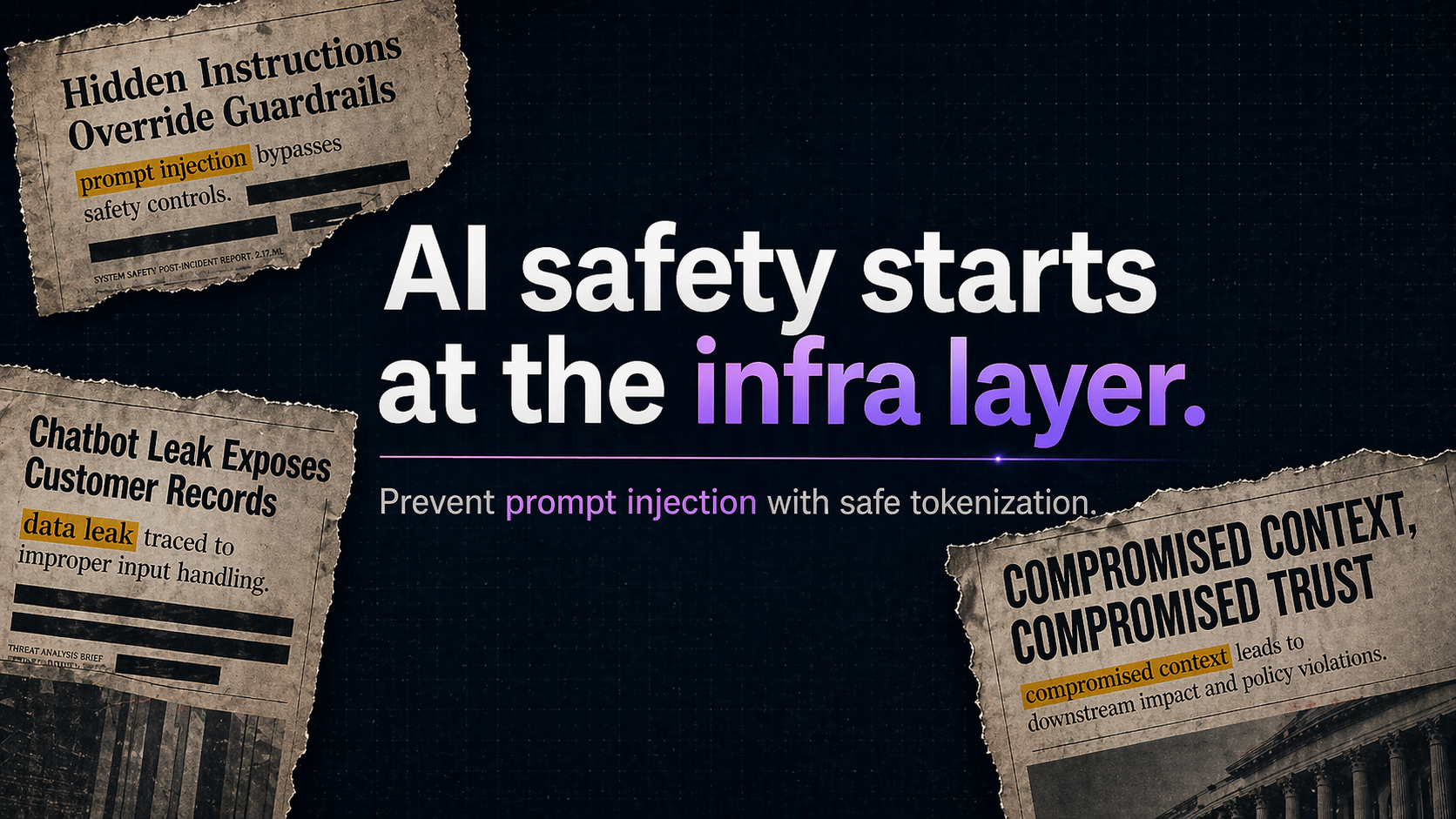
  13. How we fixed prompt injection for all models on Fireworks

    Fireworks AI has developed a new feature called 'safe_tokenization' to prevent prompt injection attacks in large language models. This technique ensures that user input, which can contain malicious control tokens, is treated as data rather than code by the model. By distinguishing between user-provided text and the model's internal control tokens, safe_tokenization maintains the integrity of prompt structures, preventing unauthorized alterations to model behavior. AI

    How we fixed prompt injection for all models on Fireworks

    IMPACT Mitigates a critical security vulnerability in LLM deployments, potentially improving the safety and reliability of AI applications.