PulseAugur / Brief
EN
LIVE 21:41:27

Brief

last 24h
[22/22] 221 sources

Multi-source AI news clustered, deduplicated, and scored 0–100 across authority, cluster strength, headline signal, and time decay.

  1. GLM-4: The Chinese-English Bilingual Workhorse You Didn't Know You Needed

    GLM-4, a bilingual Chinese-English model developed by Tsinghua University and Zhipu AI, is highlighted for its strong performance in handling both languages natively. Optimized for agent workflows and featuring a Mixture of Experts architecture, it offers efficient inference and a long context window of up to 128K tokens. This model is particularly beneficial for developers building tools that require seamless integration of Chinese and English content, unlike many English-centric open-source alternatives. AI

    IMPACT Provides a strong alternative for developers working with both Chinese and English, potentially improving efficiency and reducing costs for multilingual AI applications.

  2. Llama 4: Meta's Latest — Scout, Maverick, and the MoE Revolution

    Meta has released Llama 4 in April 2025, featuring a new Mixture of Experts (MoE) architecture. Two variants, Scout and Maverick, are available, with Scout serving as a balanced default and Maverick offering broader knowledge for specialized tasks. Both models leverage MoE to activate approximately 17 billion parameters per token, enabling high performance comparable to much larger models while remaining runnable on consumer hardware. AI

    IMPACT Sets a new standard for locally runnable large models, potentially accelerating adoption of advanced AI capabilities on consumer hardware.

  3. ZipMoE: Efficient On-Device MoE Serving via Lossless Compression and Cache-Affinity Scheduling

    Researchers have developed ZipMoE, a system designed to make Mixture-of-Experts (MoE) large language models more efficient for on-device deployment. ZipMoE utilizes lossless compression and a cache-affinity scheduling approach to reduce memory footprint and improve inference speed without sacrificing model accuracy. Experiments show significant reductions in latency and increases in throughput on edge devices, shifting the inference bottleneck from I/O to computation. AI

    IMPACT Enables deployment of powerful MoE models on resource-constrained devices, potentially broadening AI accessibility and application scope.

  4. Training

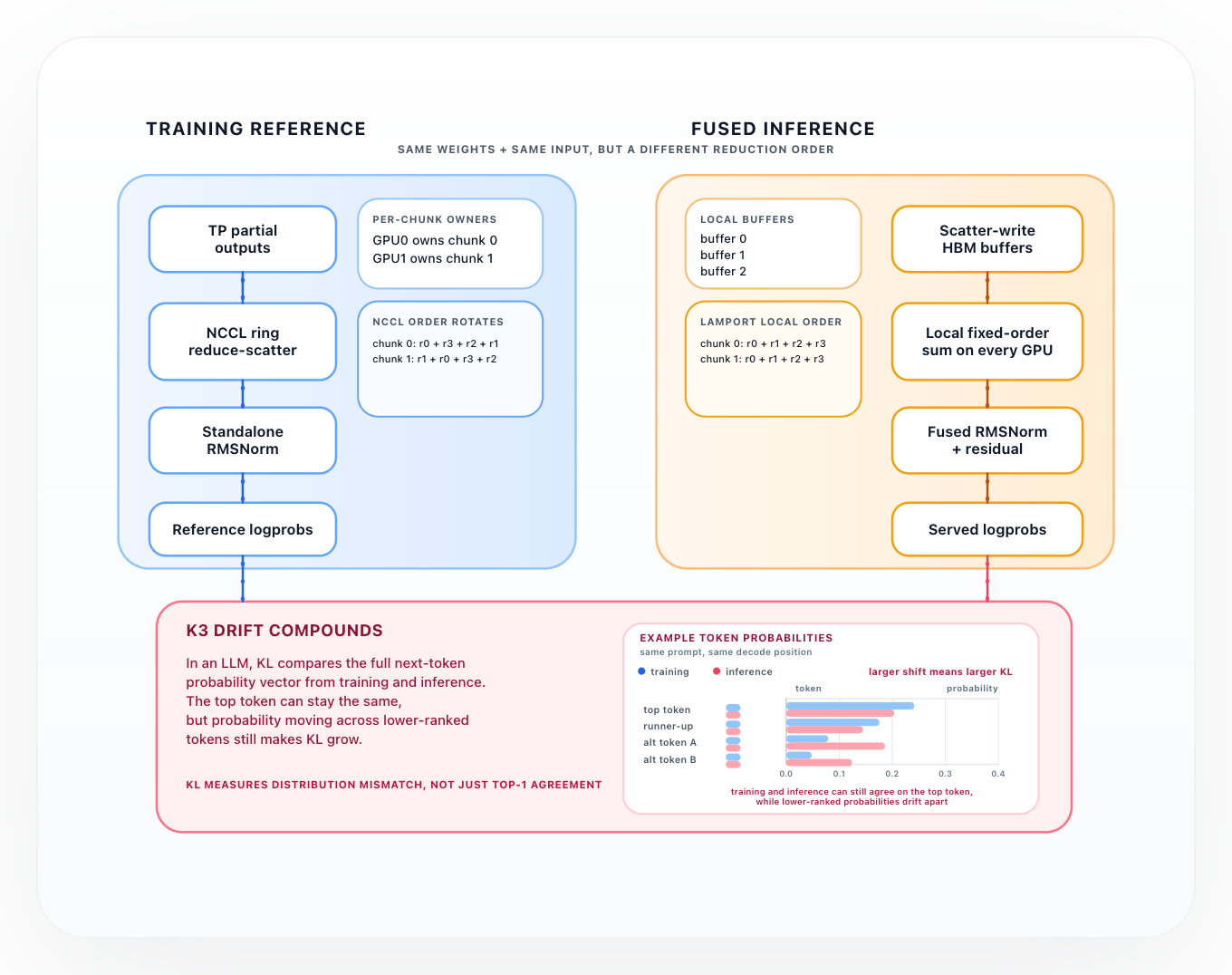
    Fireworks AI has identified critical numerical parity bugs that can arise when training and serving large language models, particularly Mixture-of-Experts (MoE) architectures. These discrepancies, stemming from the non-associative nature of floating-point arithmetic and differing summation orders in distributed training versus inference, can lead to subtle but significant issues. Such drift can compromise the integrity of reinforcement learning from human feedback (RLHF) due to altered log probabilities and erode customer trust in fine-tuned models. AI

    Training

    IMPACT Highlights potential issues in LLM training and serving pipelines that could affect model performance and reliability, especially for MoE architectures.

  5. CHASD: Language Increment-Calibrated Contrastive Decoding against Hallucination in LVLMs

    Researchers have developed a new inference-time framework called CHASd to combat hallucinations in Large Vision-Language Models (LVLMs). This method, Contrastive Hallucination-Aware Step-wise Decoding, selectively activates a contrastive decoding branch only when token prediction confidence is low. It uses localized visual perturbations guided by attention to minimize interference with useful visual evidence, improving hallucination metrics on several benchmarks while maintaining efficient inference. AI

    IMPACT Reduces object hallucinations in vision-language models, improving reliability for multimodal AI applications.

  6. Qwen3-Coder-Next: 80B total, 3B active, 70.6 on SWE-Bench

    Alibaba's Qwen3-Coder-Next, an 80 billion parameter model with 3 billion active parameters, has achieved a 70.6 score on the SWE-Bench Verified benchmark. This performance is notable as it rivals top closed-source models while offering downloadable weights under the Apache 2.0 license. The model employs a sparse Mixture-of-Experts architecture and a hybrid attention mechanism, combining linear attention for long contexts with standard attention for global context reconstruction. AI

    IMPACT Sets a new SOTA for open-source coding models on SWE-Bench, making advanced coding assistance more accessible.

  7. Sparse Efficiency vs. Superposition: The Interpretability Tradeoff

    The human brain's extreme energy efficiency, estimated to be 10,000 times greater than current AI models, is attributed to its sparse and localized processing. While techniques like mixture-of-experts offer a path toward similar efficiency in AI by using specialized sub-networks, they may reduce the benefits of superposition. Superposition, a dense shared representational space, allows neural networks to compress multiple features into the same neurons, contributing to their power but hindering interpretability. The author posits that more segmented architectures could weaken superposition, potentially making AI models easier to inspect and govern, and seeks a balance between efficiency, power, and interpretability. AI

    Sparse Efficiency vs. Superposition: The Interpretability Tradeoff

    IMPACT Explores a fundamental tradeoff between AI model efficiency and interpretability, potentially guiding future architectural and safety research.

  8. OpenAI o3 disproves an Erdős conjecture with 125 pages of reasoning, while OpenAI files for IPO at 850B valuation and Cohere returns with an open-weights MoE mo

    OpenAI's latest model, o3, has reportedly disproven an Erdős conjecture through extensive reasoning. Concurrently, OpenAI is rumored to be preparing for an IPO with a valuation of $850 billion. In related news, Cohere has released a new open-weights Mixture-of-Experts (MoE) model. AI

    IMPACT Potential IPO signals massive market confidence in AI, while new models and research breakthroughs push the frontier.

  9. CP-MoE: Consistency-Preserving Mixture-of-Experts for Continual Learning

    Two new research papers propose novel approaches to continual learning in large language and vision-language models, aiming to mitigate catastrophic forgetting. CP-MoE introduces a transient expert to guide updates and preserve knowledge, while MoRAM utilizes fine-grained rank-1 adapters as memory units to enable content-addressable retrieval. Both methods demonstrate improved performance on benchmarks, offering better trade-offs between plasticity and stability compared to existing Mixture-of-Experts techniques. AI

    IMPACT These papers introduce novel techniques for continual learning, potentially improving the ability of large models to adapt to new information without forgetting previous knowledge.

  10. Sustainability Is Not Linear: Quantifying Performance, Energy, and Privacy Trade-offs in On-Device Intelligence

    A new research paper explores the trade-offs between performance, energy consumption, and privacy when running large language models on mobile devices. The study developed an experimental pipeline to measure these factors on an Android device, testing eight LLMs. Findings indicate that model architecture, rather than quantization, is key for energy efficiency, with Mixture-of-Experts models showing promise for balancing storage and power usage. AI

    IMPACT Quantifies the energy and performance costs of running LLMs on edge devices, guiding future model optimization for mobile deployment.

  11. FAME: Failure-Aware Mixture-of-Experts for Message-Level Log Anomaly Detection

    Researchers have developed FAME, a novel framework for message-level log anomaly detection that significantly reduces the need for manual labeling. This system utilizes a Mixture-of-Experts approach, employing large language models offline to partition log templates into failure domains. FAME trains lightweight routers and domain experts that can be run on-premise, achieving high F1 scores on benchmark datasets like BGL and Thunderbird while drastically cutting down annotation effort. AI

    IMPACT Enables more efficient and precise anomaly detection in production systems by reducing reliance on extensive manual labeling.

  12. HDMoE: A Hierarchical Decoupling-Fusion Mixture-of-Experts Framework for Multimodal Cancer Survival Prediction

    Researchers have developed a new framework called HDMoE to improve multimodal cancer survival prediction. This hierarchical decoupling-fusion mixture-of-experts approach aims to better integrate data from sources like whole slide images and genomic profiles. The framework addresses limitations in existing methods by reducing redundant information before feature decoupling and by modeling fine-grained relationships within and between modalities. AI

    HDMoE: A Hierarchical Decoupling-Fusion Mixture-of-Experts Framework for Multimodal Cancer Survival Prediction

    IMPACT Introduces a novel framework for integrating diverse medical data, potentially improving diagnostic accuracy and patient outcomes in oncology.

  13. FedCoE: Bridging Generalization and Personalization via Federated Coordinated Dual-level MoEs

    Researchers have introduced FedCoE, a novel framework for Federated Learning that aims to balance global generalization with local personalization. Unlike traditional methods that struggle with non-IID data or overfit to local information, FedCoE utilizes a dual-level Mixture-of-Experts approach. This system maintains independent global expert models and uses a shared gating network to manage client-expert correlations, preventing expert drift. FedCoE also includes an adaptive mechanism to help new clients quickly utilize global experts without extensive local training, showing significant accuracy improvements in both general and cold-start scenarios. AI

    IMPACT Introduces a new method to improve federated learning performance, potentially enabling more robust and personalized AI models in distributed environments.

  14. Quantifying Hyperparameter Transfer and the Importance of Embedding Layer Learning Rate

    Researchers have developed new methods for hyperparameter transfer, enabling more efficient scaling of large neural networks. One paper introduces a parameterization justified by dynamical mean-field theory, allowing reliable hyperparameter transfer across models ranging from 51 million to over 2 billion parameters. Another study quantifies hyperparameter transfer and highlights the critical role of the embedding layer's learning rate, suggesting that maximizing it can significantly improve training stability and performance, particularly when using the AdamW optimizer. AI

    IMPACT New parameterization and optimization techniques could significantly reduce the cost and complexity of training large-scale AI models.

  15. Diagnosing Overhead in Dispatch Operations: Cross-architecture Observatory

    A new research paper introduces DODOCO, a tool designed to diagnose overhead in dispatch operations for Mixture-of-Experts (MoE) models. The study found that common assumptions about workload representation in benchmarks and the correctability of routing imbalance by system layers are flawed. The research highlights that model architecture, rather than expert parallelism degree, is the primary factor determining performance bands. AI

    Diagnosing Overhead in Dispatch Operations: Cross-architecture Observatory

    IMPACT Reveals critical limitations in current MoE benchmarking, potentially guiding future interconnect and dispatch design for more accurate performance prediction.

  16. Beyond Routing: Characterising Expert Tuning and Representation in Vision Mixture-of-Experts

    Researchers have developed new methods to analyze the internal workings of Mixture-of-Experts (MoE) models in computer vision. Their work moves beyond simply examining how data is routed to specific "experts" within the model, instead focusing on what each expert actually encodes. The study found that an animate-inanimate distinction is a primary factor in how experts are partitioned, and this specialization is stable across different model initializations. AI

    Beyond Routing: Characterising Expert Tuning and Representation in Vision Mixture-of-Experts

    IMPACT Provides deeper insights into the internal representations of vision MoE models, potentially leading to more interpretable and robust AI systems.

  17. FPED: A Functional-Network Prior-Guided Mixture-of-Experts Framework for Interpretable Brain Decoding

    Researchers have developed FPED, a novel Mixture-of-Experts (MoE) framework designed for interpretable brain decoding using fMRI data. This approach explicitly models different functional brain networks as specialized experts, utilizing adaptive routing to capture their combined contributions to visual semantic understanding. FPED aims to overcome limitations of current methods that flatten fMRI signals, thereby disrupting the brain's natural network topology and reducing neuroscientific interpretability. The framework demonstrates competitive performance with a small parameter count and offers transparent insights into the correspondence between brain networks and semantic processing. AI

    FPED: A Functional-Network Prior-Guided Mixture-of-Experts Framework for Interpretable Brain Decoding

    IMPACT Introduces a novel framework for brain decoding that could bridge neural decoding and biologically inspired AI.

  18. Dynamic TMoE: A Drift-Aware Dynamic Mixture of Experts Framework for Non-Stationary Time Series Forecasting

    Researchers have developed Dynamic TMoE, a novel framework designed to improve non-stationary time series forecasting. This approach addresses the limitations of existing Mixture-of-Experts (MoE) models by dynamically adjusting the expert pool and incorporating temporal memory for routing. The system detects distribution shifts using Maximum Mean Discrepancy (MMD) to instantiate and prune experts, optimizing model capacity. Experiments show Dynamic TMoE achieves state-of-the-art results, significantly reducing Mean Squared Error (MSE) and Mean Absolute Error (MAE) across nine benchmarks. AI

    Dynamic TMoE: A Drift-Aware Dynamic Mixture of Experts Framework for Non-Stationary Time Series Forecasting

    IMPACT Enhances time series forecasting capabilities, potentially improving applications in finance, weather, and demand prediction.

  19. SpikingMoE: SDPrompt-Guided Dynamic Expert Fusion in Spiking Neural Networks

    Researchers have introduced SpikingMoE, a novel framework that combines Spiking Neural Networks (SNNs) with a Mixture-of-Experts (MoE) architecture. This approach utilizes a spike-driven prompt (SDprompt) for biologically plausible, input-dependent routing of information to different expert modules. Designed for neuromorphic hardware, SpikingMoE aims to enhance energy efficiency in visual recognition tasks while maintaining competitive performance, achieving high accuracy on CIFAR-10 and CIFAR-100 datasets. AI

    IMPACT Introduces a new architecture for energy-efficient visual recognition on neuromorphic hardware, potentially impacting specialized AI applications.

  20. Qwen3.6-27B: Flagship-Level Coding in a 27B Dense Model

    Qwen has released Qwen3.6-27B, a dense 27-billion-parameter multimodal model designed for advanced coding tasks. This model aims to provide flagship-level agentic coding performance, surpassing previous open-source models in this category. Various community members have already made different quantized versions of Qwen3.6-27B available on Hugging Face, facilitating its use across different platforms and libraries. AI

    Qwen3.6-27B: Flagship-Level Coding in a 27B Dense Model

    IMPACT Sets a new benchmark for dense coding models, potentially influencing future development in agentic AI and code generation.

  21. DeepSeek-V4 Pro now available on Together AI

    DeepSeek-V4 Pro, a large Mixture-of-Experts model with 1.6 trillion parameters, is now accessible on the Together AI platform. This model is designed for long-context reasoning, supporting up to a 512K-token context window in its initial Together AI deployment, with plans for a 1M-token context window. It features controllable reasoning modes to optimize for speed or depth and offers specialized pricing for cached input tokens to reduce costs on repeated queries. AI

    IMPACT Enables new applications requiring reasoning over extensive datasets, potentially lowering costs for repeated long-context queries.

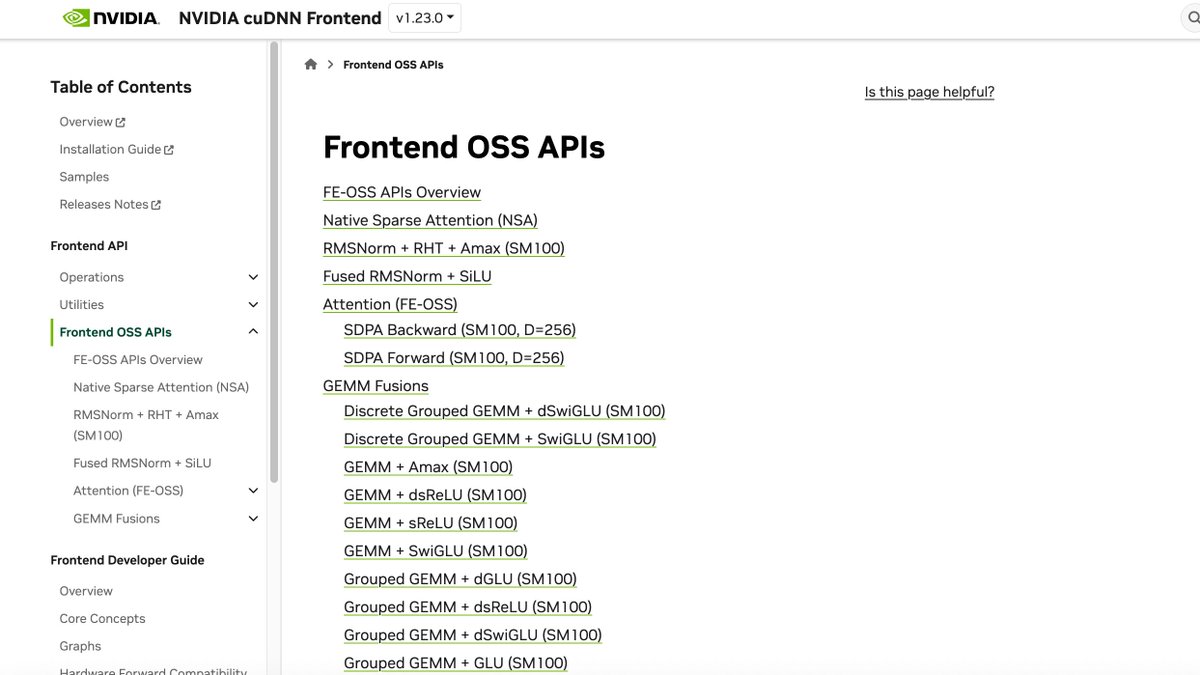
  22. @manicely6005 The public documentation can be found here too (3/3)

    NVIDIA has open-sourced parts of its cuDNN library, a significant move after 12 years of it being closed-source. This release includes over 20 Mixture-of-Experts (MoE) kernels and NSA sparse attention kernels. The codebase for these kernels is largely written in Python CuTe-DSL, with public documentation now available. AI

    @manicely6005 The public documentation can be found here too (3/3)

    IMPACT Open-sourcing of cuDNN kernels could accelerate research and development in AI infrastructure and model optimization.