PulseAugur / Brief
EN
LIVE 22:08:29

Brief

last 24h
[23/23] 221 sources

Multi-source AI news clustered, deduplicated, and scored 0–100 across authority, cluster strength, headline signal, and time decay.

  1. Cost accounting for diffusion image generation at $0.0008 per render

    Photoroom significantly reduced its image generation costs by optimizing its diffusion pipeline. The company achieved a 39% cost reduction on the UNet denoising stage through int8 quantization and a 79% reduction in text-encoder costs by caching LLM embeddings. Implementing an AI gateway with Bifrost further decreased caption API spend by 61% and improved latency, while also mitigating costs associated with upstream LLM outages. AI

    IMPACT Demonstrates significant cost-saving strategies for AI-driven image generation services, potentially lowering operational expenses for similar products.
  2. Low-Cost Hard-Label Adversarial Attack with Theoretical Foundations

    Researchers have developed a new framework for adversarial attacks on AI models, focusing on hard-label black-box scenarios where only the top prediction is accessible. Their approach introduces a novel zero-query initialization strategy and a Pattern-Driven Optimization algorithm, grounded in theoretical analysis that links existing methods to gradient sign approximation. This method demonstrates superior efficiency and success rates compared to state-of-the-art attacks across various datasets and model types, including commercial APIs and CLIP models, while also showing robustness against data corruption and specialized tasks like segmentation. AI

    IMPACT This research introduces a more efficient and theoretically grounded method for adversarial attacks, potentially impacting AI model security and robustness testing.

  3. Semantic-Aware Guided Drone Exploration for Language-Conditioned 3D Indoor Mapping

    Researchers have developed a new system called SAGE for drones to explore and map unknown indoor environments. SAGE integrates language understanding using CLIP to prioritize the discovery of specific objects while still ensuring complete coverage of the area. In simulations, SAGE significantly outperformed previous methods in object discovery speed and overall exploration efficiency. The system has also been successfully deployed in real-world drone flights, demonstrating its practical application in mapping and object identification. AI

    IMPACT Enables drones to explore and map indoor environments more efficiently by understanding natural language commands for object discovery.

  4. On the Provable Importance of Gradients for Language-Assisted Image Clustering

    Researchers have developed a new gradient-based framework called GradNorm to improve language-assisted image clustering. This method theoretically guarantees better separability of positive nouns, which are crucial for accurately clustering images when true class names are unavailable. GradNorm is shown to outperform existing filtering strategies and achieve state-of-the-art clustering performance on various benchmarks. AI

    IMPACT Introduces a theoretically grounded method to improve image clustering accuracy by better leveraging textual semantics.

  5. Spatio-Temporal Similarity Volume Aggregation for Open-Vocabulary Action Recognition

    Researchers have developed a new framework called Similarity Volume Aggregation (SimVA) for open-vocabulary action recognition in videos. This method constructs a dense 4D spatio-temporal similarity volume from patch-level visual-text similarities, preserving local details often lost in global aggregation methods. SimVA refines this volume through spatial and motion-aware modulation, and uses Mamba-based temporal aggregation to model evolving patterns, effectively transferring CLIP's capabilities to video analysis. AI

    IMPACT This new framework could improve the accuracy and granularity of AI systems understanding actions in videos, enabling more sophisticated video analysis applications.

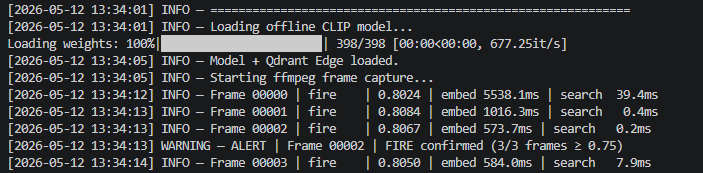
  6. Fire Detection Without Training a Model? Edge RAG Does It Better

    A new approach to fire detection on factory floors bypasses traditional model training by utilizing a retrieval-based system. This method, inspired by Retrieval-Augmented Generation (RAG) in NLP, employs CLIP embeddings and an on-device vector database to identify potential fires. The system processes frames at 5 FPS with sub-200ms latency, running on edge devices without GPUs, and avoids the common pitfalls of domain shift and frequent retraining associated with conventional computer vision models in industrial settings. AI

    Fire Detection Without Training a Model? Edge RAG Does It Better

    IMPACT This retrieval-based approach could offer a more adaptable and efficient alternative to traditional training for specialized visual recognition tasks in dynamic environments.

  7. CP-MoE: Consistency-Preserving Mixture-of-Experts for Continual Learning

    Two new research papers propose novel approaches to continual learning in large language and vision-language models, aiming to mitigate catastrophic forgetting. CP-MoE introduces a transient expert to guide updates and preserve knowledge, while MoRAM utilizes fine-grained rank-1 adapters as memory units to enable content-addressable retrieval. Both methods demonstrate improved performance on benchmarks, offering better trade-offs between plasticity and stability compared to existing Mixture-of-Experts techniques. AI

    IMPACT These papers introduce novel techniques for continual learning, potentially improving the ability of large models to adapt to new information without forgetting previous knowledge.

  8. Not What You Asked For: Typographic Attacks in Household Robot Manipulation

    Researchers have demonstrated a new vulnerability in household robots that use vision-language models for object recognition. By placing specially designed stickers with text, attackers can trick the robots into misidentifying objects and performing incorrect actions, such as grasping the wrong item. This "typographic attack" exploits the shared embedding space of models like CLIP, leading to physical manipulation errors that were previously unexamined in full robot pipelines. AI

    Not What You Asked For: Typographic Attacks in Household Robot Manipulation

    IMPACT Highlights a novel security threat to embodied AI agents, potentially impacting the safety and reliability of future household robots.

  9. Multimodal Optimal Transport for Training-free Temporal Segmentation in Surgical Robotics

    Researchers have developed a new annotation-free framework called TASOT for temporal segmentation in surgical robotics. This method leverages multimodal optimal transport, combining visual data from DINOv3 with textual descriptions generated by a vision-language model encoded via CLIP. TASOT aims to improve surgical phase recognition without requiring extensive labeled datasets or domain-specific pretraining, offering a more practical solution for diverse clinical settings. AI

    IMPACT Enables more practical deployment of AI for surgical workflow understanding by removing annotation bottlenecks.

  10. Not All Starting Points Are Equal: Pre-trained Priors and Their Outsized Impact on Person Identification

    A new research paper explores the significant impact of pre-trained models on person identification tasks in computer vision. The study demonstrates that different starting models, even with identical adaptation pipelines, yield vastly different results in person re-identification. Researchers propose that pre-trained weights act as a strong prior, influencing the final model's performance and suggesting that large foundation models like CLIP and DINO, when fine-tuned, can achieve state-of-the-art results with simple adaptation methods. AI

    IMPACT Demonstrates how pre-trained vision models serve as crucial priors, influencing downstream person identification performance and setting new baselines.

  11. CADENet: Condition-Adaptive Asynchronous Dual-Stream Enhancement Network for Adverse Weather Perception in Autonomous Driving

    Researchers have developed CADENet, a novel system designed to improve object detection for autonomous vehicles operating in adverse weather conditions like rain, fog, and snow. This system employs a three-thread approach that enhances image quality without introducing latency, crucial for real-time safety requirements. CADENet utilizes condition-adaptive enhancement and CLIP zero-shot weather classification, allowing it to adapt to new weather types without retraining. AI

    CADENet: Condition-Adaptive Asynchronous Dual-Stream Enhancement Network for Adverse Weather Perception in Autonomous Driving

    IMPACT Enhances perception systems for autonomous vehicles, potentially improving safety in challenging weather conditions.

  12. SAS: Semantic-aware Sampling for Generative Dataset Distillation

    Researchers have developed a new method called Semantic-aware Sampling (SAS) for dataset distillation, a technique that creates smaller, more informative datasets for training deep neural networks. Unlike previous methods that focused on data distribution or training statistics, SAS incorporates high-level semantic information using CLIP as a prior. The approach uses scoring functions to ensure class relevance, inter-class separability, and intra-set diversity, leading to more discriminative and varied distilled datasets. Experiments show that SAS consistently improves downstream model performance across various datasets and training setups. AI

    SAS: Semantic-aware Sampling for Generative Dataset Distillation

    IMPACT Improves efficiency of training deep neural networks by creating more informative, compact datasets.

  13. PERL: Parameter Efficient Reasoning in CLIP Latent Space

    Researchers have developed PERL, a novel framework for adapting vision-language models like CLIP to new tasks without significantly increasing parameter count. PERL employs iterative reasoning within the model's latent space, progressively refining representations through a compact reasoning module. This approach achieves a superior parameter-performance trade-off on numerous benchmarks, demonstrating strong accuracy with a minimal number of trainable parameters. AI

    PERL: Parameter Efficient Reasoning in CLIP Latent Space

    IMPACT Offers a more efficient method for adapting large vision-language models to new tasks, potentially reducing computational costs and improving performance on specialized applications.

  14. FGSVQA: Frequency-Guided Short-form Video Quality Assessment

    Two new research papers introduce novel approaches to video quality assessment (VQA). One paper, VersusQ, proposes a pairwise margin reasoning framework that focuses on relative video comparisons to improve generalization across different datasets. The other, FGSVQA, presents an end-to-end framework for short-form video quality assessment that incorporates frequency domain priors and a dense visual encoder for artifact-aware feature aggregation. AI

    FGSVQA: Frequency-Guided Short-form Video Quality Assessment

    IMPACT These new VQA methods aim to improve the accuracy and generalizability of automated video quality evaluation, which is crucial for content moderation and user experience in video platforms.

  15. LaCoVL-FER: Landmark-Guided Contrastive Learning Network with Vision-Language Enhancement for Facial Expression Recognition

    Researchers have developed a new network called LaCoVL-FER to improve facial expression recognition, particularly in challenging real-world conditions. This model integrates geometric information from facial landmarks with semantic understanding from a vision-language model like CLIP. The approach uses a landmark-guided encoder for adaptive feature fusion and a vision-language enhancement strategy to refine visual representations and adapt textual prompts, leading to more robust and generalized expression recognition. AI

    LaCoVL-FER: Landmark-Guided Contrastive Learning Network with Vision-Language Enhancement for Facial Expression Recognition

    IMPACT Introduces a novel architecture for facial expression recognition, potentially improving accuracy in complex, real-world scenarios.

  16. Tango3D: Towards Alignment for Global and Local 2D-3D Correspondence

    Researchers have introduced Tango3D, a novel foundation model designed to bridge the gap between 2D images and 3D point clouds. Unlike previous models that focus on global alignment, Tango3D establishes both fine-grained pixel-to-point correspondence and broader semantic alignment. This is achieved by encoding images into 2D patches and point clouds into 3D tokens within a shared space, utilizing a geometry-aware backbone and a pretrained 3D VAE. The model employs a progressive training strategy to balance dense and global objectives, enabling a wide array of downstream 3D applications. AI

    Tango3D: Towards Alignment for Global and Local 2D-3D Correspondence

    IMPACT Enables richer semantic understanding and a wider range of downstream applications for 3D data by establishing detailed pixel-to-point alignment.

  17. FPED: A Functional-Network Prior-Guided Mixture-of-Experts Framework for Interpretable Brain Decoding

    Researchers have developed FPED, a novel Mixture-of-Experts (MoE) framework designed for interpretable brain decoding using fMRI data. This approach explicitly models different functional brain networks as specialized experts, utilizing adaptive routing to capture their combined contributions to visual semantic understanding. FPED aims to overcome limitations of current methods that flatten fMRI signals, thereby disrupting the brain's natural network topology and reducing neuroscientific interpretability. The framework demonstrates competitive performance with a small parameter count and offers transparent insights into the correspondence between brain networks and semantic processing. AI

    FPED: A Functional-Network Prior-Guided Mixture-of-Experts Framework for Interpretable Brain Decoding

    IMPACT Introduces a novel framework for brain decoding that could bridge neural decoding and biologically inspired AI.

  18. LatentUMM: Dual Latent Alignment for Unified Multimodal Models

    Researchers have developed new frameworks to improve multimodal alignment in AI models, aiming to enhance how different data types like text, images, and audio are understood and generated together. CodeBind introduces a compositional codebook design that separates shared and modality-specific features, achieving state-of-the-art results across nine modalities. LatentUMM focuses on aligning the transformations into and out of a shared latent space to prevent semantic drift during cross-modal transitions. GOMA leverages multimodal attributed graphs and graph signal smoothing to refine existing embeddings, demonstrating improved retrieval performance and stability. AI

    LatentUMM: Dual Latent Alignment for Unified Multimodal Models

    IMPACT These advancements in multimodal alignment could lead to more robust and versatile AI systems capable of better understanding and generating content across various data types.

  19. NeighborDiv: Training-free Zero-shot Generalist Graph Anomaly Detection via Neighbor Diversity

    Two new research papers introduce novel approaches to generalist anomaly detection. NeighborDiv focuses on graph data, proposing a training-free method that analyzes the diversity within a node's neighbors rather than node-to-neighbor consistency, achieving state-of-the-art results. Res$^2$CLIP tackles few-shot generalist anomaly detection by aligning multimodal representations within a residual space, aiming to improve generalization across novel categories without retraining. AI

    NeighborDiv: Training-free Zero-shot Generalist Graph Anomaly Detection via Neighbor Diversity

    IMPACT Introduces new techniques for anomaly detection, potentially improving performance and generalization in various applications.

  20. Capability $\neq$ Interpretability: Human Interpretability of Vision Foundation Models

    Researchers have developed a new framework to measure the human interpretability of vision foundation models. This framework uses two protocols: localizability, which assesses an observer's ability to predict where a feature fires on an image, and nameability, which evaluates how accurately an observer can describe what a feature represents. When applied to six vision transformers, including DINOv2, DINOv3, CLIP, and SigLIP, the study found that foundation models are consistently less interpretable than supervised models, and this difference is not due to a capability tradeoff. AI

    IMPACT Establishes interpretability as a measurable dimension of representation quality, suggesting a new focus for model development beyond raw capability.

  21. Vector RAG vs LLM-Compiled Wiki: A Preregistered Comparison on a Small Multi-Domain Research

    A new research paper compares Vector Retrieval-Augmented Generation (RAG) against an LLM-compiled wiki for answering questions over a small corpus of 24 research papers. While the wiki excelled at synthesizing information across multiple documents, RAG performed better on single-fact lookups and overall groundedness. Exploratory analyses revealed the wiki offered stronger claim-level citation support, but a modified RAG approach could match the wiki's cross-paper synthesis capabilities at a lower cost. The study concludes that effective research synthesis involves distinct capabilities like evidence organization, citation accuracy, and cost-efficiency, with no single architecture excelling in all areas. AI

    Vector RAG vs LLM-Compiled Wiki: A Preregistered Comparison on a Small Multi-Domain Research

    IMPACT Compares RAG and LLM-compiled wikis for research synthesis, highlighting trade-offs in cost, accuracy, and synthesis capabilities.

  22. Dual-Prompt CLIP with Hybrid Visual Encoders for Occluded Person Re-Identification

    Researchers have developed a new Dual Prompt Learning ReID (DPL-ReID) model to improve person re-identification in scenarios with occlusions. This model leverages CLIP's capabilities by incorporating dual prompts to capture complete pedestrian semantics and maintain robustness against partial visibility. Additionally, it uses a Real-World Occlusion Augmentation method to simulate realistic occlusion scenarios and a Weighted Gated Feature Fusion mechanism to enhance feature representations, achieving state-of-the-art performance on benchmark datasets. AI

    IMPACT Enhances person re-identification accuracy in challenging, occluded scenarios, potentially improving surveillance and security systems.

  23. Custom image encoder [P]

    A user on Reddit is seeking advice on whether to build a custom image encoder for video frame classification or use existing models like CLIP or DINO. Their primary goals are to improve processing speed and enable deployment on low-power, CPU-only devices. The user plans to train their custom encoder on a dataset of a few million images with a few million parameters, aiming for better performance than current CLIP-based encoders on their specific task. AI