PulseAugur / Brief
EN
LIVE 23:48:22

Brief

last 24h
[21/21] 221 sources

Multi-source AI news clustered, deduplicated, and scored 0–100 across authority, cluster strength, headline signal, and time decay.

  1. Sliding Windows Forget: Why Long-Running LLM Apps Need Memory Policy

    A new prototype called LLM-Context-Optimization-Engine has been developed to address failures in long-running Large Language Model applications. These failures often stem from selecting the wrong context, rather than pure reasoning errors. The engine benchmarks various context selection policies, including sliding windows, full history, and retrieval methods, to determine which pieces of prior state are most relevant for the next model call. An importance-based selection policy demonstrated a high retention rate of critical facts within a limited budget, highlighting the need for memory policies over simple memory storage in persistent LLM applications. AI
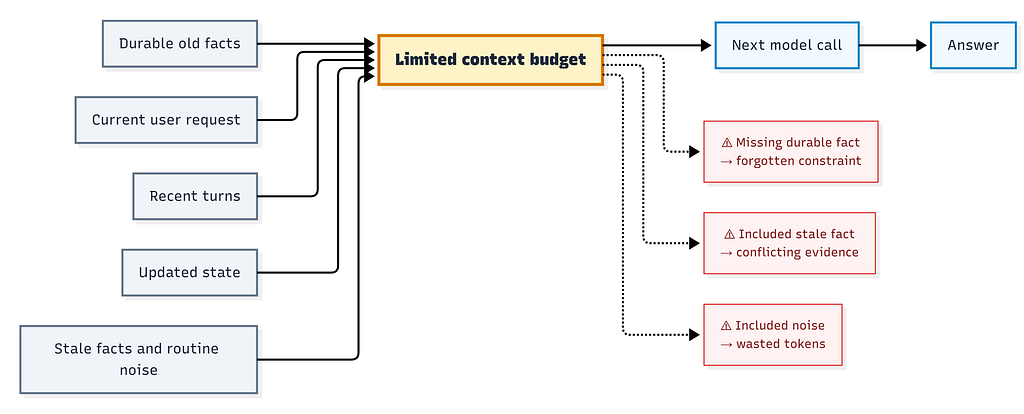
    Sliding Windows Forget: Why Long-Running LLM Apps Need Memory Policy

    IMPACT Highlights the need for sophisticated memory policies in LLM applications to manage context effectively, crucial for agent development.

  2. OnePred: Next-Query Prediction via Recursive Intent Memory in Multi-Turn Conversations

    Researchers have developed OnePred, a novel system designed to predict the next user query in multi-turn conversations with large language models. This approach aims to move beyond reactive AI by anticipating user needs without requiring full dialogue history, thus reducing token consumption. OnePred utilizes a recursively updated memory to track evolving user intent, achieving significant efficiency gains and improved prediction quality, particularly in longer conversations. AI

    IMPACT Enhances conversational AI by enabling proactive responses and reducing computational costs, potentially leading to more fluid and efficient user interactions.

  3. How to Evaluate LLM Output Quality Programmatically

    This article outlines a practical, multi-layered framework for programmatically evaluating the quality of Large Language Model (LLM) outputs. It emphasizes defining specific quality dimensions such as correctness, format compliance, safety, and consistency based on the use case. The framework includes deterministic checks for immediate failure detection and semantic similarity measures using sentence embeddings for free-form text evaluation. AI

    IMPACT Provides a practical framework for developers to ensure the quality and reliability of LLM integrations in production environments.

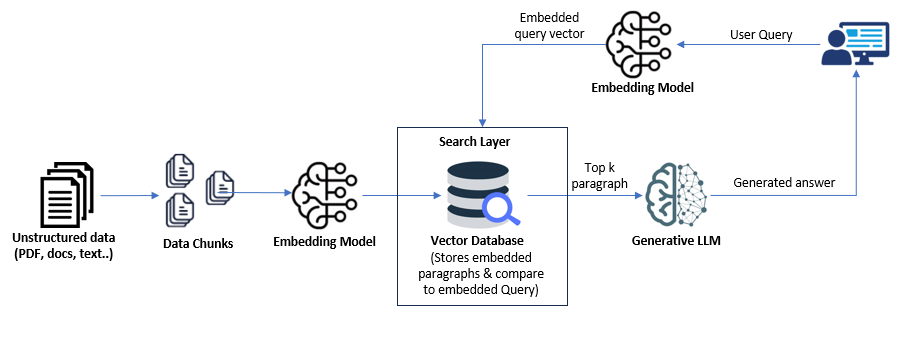
  4. Building a Cross-Cloud RAG Workflow with ChromaDB on Azure and AWS

    This article details how to build a cross-cloud Retrieval-Augmented Generation (RAG) workflow using ChromaDB, a vector database, across Azure and AWS. It focuses on enhancing Large Language Model (LLM) capabilities by integrating external data sources. The guide aims to provide practical steps for developers looking to implement such a system in a multi-cloud environment. AI

    Building a Cross-Cloud RAG Workflow with ChromaDB on Azure and AWS

    IMPACT Provides a technical guide for developers on integrating LLMs with external data via RAG in a multi-cloud setup.

  5. AI Inside the Monolith: Delivering a Lightweight, Modern UI for Oracle EBS with Zero Core Rewrite

    A new architectural approach has been developed to integrate generative AI with monolithic enterprise systems like Oracle E-Business Suite (EBS) without altering the core legacy code. This method involves creating a lightweight semantic layer that acts as a plugin, translating complex technical data structures into understandable business terms for AI models. This abstraction layer prevents AI hallucinations and ensures accurate data interpretation, even in heavily customized environments, by operating on virtual data marts instead of direct database access. AI

    AI Inside the Monolith: Delivering a Lightweight, Modern UI for Oracle EBS with Zero Core Rewrite

    IMPACT Enables AI integration with legacy enterprise systems, potentially unlocking new analytical capabilities without costly system overhauls.

  6. Three RAG failures that look like model problems but aren't

    This article discusses three common failures in Retrieval-Augmented Generation (RAG) systems that are often misattributed to the underlying large language model (LLM). It highlights issues such as incorrect chunking strategies, ineffective prompt engineering, and problems with the retrieval mechanism itself. The author emphasizes that optimizing these components is crucial for improving RAG performance, rather than solely focusing on the LLM. AI

    IMPACT Addresses common pitfalls in RAG implementation, guiding developers to optimize retrieval and prompting for better AI application performance.

  7. Turning LLM Outputs Into Production Systems

    This article details the practical steps and considerations required to transition a Large Language Model (LLM) demonstration into a reliable production system. It emphasizes the challenges and necessary infrastructure beyond initial impressive outputs, focusing on building trust and robustness for real-world applications. The piece likely covers aspects of MLOps tailored for LLMs, ensuring their outputs are consistently usable and dependable in a business context. AI

    Turning LLM Outputs Into Production Systems

    IMPACT Provides practical guidance for deploying and managing LLMs in production environments, crucial for operationalizing AI.

  8. LEAP: A closed-loop framework for perovskite precursor additive discovery

    Researchers have developed LEAP, a closed-loop framework that uses a domain-specific large language model combined with active learning to discover additives for perovskite solar cells. This LLM is trained to extract knowledge from scientific literature and represent molecules, which then informs a Bayesian optimization process for prioritizing additives. Experimental validation showed improved additive prioritization, leading to higher power conversion efficiencies in perovskite devices. AI

    IMPACT Introduces a novel LLM-driven framework for accelerating materials discovery in photovoltaics.

  9. An Entity Linking Agent for Question Answering

    Researchers have developed a new entity linking agent designed to improve question answering systems by more effectively connecting natural language mentions to knowledge base entries. This agent, built upon a large language model, mimics human cognitive processes to identify entity mentions, retrieve candidates, and make linking decisions. Experiments demonstrated the agent's robustness and effectiveness in both tool-based entity linking and overall question answering tasks. AI

    IMPACT Improves accuracy in question-answering systems by enhancing the critical entity linking step.

  10. Scene Abstraction for Lexical Semantics: Structured Representations of Situated Meaning

    Researchers have developed a framework called Scene Abstraction to represent the situated meaning of words, moving beyond simple property-based definitions. This approach uses few-shot prompting of large language models to create structured representations of interpretive scenes, including contextual elements and expression profiles. The framework was validated with a new dataset, COCA-Scenes, and demonstrated improved accuracy in identifying word-contextual scenes compared to existing methods. AI

    IMPACT This research could lead to more nuanced and context-aware language models, improving their understanding of subtle word meanings and affective associations.

  11. Direct content-based retrieval from music scores images

    Researchers have developed new methods for content-based retrieval of music scores, moving beyond traditional metadata searches. The study explores characteristics relevant for search and proposes systematic ways to build query datasets. Experiments compare transcription-based Optical Music Recognition (OMR) with transcription-free Transformer and Large Language Models, finding OMR excels in-domain while transcription-free models handle variability better. AI

    IMPACT Introduces novel approaches for searching visual music data, potentially improving accessibility for musicians and researchers.

  12. AutoRPA: Efficient GUI Automation through LLM-Driven Code Synthesis from Interactions

    Researchers have developed AutoRPA, a framework that converts the decision logic of LLM-based agents into efficient Robotic Process Automation (RPA) functions. This approach addresses the inefficiency of repeatedly invoking LLM reasoning for repetitive GUI tasks. AutoRPA utilizes a translator-builder pipeline and a hybrid repair strategy to synthesize robust RPA functions, significantly improving runtime efficiency and reusability while drastically reducing token usage. AI

    AutoRPA: Efficient GUI Automation through LLM-Driven Code Synthesis from Interactions

    IMPACT Automates repetitive GUI tasks by converting LLM decision logic into efficient RPA, reducing token usage and improving runtime.

  13. VBFDD-Agent for Electric Vehicle Battery Fault Detection and Diagnosis: Descriptive Text Modeling of Battery Digital Signals

    Researchers have developed VBFDD-Agent, an AI system designed to improve fault detection and diagnosis for electric vehicle batteries. This agent transforms raw battery data into natural language descriptions, creating a corpus for better understanding and maintenance. By integrating this corpus with maintenance manuals and LLM reasoning, VBFDD-Agent provides structured diagnostic results and actionable recommendations, enhancing safety and reliability. AI

    VBFDD-Agent for Electric Vehicle Battery Fault Detection and Diagnosis: Descriptive Text Modeling of Battery Digital Signals

    IMPACT Enhances EV battery safety and maintenance through AI-driven text analysis and decision support.

  14. Advanced AI Service Provisioning in O-RAN through LLM Engine Integration

    Researchers have developed a Dual-Brain architecture to integrate Large Language Models (LLMs) into Open Radio Access Network (O-RAN) systems. This approach uses an LLM-based orchestrator for intent translation and code generation, coupled with an automated ML engine called NeuralSmith for on-demand model training. The system aims to streamline the creation and deployment of AI applications within O-RAN, addressing the current manual and slow processes. AI

    IMPACT Streamlines AI integration in telecommunications infrastructure, potentially accelerating 5G and future network advancements.

  15. TPMM-DPO: Trajectory-aware Preference-guided Model Merging for Iterative Direct Preference Optimization

    Researchers have introduced TPMM-DPO, a novel method for aligning large language models that addresses issues of error accumulation in iterative Direct Preference Optimization. This new approach treats the sequence of policy models as an optimization trajectory, adaptively merging them with learned weights to create a more stable and robust reference model. Experiments demonstrate that TPMM-DPO significantly improves generation quality and performance, outperforming standard iterative DPO by mitigating degradation in later training stages. AI

    IMPACT Improves LLM alignment stability and performance by mitigating error accumulation in iterative training.

  16. Revisiting the Adam-SGD Gap in LLM Pre-Training: The Role of Large Effective Learning Rates

    New research explores methods to improve Large Language Model (LLM) training efficiency and effectiveness. One study challenges the necessity of a strong teacher model in knowledge distillation, finding that even smaller teachers can benefit larger students with proper loss mixing. Another paper introduces "Introspective Training" (IXT), which uses feedback-conditioned data to improve scaling and performance across all LLM training stages, leading to significant compute efficiency gains. Additionally, research on optimizers suggests that stabilizing Stochastic Gradient Descent (SGD) with clipping mechanisms can help it achieve performance comparable to adaptive optimizers like Adam in LLM pre-training. AI

    IMPACT These papers explore new techniques for more efficient and effective LLM training, potentially leading to better performance and reduced computational costs.

  17. So is it that a large language model is a better servant than a master? # artificial intelligence # AI

    The cluster discusses the nature of large language models (LLMs), questioning whether they are better suited as tools or as independent entities. It poses the philosophical question of whether LLMs are merely capable servants or potentially problematic masters. The discussion is framed within the context of artificial intelligence and its implications. AI

  18. Unsupervised Process Reward Models

    Researchers have developed VRPRM, a novel process reward model that utilizes visual reasoning to enhance the fine-grained evaluation of Large Language Model (LLM) reasoning steps. This approach significantly reduces the data annotation costs typically associated with training such models. VRPRM demonstrates superior performance compared to traditional non-thinking PRMs, achieving substantial improvements with a fraction of the training data. AI

    IMPACT This research offers a more efficient method for training LLMs, potentially reducing costs and improving reasoning capabilities.

  19. The Geno-Synthetic Algorithm: Type-Factored Coevolutionary Optimization for Heterogeneous Genotypes and Assembled Phenotypes

    Researchers have introduced the Geno-Synthetic Algorithm (GSA), a novel coevolutionary framework designed to optimize complex design objects with heterogeneous parameters. Unlike traditional methods that flatten diverse data types into a single format, GSA partitions gene families by type and evolves them using type-native operators before assembling them into executable phenotypes. An open-source implementation is available, and empirical studies show GSA's unique ability to handle complex-valued descriptors and embedding vectors, making it applicable to areas like large language model prompt and embedding optimization. AI

    IMPACT Introduces a new optimization framework applicable to LLM prompt and embedding optimization.

  20. A list of ten Python libraries for working with Large Language Model # AI : https://www. kdnuggets.com/10-python-librar ies-for-building-llm-applications # Arti

    This cluster contains two identical Mastodon posts linking to a KDnuggets article. The article lists ten Python libraries useful for developing applications that utilize Large Language Models. AI

    A list of ten Python libraries for working with Large Language Model # AI : https://www. kdnuggets.com/10-python-librar ies-for-building-llm-applications # Arti

    IMPACT Provides developers with a curated list of Python libraries to streamline LLM application development.

  21. Introducing AutoJudge: Streamlined inference acceleration via automated dataset curation

    Researchers at Together AI have developed AutoJudge, a novel method to accelerate large language model inference. This technique automates the curation of task-specific datasets, enabling lossy speculative decoding without manual annotation. AutoJudge identifies critical tokens that impact downstream quality, achieving up to a 2x speedup over standard speculative decoding with minimal accuracy loss. AI

    IMPACT Accelerates LLM inference by automating dataset curation for speculative decoding, potentially reducing operational costs.