PulseAugur / Brief
EN
LIVE 01:49:48

Brief

last 24h
[10/10] 221 sources

Multi-source AI news clustered, deduplicated, and scored 0–100 across authority, cluster strength, headline signal, and time decay.

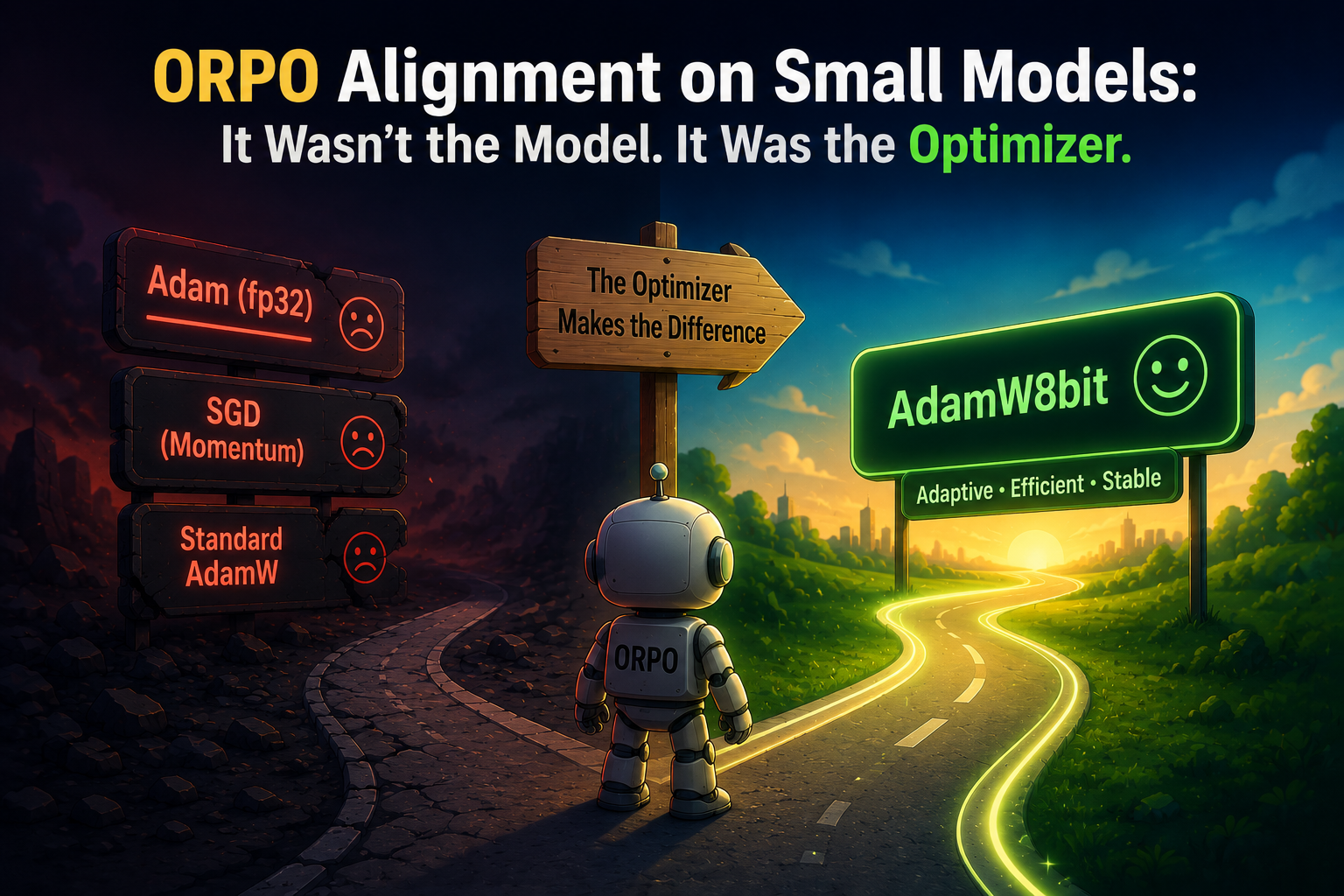
  1. Why does your ORPO Fine Tuning fail at Small Scales — & it’s one line fix

    This article addresses a common issue in training smaller language models using the ORPO (Online Preference Reinforcement Learning) method, where fine-tuning can fail at small scales. The author identifies a specific one-line code fix to resolve this problem. The piece aims to help developers successfully train smaller models to align with human preferences. AI
    Why does your ORPO Fine Tuning fail at Small Scales — & it’s one line fix

    IMPACT Provides a practical solution for developers training smaller language models, potentially improving efficiency and success rates in preference alignment.

  2. Complete-muE: Optimal Hyperparameter Transfer and Scaling for MoE Models

    Researchers have introduced Complete-muE, a novel framework designed to optimize hyperparameter transfer for Mixture-of-Experts (MoE) models. This system addresses the limitations of existing tools by enabling effective hyperparameter transfer between dense feed-forward networks and various MoE configurations. Complete-muE utilizes a two-bridge system to manage changes in architecture and token counts, allowing hyperparameters tuned on a single dense model to be applied near-optimally to all MoE setups. AI

    IMPACT Enables efficient scaling of MoE models by reducing the need for extensive hyperparameter searches.

  3. Chewing through tons of text is, unsurprisingly, a natural fit for a, well, language model. # AI # LLM https:// arstechnica.com/science/2026/0 5/two-ai-based-sc

    Two AI-powered science assistants have demonstrated success in drug retargeting tasks. These models are particularly adept at processing large volumes of text, a capability that aligns well with the nature of language models. Their application in scientific research, specifically in identifying new uses for existing drugs, highlights the growing utility of AI in complex problem-solving. AI

    Chewing through tons of text is, unsurprisingly, a natural fit for a, well, language model. # AI # LLM https:// arstechnica.com/science/2026/0 5/two-ai-based-sc

    IMPACT Demonstrates AI's growing capability in complex scientific discovery, potentially accelerating drug repurposing efforts.

  4. Calculate right class of language model for your workload

    This article guides users on selecting the appropriate class of language model for their specific needs, emphasizing architectural considerations over volatile model performance rankings. It aims to provide a stable framework for decision-making in the rapidly evolving field of AI. AI

    Calculate right class of language model for your workload

    IMPACT Provides a framework for selecting LLMs based on architecture, offering a stable approach amidst changing performance metrics.

  5. Fine-Tuning and Alignment: How Human Feedback Shapes Better AI

    The article discusses how human feedback is crucial for fine-tuning AI models, moving them beyond mere prediction to useful applications. It emphasizes that simply increasing the size of a language model does not guarantee its utility. Instead, techniques like Reinforcement Learning from Human Feedback (RLHF) are essential for aligning AI behavior with human preferences and ensuring safety. AI

    Fine-Tuning and Alignment: How Human Feedback Shapes Better AI

    IMPACT Highlights the critical role of human oversight in developing safe and useful AI systems, influencing development practices.

  6. Spectral Unforgetting: Post-Hoc Recovery of Damaged Capabilities Without Retraining

    Researchers have developed a novel post-hoc method called DG-Hard to address catastrophic forgetting in language models. This technique aims to recover lost capabilities after fine-tuning without requiring retraining, by analyzing the spectral properties of the model's weight updates. DG-Hard applies a singular-value decomposition filtering step to isolate and retain beneficial changes while removing residual noise, demonstrating strong performance across various benchmarks and even restoring safety alignment. AI

    IMPACT Offers a potential solution to catastrophic forgetting, enabling more efficient fine-tuning and preservation of model capabilities.

  7. The fallacy of the “language model” would have remained confined to the world of abstract mathematics if the Silicon Valley multinationals had a bi

    The concept of a "language model" might have remained an abstract mathematical idea if not for Silicon Valley corporations needing to recoup massive AI investments. These companies are now seeking lucrative public, and particularly military, contracts to offset their expenditures, leading to potentially fatal consequences. An example cited is the bombing of a school in Minab, Iran, in late February. AI

    The fallacy of the “language model” would have remained confined to the world of abstract mathematics if the Silicon Valley multinationals had a bi

    IMPACT Critiques the drive for profit in AI development, linking it to military applications and potential negative real-world consequences.

  8. What Really Improves Mathematical Reasoning: Structured Reasoning Signals Beyond Pure Code

    A new research paper explores the impact of code on mathematical reasoning in large language models. The study found that while code improves programming abilities, it does not generally enhance mathematical reasoning and can even compete with knowledge-intensive tasks. The researchers discovered that structured reasoning traces, like math-text mixtures, are more effective for improving reasoning than executable code alone. They suggest that increasing the density of structured math-domain samples offers a targeted approach to boost mathematical reasoning without sacrificing programming performance. AI

    What Really Improves Mathematical Reasoning: Structured Reasoning Signals Beyond Pure Code

    IMPACT Clarifies which data characteristics improve LLM reasoning, suggesting more precise data-centric optimization strategies.

  9. Learning to Train* an AI Model

    A user shared their experience fine-tuning a language model on fictional data and running it on a Raspberry Pi. Another user is seeking help from the OpenAI community to gather answers for training an AI module for a cinematography application, providing links to Google Forms for directors like Darren Aronofsky and Christopher Nolan. AI

    Learning to Train* an AI Model

    IMPACT Explores practical applications of AI training, from personal projects on limited hardware to data collection for specialized applications.

  10. Announcing the fastest inference for realtime voice AI agents

    Together AI has launched a unified platform for building real-time voice agents, integrating speech-to-text (STT), large language models (LLM), and text-to-speech (TTS) within a single cloud environment. This co-location aims to reduce latency to under 500ms and simplify deployment by eliminating inter-vendor network hops. The platform now natively hosts models like Deepgram for STT and Cartesia Sonic-3 for TTS, offering developers more choice and a streamlined experience for production-ready voice applications. AI

    Announcing the fastest inference for realtime voice AI agents

    IMPACT Accelerates development of real-time conversational AI applications by simplifying infrastructure and reducing latency.