PulseAugur / Brief
EN
LIVE 22:15:18

Brief

last 24h
[4/4] 222 sources

Multi-source AI news clustered, deduplicated, and scored 0–100 across authority, cluster strength, headline signal, and time decay.

  1. How Databricks Genie democratizes data access in financial services

    Databricks has introduced Genie, a new natural language interface designed to make data more accessible to business leaders in the financial services sector. This tool translates plain-English questions into governed SQL queries, allowing non-technical users to access insights directly from the Databricks Lakehouse. Genie aims to bridge the gap in data democratization, where previous investments primarily benefited technical teams, by enabling business decision-makers to query data without needing SQL skills or analyst intermediaries. AI

    IMPACT Enables non-technical business users in financial services to access data insights through natural language queries.

  2. Why Infrastructure Modernization Is The Real Enabler Of AI

    Modernizing outdated IT infrastructure is crucial for organizations to effectively leverage artificial intelligence. Many companies attempt to implement AI on legacy systems not designed for current demands like cloud computing and real-time data access. This approach often leads to increased complexity, new risks, and stalled AI pilot projects, as the underlying foundations are not robust enough to support advanced technologies. Incremental modernization, rather than a complete overhaul, is presented as a safer and more realistic path forward, especially in sectors like financial services. AI

    Why Infrastructure Modernization Is The Real Enabler Of AI

    IMPACT Organizations must prioritize IT infrastructure modernization to unlock the full potential of AI and avoid stalled pilot projects.

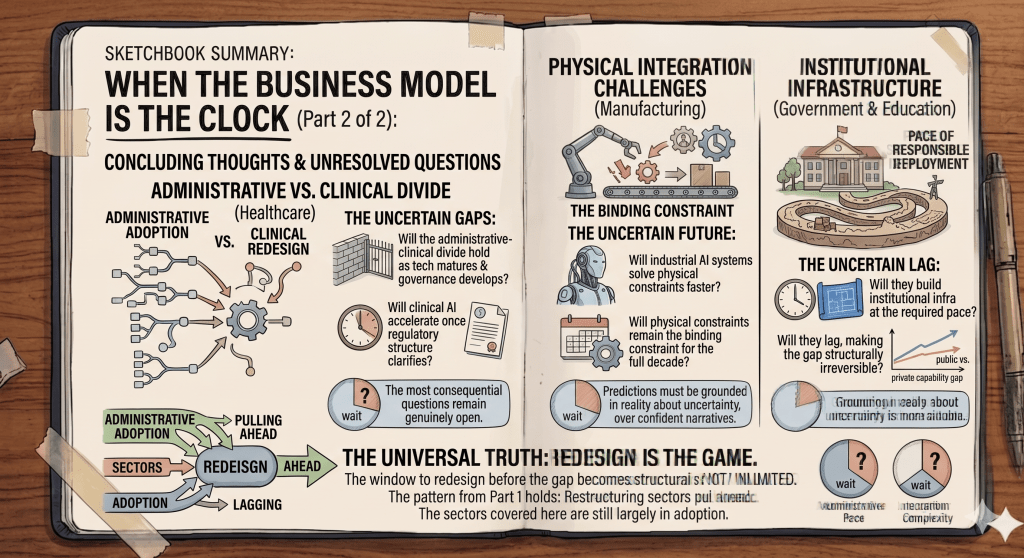
  3. Understanding Sector Change: The Role of Business Models in AI Adoption, Part 2 Part 1 of the sector clock established that the sectors restructuring fastest sh

    The adoption of AI is progressing at different rates across economic sectors, with financial and legal services leading due to their digital-native workflows and lower regulatory hurdles. In contrast, sectors like healthcare, manufacturing, and the public sector are adopting AI more slowly because of significant physical, regulatory, or accountability constraints that AI cannot easily bypass. Healthcare, for instance, is seeing rapid adoption of administrative AI for tasks like scheduling and billing, but clinical AI applications for diagnosis and treatment face much larger obstacles due to the high stakes and complex judgment involved. AI

    Understanding Sector Change: The Role of Business Models in AI Adoption, Part 2 Part 1 of the sector clock established that the sectors restructuring fastest sh

    IMPACT AI adoption will continue to be uneven across industries, with significant challenges remaining for sectors with high regulatory and physical constraints.

  4. 🤖✨ "In a groundbreaking revelation, we've learned that # AI and code do *different* things. Who knew? 🙄 Witness the majestic # Claude , a verifiable AI for # fi

    Kepler has developed a verifiable AI platform for financial services, leveraging Anthropic's Claude model to provide auditable answers from financial documents. The platform achieves 94% accuracy in extracting specific data points from filings, significantly outperforming general-purpose AI models which manage only 38-46% accuracy on similar tasks. This specialized architecture addresses the critical need for trust and verification in the highly regulated financial industry, enabling analysts to ask complex questions in plain English and receive reliable, traceable results. AI

    🤖✨ "In a groundbreaking revelation, we've learned that # AI and code do *different* things. Who knew? 🙄 Witness the majestic # Claude , a verifiable AI for # fi

    IMPACT Sets a new standard for accuracy and verifiability in AI for regulated industries like finance, potentially accelerating adoption.