PulseAugur / Brief
EN
LIVE 01:31:53

Brief

last 24h
[11/11] 221 sources

Multi-source AI news clustered, deduplicated, and scored 0–100 across authority, cluster strength, headline signal, and time decay.

  1. Why Enterprises Should Not Let LLMs Execute SQL Directly?

    Enterprises should avoid allowing large language models to directly execute SQL queries due to significant security, permission, cost, and auditing risks. Prompts alone are insufficient to enforce control over LLM-generated SQL. Implementing a deterministic validation layer between LLMs and production databases is crucial for managing these risks and transforming the SQL generation process into a controllable system. AI

    IMPACT Highlights critical security and operational risks for businesses integrating LLMs into data analysis workflows, emphasizing the need for robust governance layers.

  2. Your AI Agent Is a Data Leak

    AI assistants currently lack the ability to access and interpret user data, limiting their effectiveness in tasks like debugging and product analytics. A new tool, activerecord-mcp, bridges this gap by allowing AI models to query application data through the application layer, rather than direct database access. This approach enhances AI's analytical capabilities while implementing security measures like redaction and read-only roles to protect sensitive information. AI

    Your AI Agent Is a Data Leak

    IMPACT Enables AI assistants to perform deeper analysis on application data, improving debugging and product analytics capabilities.

  3. One pattern I’m seeing right now: companies mining their own existing databases of public information — press releases, blog posts, social media — to program ch

    Companies are increasingly using their own existing public data, such as press releases and blog posts, to train chatbots. These chatbots are designed to respond to user queries exclusively with information that has already been approved and published. This approach aims to ensure that the AI's responses are consistent with the company's official messaging and brand guidelines. AI

    One pattern I’m seeing right now: companies mining their own existing databases of public information — press releases, blog posts, social media — to program ch

    IMPACT This approach allows companies to maintain brand consistency and control over AI-generated responses by limiting them to pre-approved content.

  4. I used to think that there was a possibility for the points of the “good-fast-cheap” triangle to budge a bit but after so many decades of this, I realize now th

    The author argues that the tech industry, including AI, operates on a "fast and cheap" principle, with "good enough" being the only aspiration for product quality. This perspective suggests that companies prioritize speed and cost-effectiveness over genuine quality, a dynamic amplified by the rapid rise of AI. However, the author predicts a potential collapse due to the increasing costs of AI services and a shift back towards hiring junior engineers, viewing the current AI boom as a familiar capitalist cycle rather than true disruption. AI

    I used to think that there was a possibility for the points of the “good-fast-cheap” triangle to budge a bit but after so many decades of this, I realize now th

    IMPACT Suggests AI's rapid adoption is driven by cost-cutting and 'good enough' product strategies, potentially leading to a market correction.

  5. Since Artificial Intelligence became the technology of the moment, several companies that actually work using automation or traditional technologies

    The article discusses how the rise of Artificial Intelligence has led some companies to misrepresent their work as AI-driven when they actually use traditional automation or older technologies. This trend highlights a growing concern about deceptive marketing practices within the tech industry as AI gains prominence. AI

    IMPACT Highlights potential for deceptive marketing as AI becomes a buzzword, impacting user trust and industry perception.

  6. AI-powered cyberattacks are surging: Specific measures companies and SMEs should take [Latest 2026] https://rocket-boys.co.jp/security-measures-lab/ai-cyberattacks-smb-defense-measures/ #SecurityMeasuresLab #security #

    Cyberattacks leveraging AI are rapidly increasing, posing a significant threat to businesses of all sizes. The article outlines specific defensive measures that companies, including small and medium-sized enterprises, should implement to counter these evolving threats. It emphasizes the need for proactive strategies to mitigate risks associated with AI-powered malicious activities. AI

    AI-powered cyberattacks are surging: Specific measures companies and SMEs should take [Latest 2026] https://rocket-boys.co.jp/security-measures-lab/ai-cyberattacks-smb-defense-measures/ #SecurityMeasuresLab #security #

    IMPACT Businesses must adopt new strategies to defend against AI-enhanced cyber threats.

  7. I know companies that have set enforced KPIs for the use of AI (e.g. "AI should be used for X number of tasks") & I don't understand how people can't see how st

    A tech professional expressed frustration with companies mandating AI usage through specific KPIs, likening it to a carpenter being forced to use a hammer for a set number of tasks. The argument is that tools should be applied organically based on need, not dictated by arbitrary performance metrics. This approach is seen as counterproductive and misunderstands the nature of tool utilization in a work context. AI

    I know companies that have set enforced KPIs for the use of AI (e.g. "AI should be used for X number of tasks") & I don't understand how people can't see how st

    IMPACT Mandatory AI KPIs may stifle innovation and efficient tool adoption within organizations.

  8. 🤖 AI promised efficiency and savings, but with costs, integration, and uncertain ROI, some companies are hitting the brakes. # AI # Business 🔗 https://www.tomshw.it/hardwa

    Despite promises of efficiency and cost savings, some companies are slowing their AI adoption. Concerns about high implementation costs, integration challenges, and uncertain return on investment are leading these businesses to reconsider their AI strategies. AI

    IMPACT Highlights growing concerns about the practical business challenges of AI implementation, suggesting a potential slowdown in widespread adoption.

  9. 3 Steps Not To Ignore In Nature Plans

    Investors are increasingly demanding transparency from companies regarding nature-related financial risks, despite varying governmental disclosure requirements. These risks, such as declining bee populations impacting agriculture or depleted water sources affecting mining, have significant economic consequences. A global investor initiative has developed a benchmark to guide companies in reporting their strategies for addressing biodiversity loss, emphasizing the need for comprehensive plans that integrate nature and climate risk management. AI

    3 Steps Not To Ignore In Nature Plans
  10. 📈 Why AI bills rise as costs fall

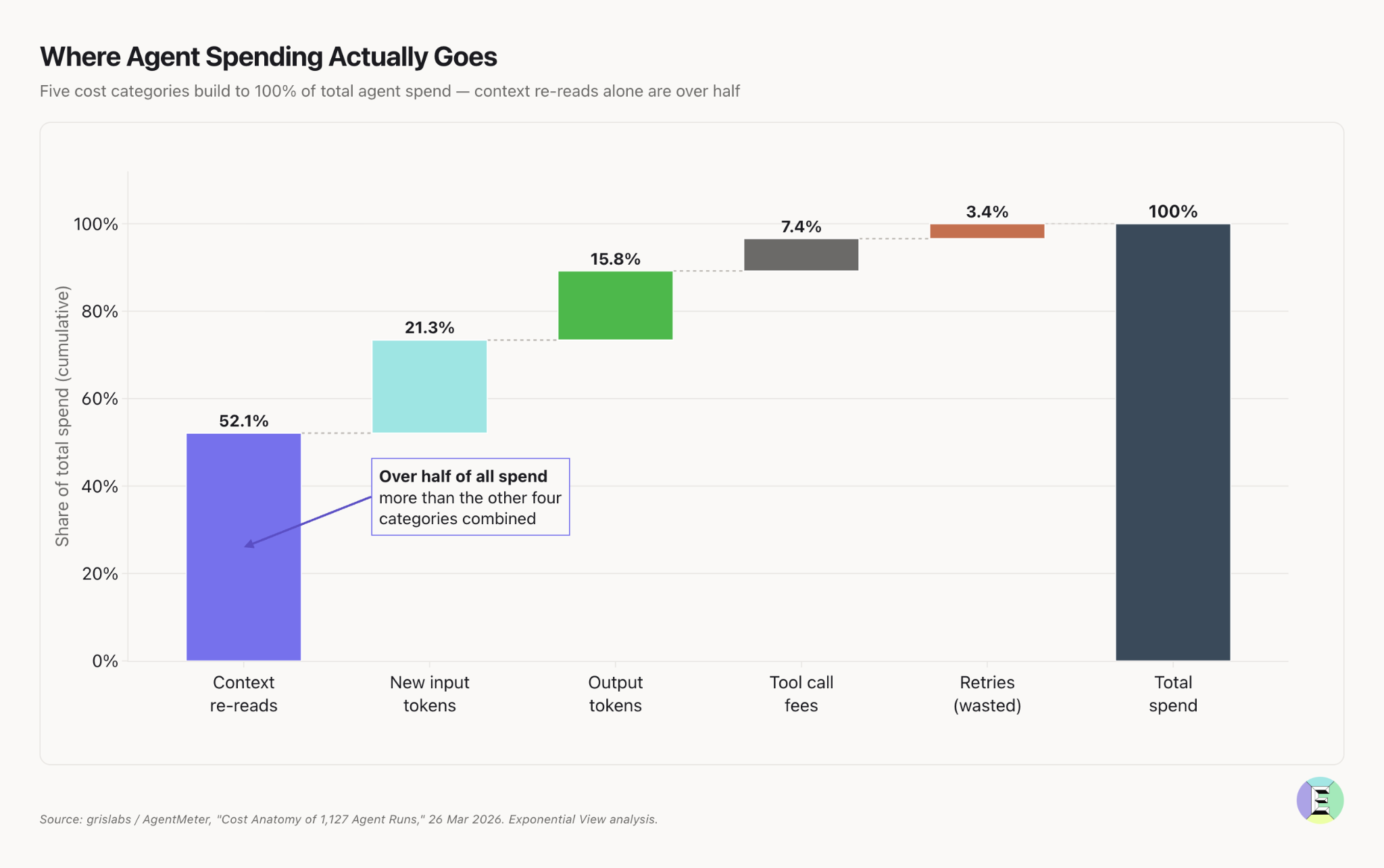
    The cost of using AI, particularly AI agents, is rising unexpectedly due to high token consumption. While token prices have fallen significantly, the complexity of agent operations, involving numerous tool calls and internal processing steps, leads to token amplification. This hidden work, often unseen by users or even the paying companies, constitutes the majority of token usage and contributes to unpredictable and inflated AI bills. AI

    📈 Why AI bills rise as costs fall

    IMPACT Highlights the hidden costs and forecasting challenges associated with AI agent token consumption, impacting enterprise adoption and budgeting.

  11. Companies With Goals Of AI Tokenmaxxing Are Foolishly Inspiring Employees To Waste Costly AI Resources

    A new trend called "tokenmaxxing" involves companies encouraging employees to use AI by tracking token consumption, often with leaderboards and rewards. However, this can lead to employees generating low-value content simply to increase their token count, wasting expensive AI resources. Separately, a significant number of companies are using AI as a justification for layoffs and hiring freezes, presenting it as a strategic move rather than an acknowledgment of financial strain. AI

    Companies With Goals Of AI Tokenmaxxing Are Foolishly Inspiring Employees To Waste Costly AI Resources

    IMPACT Companies may be misincentivizing AI use by focusing on token counts, and using AI as a narrative to mask financial difficulties during layoffs.