PulseAugur / Brief
EN
LIVE 14:56:16

Brief

last 24h
[7/7] 221 sources

Multi-source AI news clustered, deduplicated, and scored 0–100 across authority, cluster strength, headline signal, and time decay.

  1. Kolmogorov-Arnold Fourier Networks

    Researchers have developed a new variant of Kolmogorov-Arnold Networks (KANs) called Kolmogorov-Arnold Fourier Networks (KAFs) to address limitations in parameter efficiency and high-frequency feature capture. KAFs reparameterize the network using spectral representations and trainable Random Fourier Features, reducing parameter complexity and improving performance across various tasks like computer vision and NLP. Concurrently, another research effort explores a physical analogue KAN architecture using reconfigurable nonlinear-processing units (RNPUs) for hardware implementation, demonstrating potential for significant energy and latency reductions compared to traditional MLPs, especially for edge inference. AI

    IMPACT These advancements in KAN architectures and their hardware implementations could lead to more efficient and powerful neural network models, particularly for edge computing.

  2. Letting Agents See the World: New Industry Scene Practices of CV × AI Agent | 2026 AI Partner · Beijing Yizhuang AI+ Industry Conference

    Dahua shares its strategy for integrating Computer Vision (CV) with AI Agents to enhance industrial applications, moving beyond simple chatbots to systems capable of silent monitoring and autonomous decision-making. The company has developed the Xinghan large model series, including V-series for visual understanding and L-series for industry-specific logic, aiming to bridge the gap between AI capabilities and industry comprehension. Dahua's approach focuses on building AI Agents that can act as external brains, integrating with existing data and systems while respecting data security, ultimately enabling industries and individuals to benefit from AI. AI

    Letting Agents See the World: New Industry Scene Practices of CV × AI Agent | 2026 AI Partner · Beijing Yizhuang AI+ Industry Conference

    IMPACT Dahua's strategy could accelerate AI adoption in specialized industries by addressing data integration and understanding gaps.

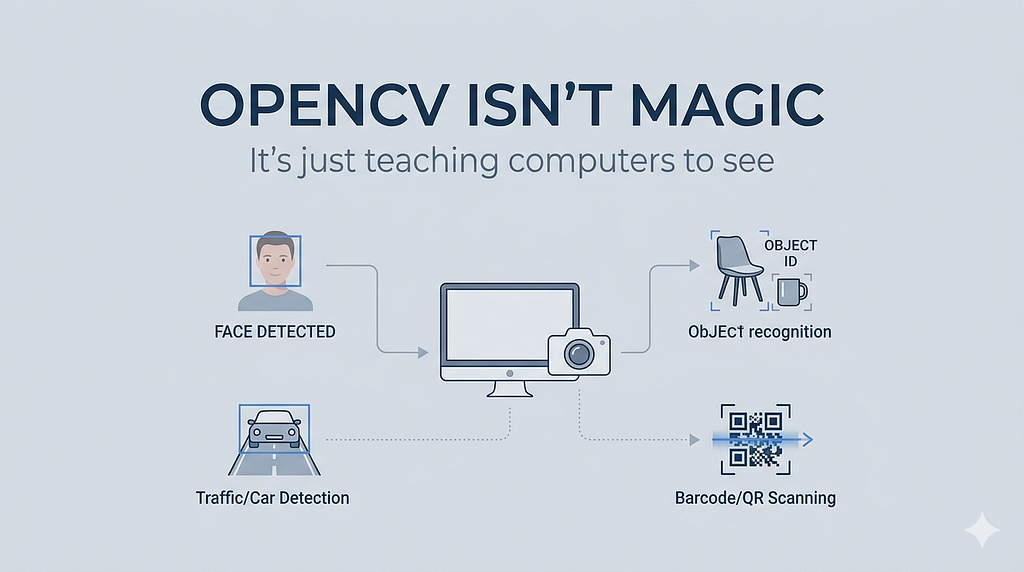
  3. OpenCV Isn’t Magic — It’s Just Teaching Computers to See

    OpenCV, an open-source library, is a foundational tool for computer vision that predates and supports modern AI models. It handles essential pre-processing tasks like cleaning and formatting visual data, which is crucial before AI models can make accurate predictions. This library is widely used across various industries, from robotics to medical imaging, enabling systems to interpret and react to visual information. AI

    OpenCV Isn’t Magic — It’s Just Teaching Computers to See

    IMPACT Provides essential infrastructure for AI systems by enabling robust pre-processing of visual data, making AI models more reliable in real-world applications.

  4. Accelerate your AI development with precision-guided training data! 🚀 From computer vision to NLP, high-quality data annotation is the secret to reducing algori

    Digi-Texx offers data annotation services to enhance AI development across various domains like computer vision and NLP. Their services aim to reduce algorithmic bias and improve the scalability of machine learning models. The company emphasizes the importance of high-quality training data for building robust AI systems. AI

    IMPACT Data annotation services are crucial for improving AI model performance and reducing bias, impacting the efficiency and reliability of AI applications.

  5. Yann LeCun proposes Joint-Embedding Predictive Architecture (JEPA) as an alternative to large language models (LLMs) as a path to AI for robotics and artificial

    Yann LeCun has proposed the Joint-Embedding Predictive Architecture (JEPA) as a potential alternative to large language models (LLMs) for achieving artificial general intelligence (AGI). This approach aims to build AI systems capable of understanding the world through prediction and representation learning, particularly for applications in robotics and computer vision. LeCun suggests that JEPA could offer a more efficient and effective path toward AGI compared to the current LLM paradigm. AI

    Yann LeCun proposes Joint-Embedding Predictive Architecture (JEPA) as an alternative to large language models (LLMs) as a path to AI for robotics and artificial

    IMPACT Proposes a new architectural direction for AI research, potentially shifting focus from LLMs to predictive representation learning for AGI.

  6. Synthetic Data Alone is Enough? Rethinking Data Scarcity in Pediatric Rare Disease Recognition

    Researchers have investigated the efficacy of using synthetic data alone for recognizing rare pediatric diseases through facial phenotypes. Their study found that training models exclusively on synthetic images achieved performance comparable to real-data-only models when sufficient synthetic data was available. This suggests that high-fidelity synthetic data can effectively approximate real-world distributions, offering a privacy-preserving resource for medical education and patient communication. AI

    IMPACT Synthetic data generation can overcome data scarcity and privacy concerns in specialized medical fields, potentially accelerating diagnostic tool development.

  7. Unlock actionable insights from visual data with # ComputerVision in Miami. Our solutions automate analysis, reduce errors, and boost efficiency. Learn how to t

    Codeponents offers computer vision solutions for Miami businesses, aiming to extract actionable insights from visual data. Their services are designed to automate analysis, reduce errors, and enhance operational efficiency. The company highlights its precision-driven approach and provides links to discover their services and client case studies. AI

    Unlock actionable insights from visual data with # ComputerVision in Miami. Our solutions automate analysis, reduce errors, and boost efficiency. Learn how to t

    IMPACT Provides businesses with tools to leverage visual data for operational improvements.