PulseAugur / Brief
EN
LIVE 09:44:54

Brief

last 24h
[9/9] 221 sources

Multi-source AI news clustered, deduplicated, and scored 0–100 across authority, cluster strength, headline signal, and time decay.

  1. Sensing Intelligence as a Trainable Metamaterial Property

    Researchers have introduced the concept of "sensing intelligence," proposing that a metamaterial's physical structure can be optimized to preprocess external stimuli. This approach allows a neural network to train its own physical body, improving the efficiency of signal interpretation. By using differentiable simulation, the body's geometry is optimized to reduce the sensing loss, leading to up to a fivefold increase in accuracy or a significant reduction in the need for electronic sensors. AI

    IMPACT This research could lead to more efficient AI systems by offloading some signal processing to the physical structure of devices, reducing computational load.
  2. Parallel Differentiable Reachability for Learning and Planning with Certified Neural Dynamics and Controllers

    Researchers have developed a new parallelizable, differentiable reachability framework designed for continuous- and discrete-time systems. This framework integrates Taylor-model flowpipe construction with linear bound propagation, enabling GPU-batched computation and automatic differentiation. The system supports both analytical and neural network-based dynamics and controllers, offering a way to provide formal guarantees under uncertainty for closed-loop neural systems in robotics. AI

    IMPACT Enables formal guarantees for neural network-based robotics systems, potentially improving safety and reliability in complex tasks.

  3. I Swapped the ML Model in My Android App. The App Had No Idea.

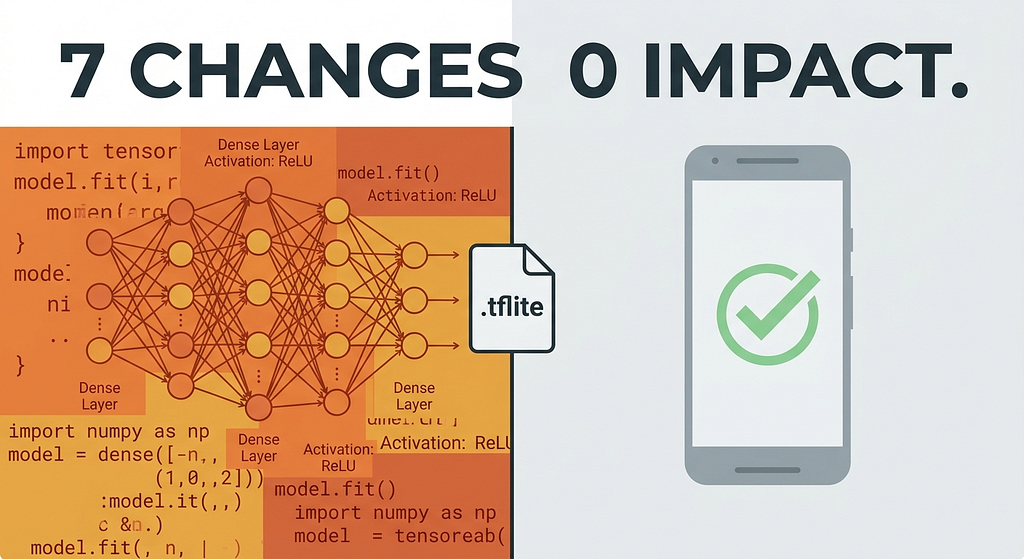
    The author details how they successfully replaced the machine learning model in their Android application, FinRisk, without altering the existing codebase. This was achieved through an interface-driven design that allowed the new neural network model to seamlessly replace the old logistic regression model. The upgrade was prompted by the original model's inability to correctly classify a specific edge case involving high income and high debt, a limitation inherent in its architecture. AI

    I Swapped the ML Model in My Android App. The App Had No Idea.

    IMPACT Demonstrates how interface-driven design can abstract ML model complexity, enabling easier upgrades and maintenance in applications.

  4. Representability-Aware Neural Networks for Reduced Density Matrices: Application to Fractional Chern Insulators

    Researchers have developed a new neural network framework designed to predict two-particle reduced density matrices (2-RDMs) with improved accuracy and efficiency. This framework incorporates representability conditions directly into its architecture and loss function, allowing it to operate across different momentum meshes. The approach was applied to study fractional Chern insulators in twisted bilayer MoTe$_2$, where it achieved highly accurate predictions for the 2-RDM and ground-state energy, outperforming traditional semidefinite programming methods in terms of parameter count and energy accuracy. AI

    IMPACT Introduces a novel neural network architecture for predicting complex quantum material properties, potentially accelerating condensed matter physics research.

  5. Neural Acceleration for Graph Partitioning

    Researchers have developed a novel neural network approach to accelerate graph partitioning, a crucial task in fields like social network analysis and VLSI design. This method replaces the computationally intensive Fiedler vector calculation, a key step in spectral bisection, with an artificial neural network approximation. The new technique maintains partitioning quality comparable to traditional spectral methods while substantially reducing computational overhead, thereby enhancing scalability and efficiency for large-scale datasets. AI

    IMPACT Accelerates a core computational task in various scientific domains, potentially enabling larger and more complex analyses.

  6. Training Neural Networks with Optimal Double-Bayesian Learning

    Researchers have introduced a novel probabilistic framework to optimize the learning rate in neural network training, moving beyond empirical trial-and-error. This new approach develops classic Bayesian statistics into a dual-Bayesian decision mechanism. The framework theoretically derives an optimal learning rate, which has been validated through experiments on various classification, segmentation, and detection tasks. AI

    Training Neural Networks with Optimal Double-Bayesian Learning

    IMPACT This new Bayesian framework could lead to more efficient and effective neural network training by providing a theoretically derived optimal learning rate.

  7. How Many Training Samples Are Needed for the Inverse Kinematics Solutions by Artificial Neural Networks

    A new study published on arXiv investigates the optimal number of training samples required for artificial neural networks (ANNs) to accurately solve inverse kinematics (IK) problems in robotics. The research found that beyond 125 training samples, additional data did not significantly improve the model's efficiency or approximation accuracy. This work offers practical guidance for optimizing data requirements in ANN-based IK solutions, balancing computational costs with desired accuracy for robotic applications. AI

    IMPACT Provides practical guidance on data efficiency for ANN-based IK solutions, potentially reducing computational costs in robotics.

  8. ACCoRD: Actor-Critic Conflict Resolution with Deep learning for O-RAN xApps

    Researchers have developed a new deep learning approach called ACCoRD to resolve control conflicts within Open Radio Access Networks (O-RAN). This method utilizes an Actor-Critic reinforcement learning algorithm, specifically PPO-Clip, to train an Artificial Neural Network. The system analyzes network data and conflicting decisions to infer optimal conflict resolution actions, with ongoing adjustments based on feedback. Simulations indicate that ACCoRD significantly outperforms traditional rule-based methods in reducing negative network events during medium and high traffic conditions. AI

    IMPACT Introduces a novel deep learning method for network conflict resolution, potentially improving efficiency in O-RAN environments.

  9. Frequency Matching in Spiking Neural Networks for mmWave Sensing

    Researchers have developed a new method for using spiking neural networks (SNNs) in millimeter-wave (mmWave) sensing applications. By analyzing the inherent temporal filtering of SNNs and matching their effective bandwidth to the data's spectral content, the approach can suppress high-frequency noise. This frequency-matching technique resulted in a 6.22% average accuracy improvement and a 3.64x reduction in energy consumption compared to traditional artificial neural networks on mmWave datasets. AI

    IMPACT Enhances efficiency and accuracy for edge AI applications by optimizing neural network performance on noisy sensor data.