PulseAugur / Brief
EN
LIVE 23:30:22

Brief

last 24h
[6/6] 221 sources

Multi-source AI news clustered, deduplicated, and scored 0–100 across authority, cluster strength, headline signal, and time decay.

  1. AT&T is the first carrier to charge an admin fee for its prepaid plans AT&T is the first, but how long before Verizon and AT&T follow suit? https://www. android

    AT&T has become the first mobile carrier to implement an administrative fee on its prepaid plans. This new charge is expected to be closely watched by other major carriers like Verizon, who may follow suit. The introduction of this fee could signal a broader trend in how carriers structure their pricing for prepaid services. AI


    AT&T is the first carrier to charge an admin fee for its prepaid plans AT&T is the first, but how long before Verizon and AT&T follow suit? https://www. android
  2. 🕵🏻‍♂️ [InfoSec MASHUP] 21/2026 - The Supply Chain Didn't Break. It Was Walked. This week's issue reads like a case study in cascade failure. A malicious VS Code

    A coordinated series of cyberattacks, attributed to the group TeamPCP, has exploited vulnerabilities across the software supply chain. These attacks, which began with a malicious VS Code extension on a GitHub employee's device, led to the exfiltration of thousands of internal repositories. Further incidents include the compromise of Grafana via an unrotated token, a breach of a widely used GitHub Action, and the discovery of sensitive credentials in a public spreadsheet, highlighting the pervasive nature of supply chain risks. AI

  3. Mobile phishing is a bigger threat than email now - how to stay protected Verizon's latest DBIR shows attackers are turning to texts and calls as email defenses

    Mobile phishing attacks are now surpassing email as the primary threat vector, according to Verizon's latest Data Breach Investigations Report. Attackers are increasingly exploiting SMS messages and phone calls, driven by improved email security measures. Businesses are advised to implement new strategies to combat this evolving landscape of cyber threats. AI

    Mobile phishing is a bigger threat than email now - how to stay protected Verizon's latest DBIR shows attackers are turning to texts and calls as email defenses

    IMPACT This report highlights evolving cyber threats, which may influence AI-driven security solutions.

  4. After 19 years: Attacks via vulnerabilities overtake those with stolen credentials | Security https://www.heise.de/news/KI-Aera-Laut-Ver izon-mehr-Angriffe-ueber-

    Verizon's latest Data Breach Investigations Report indicates a shift in cyberattack methods, with vulnerabilities now surpassing stolen credentials as the primary attack vector. This trend marks a significant change after 19 years of stolen credentials dominating the threat landscape. The report also highlights the growing influence of AI in the cybercrime era, suggesting its role in both facilitating and combating these evolving threats. AI

    IMPACT The report highlights the evolving cybercrime landscape, which may influence AI security strategies.

  5. https://www. europesays.com/3015718/ Shaping the future of AI at Hebrew University of Jerusalem # AI # ArtificialIntelligence # CanadianFriendsOfHebrewUniversit

    The Verizon 2026 Data Breach Investigations Report highlights a concerning rise in cybercrime, offering lessons for organizations on how to bolster their defenses. Separately, discussions are underway at the Hebrew University of Jerusalem regarding the future trajectory of artificial intelligence. AI

    https://www. europesays.com/3015718/ Shaping the future of AI at Hebrew University of Jerusalem # AI # ArtificialIntelligence # CanadianFriendsOfHebrewUniversit

    IMPACT Discussions on AI's future and reports on cybersecurity trends offer insights into the evolving landscape for AI operators.

  6. Verizon’s latest DBIR says vulnerability exploitation has surpassed stolen credentials as the top breach vector, with AI accelerating exploit development and at

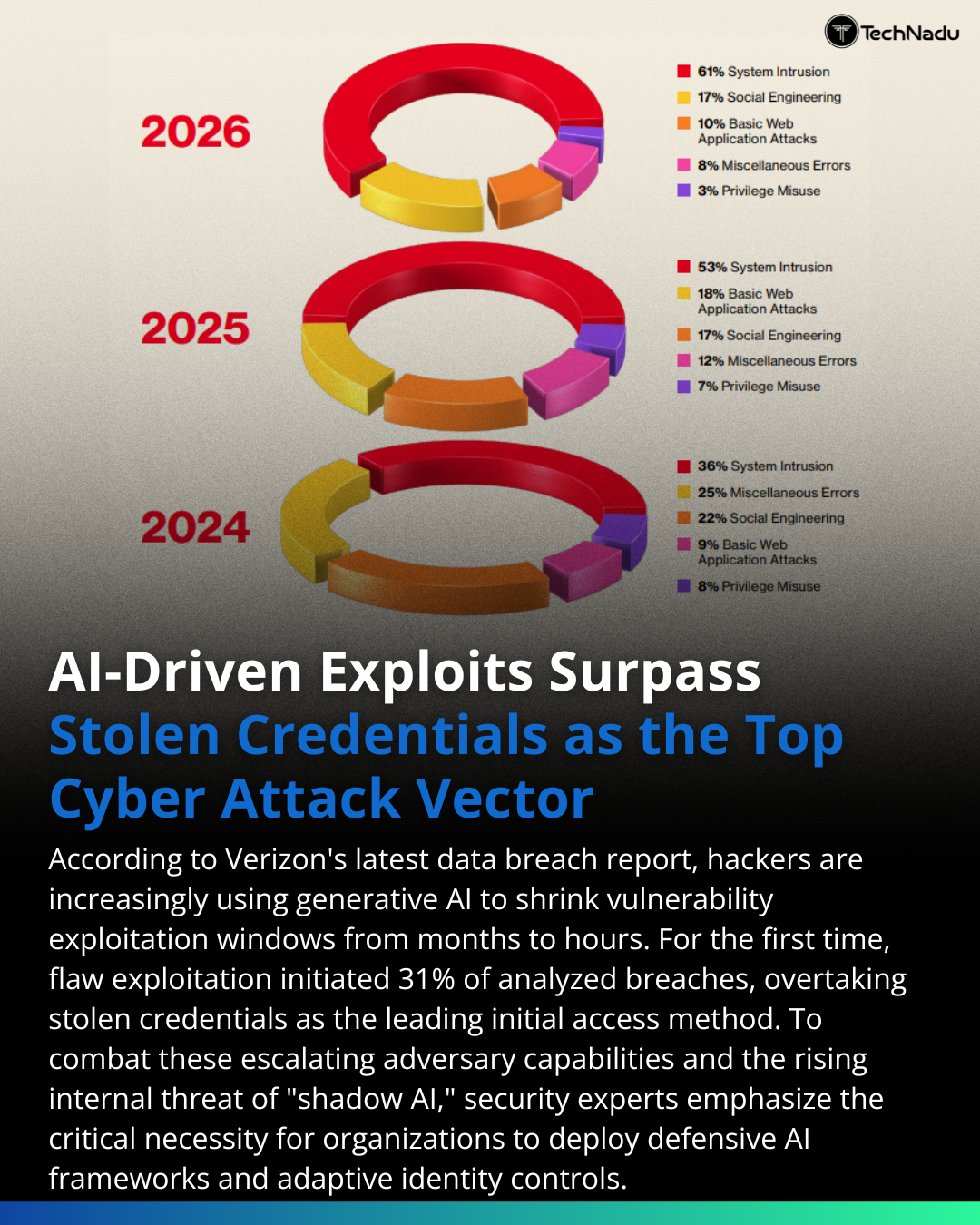
    Verizon's 2026 Data Breach Investigations Report indicates that AI is now the primary tool hackers use to exploit software vulnerabilities, accounting for 31% of recent cyber breaches. This method has surpassed stolen passwords as the leading attack vector. The report also highlights an increase in mobile phishing and supply chain attacks, alongside concerns about shadow AI risks. AI

    Verizon’s latest DBIR says vulnerability exploitation has surpassed stolen credentials as the top breach vector, with AI accelerating exploit development and at

    IMPACT AI is increasingly weaponized by cybercriminals to exploit software vulnerabilities, posing a growing threat to organizations.