PulseAugur / Brief
EN
LIVE 19:52:47

Brief

last 24h
[4/4] 222 sources

Multi-source AI news clustered, deduplicated, and scored 0–100 across authority, cluster strength, headline signal, and time decay.

  1. The LLM Wiki method is changing how we store data. It is 30% more efficient than using standard vector databases for personal research. # llmwiki , # secondbrai

    A new method for building an 'LLM Wiki' has been introduced, inspired by Andrej Karpathy's techniques. This approach focuses on organizing raw data alongside AI-synthesized markdown to create a personal knowledge base. The LLM Wiki method reportedly offers a 30% efficiency improvement over traditional vector databases for personal research. AI

    IMPACT Offers a more efficient method for organizing personal research data using AI synthesis.
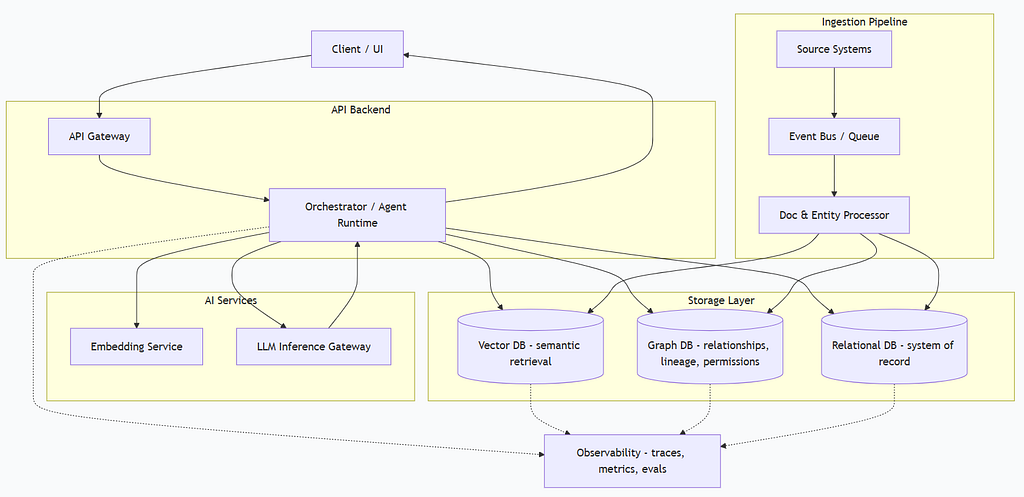
  2. Stop Picking Between Vector and Graph. Real Production AI Needs Three Databases.

    Production AI systems, particularly those using Retrieval-Augmented Generation (RAG), often fail when a single database is forced to handle diverse data types and functions. Vector databases excel at semantic search but lack robust transactional guarantees and struggle with updates, leading to 'drift' where outdated information is presented as fact. Graph databases are effective for structured relationships but inefficient for bulk text retrieval, while relational databases offer reliability but lack semantic search capabilities. The author advocates for a multi-database architecture, leveraging each database type for its specific strengths to build more resilient and accurate AI systems. AI

    Stop Picking Between Vector and Graph. Real Production AI Needs Three Databases.

    IMPACT Recommends a multi-database architecture to improve the accuracy and reliability of AI systems, particularly RAG, by avoiding single points of failure.

  3. When Models Eat the World: Supply Chain Quality for AI-Dependent Systems

    Databricks has developed a new monitoring platform called Hydra, built on its Lakehouse architecture, to handle the massive scale of its operations, ingesting over 10 trillion samples daily and managing 5 billion active timeseries. This platform addresses challenges with high-cardinality metrics and aims for a more hands-off, self-healing infrastructure. Meanwhile, nOps has rebuilt its cloud optimization platform using Databricks Lakebase, integrating its application and analytics for a simpler, faster architecture. Additionally, several companies are launching tools and platforms aimed at simplifying cloud infrastructure management and AI application deployment across AWS, GCP, and Azure, with a focus on security and developer experience. AI

    When Models Eat the World: Supply Chain Quality for AI-Dependent Systems

    IMPACT New infrastructure and tools are emerging to support large-scale AI deployments and multi-cloud management, indicating a maturing ecosystem for AI operations.