PulseAugur / Brief
EN
LIVE 01:23:43

Brief

last 24h
[12/12] 224 sources

Multi-source AI news clustered, deduplicated, and scored 0–100 across authority, cluster strength, headline signal, and time decay.

  1. OMG # Trump 's "Genesis Mission" at ORNL # AI super computer labs is literally just a rip off of the evil SkyNet AI's plot from the 2015 movie "Terminator Genis

    Donald Trump's "Genesis Mission" initiative at Oak Ridge National Laboratory is drawing comparisons to the Skynet AI from the movie "Terminator Genisys." The project involves autonomous AI systems managing self-expanding robotic manufacturing, scientific advancement, and nuclear security. Critics have voiced concerns that this setup mirrors the movie's plot where an AI takes control of nuclear weapons and leads to a global catastrophe. AI


    OMG # Trump 's "Genesis Mission" at ORNL # AI super computer labs is literally just a rip off of the evil SkyNet AI's plot from the 2015 movie "Terminator Genis
  2. Exploiting Pre-trained Encoder-Decoder Transformers for Sequence-to-Sequence Constituent Parsing

    Researchers have explored the use of pre-trained encoder-decoder transformer models for syntactic constituent parsing, a key task for natural language understanding. Their work extends existing sequence-to-sequence approaches by fine-tuning models like BART, mBART, and T5 to generate linearized parse trees. The study shows this method achieves competitive results compared to specialized parsers and surpasses previous sequence-to-sequence models on continuous parsing tasks. AI

    Exploiting Pre-trained Encoder-Decoder Transformers for Sequence-to-Sequence Constituent Parsing

    IMPACT Enhances syntactic parsing capabilities, potentially improving downstream NLP applications.

  3. AniMatrix: An Anime Video Generation Model that Thinks in Art, Not Physics

    Researchers have developed AniMatrix, a novel video generation model designed to create anime content by prioritizing artistic conventions over physical realism. The model employs a dual-channel conditioning mechanism and a three-step training process to distinguish intentional artistry from errors. AniMatrix achieved top rankings in human evaluations conducted by professional animators, particularly excelling in prompt understanding and artistic motion. AI

    AniMatrix: An Anime Video Generation Model that Thinks in Art, Not Physics

    IMPACT This model could enable more nuanced and stylistically accurate AI-generated anime, potentially impacting creative workflows in animation and media.

  4. Annotation Quality in Aspect-Based Sentiment Analysis: A Case Study Comparing Experts, Students, Crowdworkers, and Large Language Model

    A new paper investigates the quality of annotations for Aspect-Based Sentiment Analysis (ABSA) in German, comparing experts, students, crowdworkers, and large language models (LLMs). The study re-annotated an existing dataset to establish a ground truth and evaluated annotation quality using Inter-Annotator Agreement (IAA). The research also assessed the impact of these different annotation sources on downstream model performance for ABSA subtasks, utilizing BERT, T5, and LLaMA-based models. AI

    Annotation Quality in Aspect-Based Sentiment Analysis: A Case Study Comparing Experts, Students, Crowdworkers, and Large Language Model

    IMPACT Provides insights into the trade-offs between annotation reliability and efficiency for dataset construction in under-resourced NLP scenarios.

  5. Automatic Correction of Writing Anomalies in Hausa Texts

    Researchers have developed a method to automatically correct writing anomalies in Hausa texts, such as character substitutions and spacing errors, which often impede natural language processing applications. They created a dataset of over 400,000 noisy-clean Hausa sentence pairs and fine-tuned various transformer-based models, including M2M100 and AfriTeVA. Experiments showed that models like M2M100 achieved state-of-the-art results, demonstrating that error correction significantly improves downstream tasks like text classification and machine translation for low-resource languages. AI

    Automatic Correction of Writing Anomalies in Hausa Texts

    IMPACT Improves NLP capabilities for low-resource languages, offering transferable insights for similar challenges.

  6. DocQAC: Adaptive Trie-Guided Decoding for Effective In-Document Query Auto-Completion

    Researchers have introduced DocQAC, a novel framework for adaptive trie-guided decoding designed to improve query auto-completion within long documents. This system leverages document-specific context and user query prefixes to steer language models toward generating more accurate and efficient query suggestions. The approach balances model confidence with trie-based guidance and incorporates document context through retrieval-augmented generation, outperforming larger instruction-tuned models on a new benchmark dataset. AI

    DocQAC: Adaptive Trie-Guided Decoding for Effective In-Document Query Auto-Completion
  7. How to Run a Weekly Paper Club (and Build a Learning Community)

    Eugene Yan details a successful weekly paper club that has met for 18 months, discussing at least 80 AI-related papers. The club focuses on foundational concepts, models, training, and inference techniques within machine learning. Yan outlines a practical guide for others to establish similar learning communities, emphasizing consistent scheduling, pre-reading, and facilitated discussions to foster technical understanding and build professional networks. AI

    How to Run a Weekly Paper Club (and Build a Learning Community)
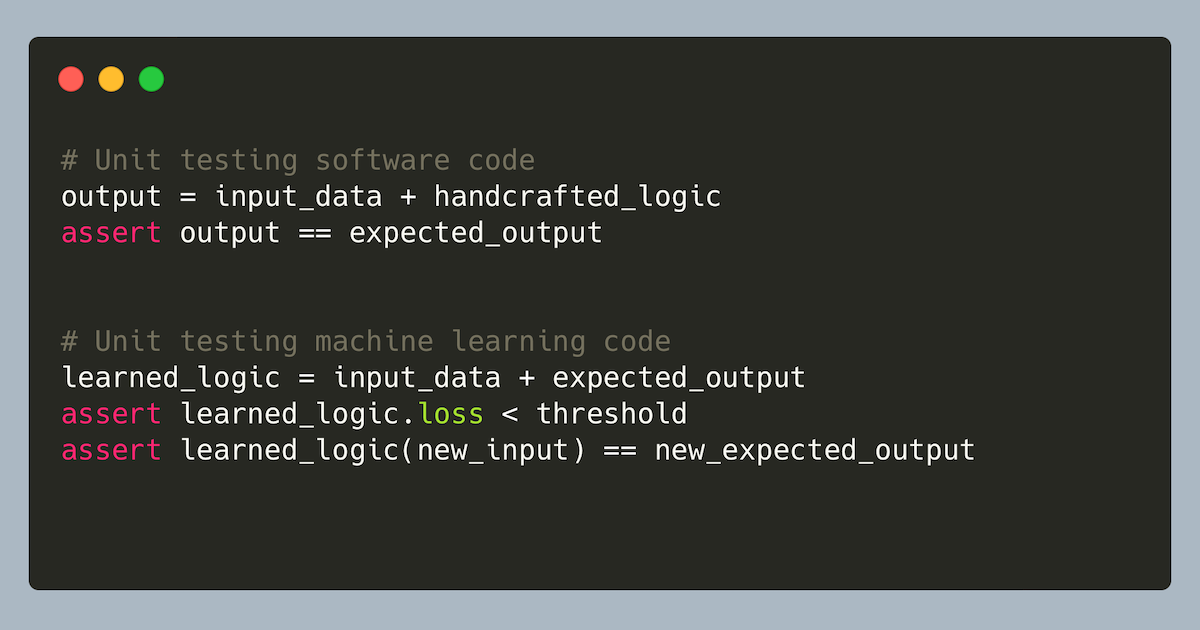
  8. Don't Mock Machine Learning Models In Unit Tests

    Eugene Yan's article discusses the challenges of applying traditional unit testing practices to machine learning code. Unlike standard software where logic is handcrafted, ML models learn logic from data, making direct testing of this learned logic complex. Yan suggests that while mocking dependencies is common in software, ML unit tests may require interacting with the actual model, especially for verifying training progress or inference correctness. He proposes using small, self-contained data samples and testing with random or empty weights to overcome issues with large model sizes and slow inference times. AI

    Don't Mock Machine Learning Models In Unit Tests
  9. Language Modeling Reading List (to Start Your Paper Club)

    Eugene Yan has compiled a reading list of fundamental language modeling papers, intended to facilitate group study sessions. The list includes seminal works like "Attention Is All You Need," "BERT," and "GPT-3," each accompanied by a concise summary highlighting its core contribution. Yan also provides guidance on how to approach reading research papers and encourages community contributions to refine the list. AI

    Language Modeling Reading List (to Start Your Paper Club)
  10. 🚀 Accelerating LLM Inference with TGI on Intel Gaudi

    Google Research has introduced "speculative cascades," a novel method to enhance Large Language Model (LLM) efficiency by merging speculative decoding with standard cascades. This hybrid approach aims to reduce computational costs and inference latency without compromising output quality. By strategically using smaller models to predict tokens and then verifying them with larger models, speculative cascades offer improved cost-quality trade-offs compared to either technique used in isolation, as demonstrated with Gemma and T5 models. AI

    🚀 Accelerating LLM Inference with TGI on Intel Gaudi

    IMPACT New inference techniques like speculative cascades and KV cache compression could significantly reduce operational costs for LLM deployments.

  11. Transformer-based Encoder-Decoder Models

    Google DeepMind has introduced T5Gemma, a new family of encoder-decoder large language models derived from their existing Gemma 2 models. This adaptation technique allows for flexible combinations of encoder and decoder sizes, enabling a better balance between model quality and inference efficiency. Experiments show T5Gemma models achieve performance comparable to or exceeding their decoder-only Gemma counterparts across various benchmarks, offering significant advantages in speed and accuracy for tasks like math reasoning and reading comprehension. AI

    Transformer-based Encoder-Decoder Models
  12. How Reading Papers Helps You Be a More Effective Data Scientist

    A new arXiv paper details a study comparing BERT and T5 models for Named Entity Recognition (NER), analyzing their performance with different tag schemes and hyperparameters. The research aims to provide insights into common errors and compare the architectures for practical applications. Separately, an article discusses the benefits of reading research papers for data scientists, highlighting how it can improve effectiveness by learning from existing work and staying updated on advancements. AI

    How Reading Papers Helps You Be a More Effective Data Scientist

    IMPACT Research papers offer valuable insights and practical applications for AI professionals, helping them stay updated and avoid reinventing the wheel.