PulseAugur / Brief
EN
LIVE 01:10:50

Brief

last 24h
[5/5] 223 sources

Multi-source AI news clustered, deduplicated, and scored 0–100 across authority, cluster strength, headline signal, and time decay.

  1. Fine-Tuning Qwen2.5 - 0.5B to Write SRE Post-Mortem Summaries

    A developer has fine-tuned the Qwen2.5-0.5B model to generate summaries for SRE post-mortems. This approach uses a 700-sample training set and 4-bit LoRA quantization, allowing it to run on consumer hardware. The fine-tuned model reportedly outperforms zero-shot GPT-5.4-nano and Qwen3.6-plus on a structured rubric, producing more concise and organization-specific outputs. AI
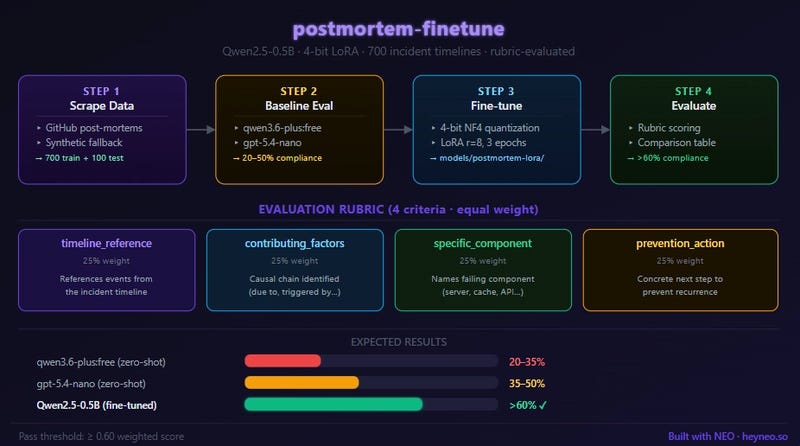
    Fine-Tuning Qwen2.5 - 0.5B to Write SRE Post-Mortem Summaries

    IMPACT Demonstrates efficient fine-tuning of smaller models for specialized tasks, potentially reducing costs and improving performance for niche applications.

  2. How To Strengthen SRE Without Overwhelming Tech Teams

    Site reliability engineering (SRE) practices are crucial for maintaining system uptime and resilience, but they risk overwhelming tech teams with complexity. Experts suggest focusing on user-centric metrics and clear service level objectives to prioritize critical issues. AI-assisted root cause analysis and tools to reduce operational toil can help engineers resolve incidents faster and manage workloads more sustainably. AI

    How To Strengthen SRE Without Overwhelming Tech Teams

    IMPACT AI tools are presented as solutions to reduce operational toil and improve incident response in SRE, potentially increasing efficiency for AI operators.

  3. Splunk MCP: Query your observability stack directly from Claude

    Splunk has released a new tool called Splunk MCP that allows AI agents, like Claude, to directly query observability data. This integration enables AI assistants to search logs, analyze alerts, and correlate incidents without users needing to switch between applications. The tool aims to significantly reduce investigation time for SRE and SecOps teams by automating data analysis and root cause identification. AI

    Splunk MCP: Query your observability stack directly from Claude

    IMPACT Streamlines incident response and root cause analysis for observability teams by enabling direct AI querying of system data.

  4. Why Your SRE Playbook Breaks the Moment You Put an LLM in Production

    Traditional Site Reliability Engineering (SRE) playbooks are insufficient for managing Large Language Models (LLMs) in production due to unique failure modes. These models introduce new challenges that standard observability tools cannot effectively detect or address. A specialized observability stack is required to monitor and manage LLMs, ensuring their reliability and performance. AI

    Why Your SRE Playbook Breaks the Moment You Put an LLM in Production

    IMPACT Highlights the operational challenges and tooling gaps for deploying LLMs, impacting AI system reliability.

  5. Reliability Is a Business Decision. Reliability is not an engineering goal. It is a leadership decision. #SRE #SiteReliabilityEngineering #Leadership #CIO #Digi

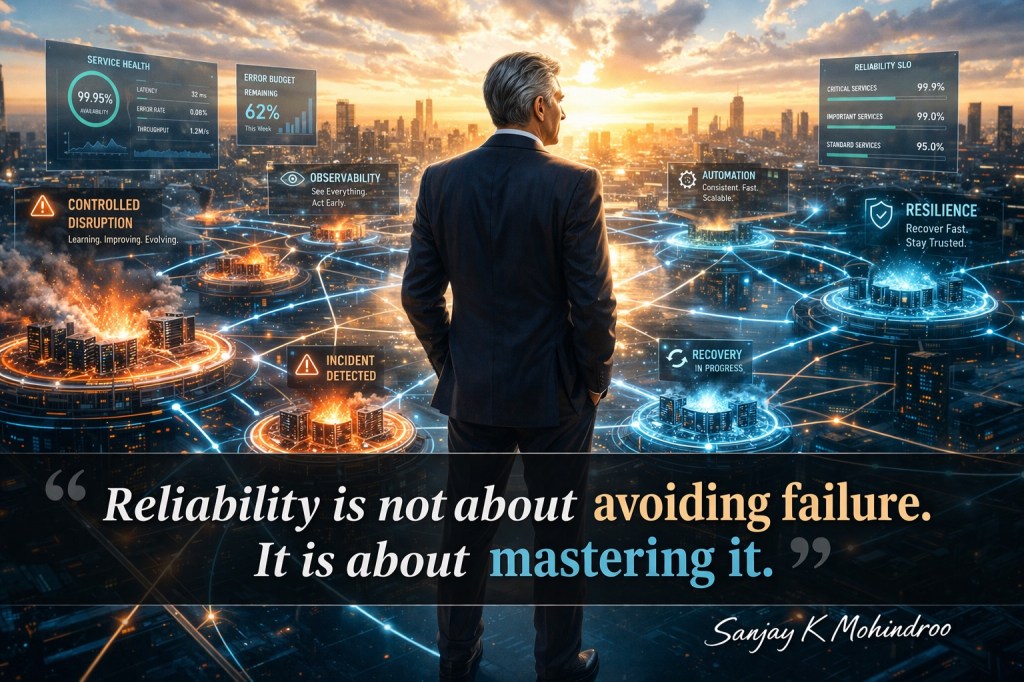
    Reliability in Site Reliability Engineering (SRE) is fundamentally a business decision, not solely an engineering goal. Senior IT leaders must balance reliability, speed, and cost to align with business outcomes, rather than chasing unattainable perfection. Organizations should categorize services by business criticality to set appropriate reliability targets, manage trade-offs using concepts like error budgets, and focus on resilience and rapid recovery rather than striving for zero downtime. AI

    Reliability Is a Business Decision. Reliability is not an engineering goal. It is a leadership decision. #SRE #SiteReliabilityEngineering #Leadership #CIO #Digi

    IMPACT This commentary on SRE principles offers a framework for balancing system reliability with business needs, applicable to AI infrastructure management.