PulseAugur / Brief
EN
LIVE 09:05:03

Brief

last 24h
[2/2] 221 sources

Multi-source AI news clustered, deduplicated, and scored 0–100 across authority, cluster strength, headline signal, and time decay.

  1. Vision-OPD: Learning to See Fine Details for Multimodal LLMs via On-Policy Self-Distillation

    Researchers are developing multimodal large language models (MLLMs) that can process and integrate information from various data types, including text, audio, and video. One approach, MM-When2Speak, focuses on improving conversational timing by predicting when a brief reaction or a full response is appropriate, showing a threefold improvement in performance. Other research explores training MLLMs using only pairwise modalities to reduce data curation effort and addresses fine-grained visual understanding challenges through self-distillation techniques. These advancements aim to create more natural, engaging, and capable AI systems that can better perceive and interact with the real world. AI

    Vision-OPD: Learning to See Fine Details for Multimodal LLMs via On-Policy Self-Distillation

    IMPACT Enhances AI's ability to understand and interact with the real world through diverse data inputs, improving conversational engagement and fine-grained perception.
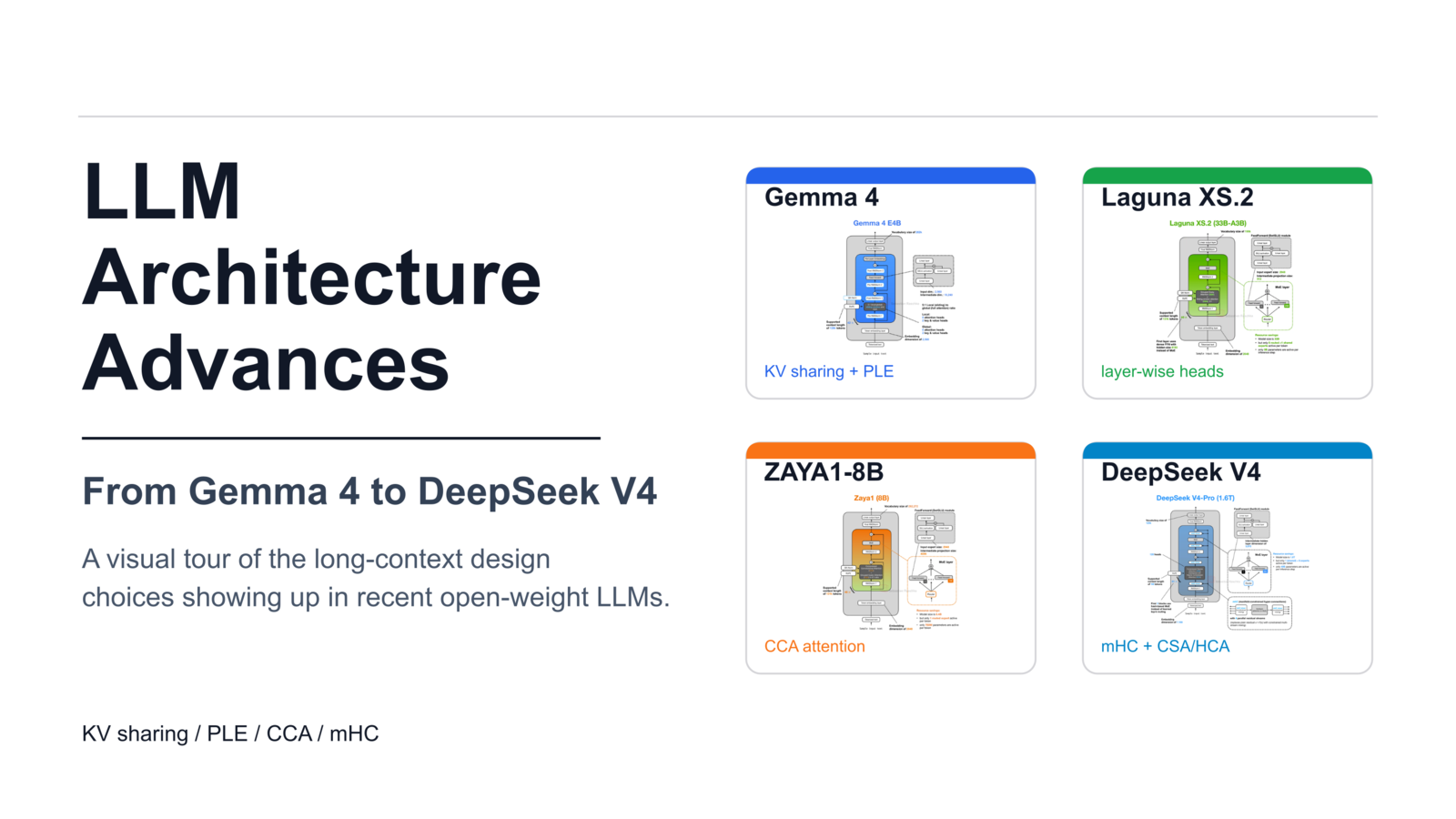
  2. Recent Developments in LLM Architectures: KV Sharing, mHC, and Compressed Attention

    Sebastian Raschka's analysis highlights recent architectural innovations in open-weight LLMs aimed at improving long-context efficiency. Key developments include KV sharing and per-layer embeddings in Google's Gemma 4 models, layer-wise attention budgeting in Laguna XS.2, and compressed convolutional attention in ZAYA1-8B. DeepSeek V4 also incorporates mHC and compressed attention, addressing the growing constraints of KV cache size and memory traffic as models handle longer contexts for reasoning and agent workflows. AI

    Recent Developments in LLM Architectures: KV Sharing, mHC, and Compressed Attention

    IMPACT New architectural techniques in open-weight LLMs are improving efficiency for long contexts, potentially enabling more complex reasoning and agent capabilities.