PulseAugur / Brief
EN
LIVE 14:56:27

Brief

last 24h
[3/3] 221 sources

Multi-source AI news clustered, deduplicated, and scored 0–100 across authority, cluster strength, headline signal, and time decay.

  1. Why Your 98% Accurate ResNet Needs Grad-CAM to Win Over Radiologists

    This tutorial demonstrates how to build and evaluate an Alzheimer's MRI classification pipeline using PyTorch's ResNet18 model. It highlights the common pitfall of models achieving high accuracy by exploiting dataset-specific artifacts rather than genuine medical features. The guide emphasizes the importance of using techniques like Grad-CAM to visualize model attention and ensure it's focusing on relevant anatomical regions before clinical deployment. AI
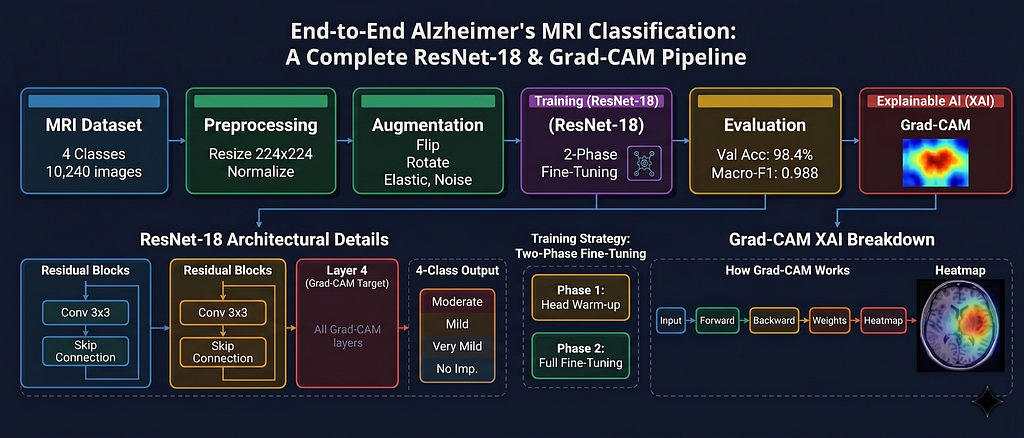
    Why Your 98% Accurate ResNet Needs Grad-CAM to Win Over Radiologists

    IMPACT Provides a practical method for validating AI models in sensitive domains like medical imaging, ensuring trustworthiness beyond simple accuracy metrics.

  2. Per-pixel bounding-box regression + DBSCAN for handwritten word detection - visual walkthrough of WordDetectorNet [P]

    A new approach to handwritten word detection, called WordDetectorNet, uses per-pixel bounding-box regression combined with DBSCAN clustering. Instead of traditional methods like anchor-based detection and Non-Maximum Suppression, this model classifies each pixel as a "word pixel" and regresses distances to its bounding box. Thousands of overlapping candidate boxes are then clustered using DBSCAN with a 1-IoU distance metric, and the median box per cluster is selected as the final detection. AI

    Per-pixel bounding-box regression + DBSCAN for handwritten word detection - visual walkthrough of WordDetectorNet [P]

    IMPACT Introduces a novel approach to object detection that could influence future computer vision models.

  3. Dual-axis attribution of zebrafish tectal microcircuits for energy-efficient and robust neurocomputing

    Researchers have developed a new method to attribute specific computational functions to microcircuits within biological neural networks, using the zebrafish tectal microcircuit as a model. By analyzing signal propagation and simulating network perturbations, they identified distinct subcircuits responsible for energy-efficient processing and robustness. These attributed functions were then integrated into artificial neural networks, demonstrating improved performance under reduced computation and input noise. AI

    IMPACT Provides a framework for designing more efficient and robust artificial neural networks by drawing inspiration from biological circuit organization.