PulseAugur / Brief
EN
LIVE 22:58:44

Brief

last 24h
[3/3] 221 sources

Multi-source AI news clustered, deduplicated, and scored 0–100 across authority, cluster strength, headline signal, and time decay.

  1. Expressive Power of Deep Homomorphism Networks over Relational Databases

    Researchers have introduced Deep Homomorphism Networks (DHNs) as a powerful architecture for learning from relational databases, drawing parallels to fragments of SQL. Their study connects DHNs with various extensions of first-order logic, including those with counting and ratio quantifiers. These findings also shed light on the decidability of static analysis problems for DHNs and are supported by experimental results showing performance differences that align with their expressive power. AI

    IMPACT Introduces a new model architecture with theoretical connections to SQL, potentially improving database learning tasks.
  2. RelPrism: A Multi-Faceted Pre-training Framework with Self-Generated Tasks for Relational Databases

    Researchers have developed RelPrism, a novel framework for self-supervised learning in relational databases. This multi-faceted approach constructs intrinsic, relational, and hybrid attributes from various perspectives and uses multi-granularity clustering to create pseudo-task pools. By exposing representations to diverse information and granularities, RelPrism enhances adaptability for downstream tasks. Experiments show significant improvements in classification and regression performance compared to existing methods. AI

    IMPACT Introduces a new self-supervised learning framework that improves performance on relational database tasks, potentially benefiting data analysis and prediction systems.

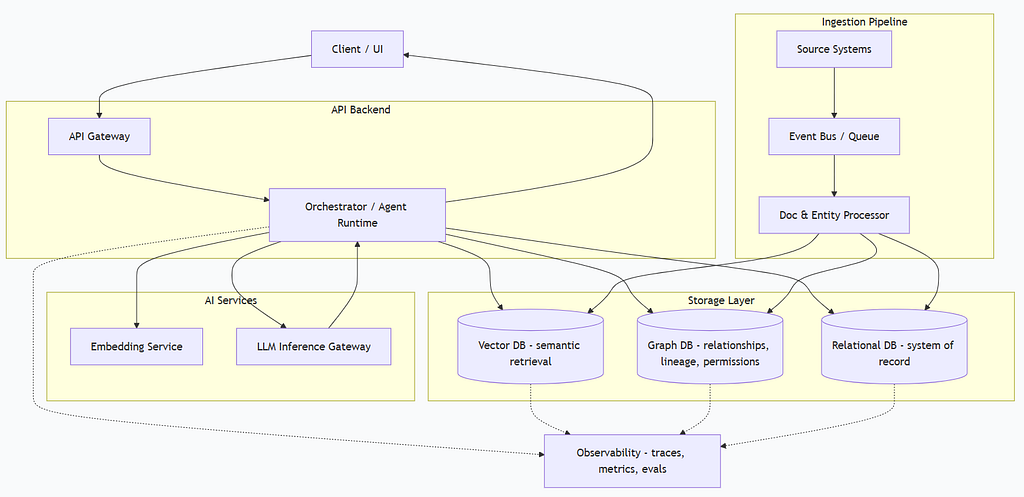
  3. Stop Picking Between Vector and Graph. Real Production AI Needs Three Databases.

    Production AI systems, particularly those using Retrieval-Augmented Generation (RAG), often fail when a single database is forced to handle diverse data types and functions. Vector databases excel at semantic search but lack robust transactional guarantees and struggle with updates, leading to 'drift' where outdated information is presented as fact. Graph databases are effective for structured relationships but inefficient for bulk text retrieval, while relational databases offer reliability but lack semantic search capabilities. The author advocates for a multi-database architecture, leveraging each database type for its specific strengths to build more resilient and accurate AI systems. AI

    Stop Picking Between Vector and Graph. Real Production AI Needs Three Databases.

    IMPACT Recommends a multi-database architecture to improve the accuracy and reliability of AI systems, particularly RAG, by avoiding single points of failure.