PulseAugur / Brief
EN
LIVE 23:46:23

Brief

last 24h
[27/27] 221 sources

Multi-source AI news clustered, deduplicated, and scored 0–100 across authority, cluster strength, headline signal, and time decay.

  1. How I made my React site agent-ready in 100 lines

    A developer has outlined a method to make React websites more accessible to AI agents, requiring approximately 100 lines of code. This approach involves implementing the proposed WebMCP standard, creating an `llms.txt` sitemap for models, and utilizing declarative form metadata like HTML5 attributes and ARIA roles. The new Lighthouse Agentic Browsing audit, set to be available in Chrome DevTools for Agents in 2026, verifies these changes. AI

    IMPACT Enables websites to be more easily navigated and interacted with by AI agents, potentially improving user experience and automation.

  2. Co-ReAct: Rubrics as Step-Level Collaborators for ReAct Agents

    Researchers have developed Co-ReAct, a new framework that uses step-level rubrics to guide ReAct-style AI agents during inference. This approach aims to improve the decision-making process for search-intensive, multi-step reasoning tasks, which often suffer from shallow or redundant trajectories. Co-ReAct injects rubrics into the agent's context at each step to guide evidence seeking, reasoning, and self-evaluation, leading to consistent improvements on benchmarks like DeepResearchBench and SQA-CS-V2. AI

    IMPACT Enhances AI agent performance in complex reasoning tasks by providing step-by-step guidance.

  3. OpenClaw Hit 250K Stars Faster Than React. I Spent 24 Hours Trying to Like It.

    OpenClaw, a new open-source developer tool, has rapidly gained popularity, surpassing React's GitHub star count in just 60 days. The tool allows users to select their preferred AI model, including options from Anthropic, OpenAI, and Google, for code generation and refactoring tasks. A key feature is the SOUL.md file, which defines the agent's persona and working style, proving more impactful per line than the project's CLAUDE.md description. AI

    IMPACT Sets a new benchmark for developer tool adoption and highlights the impact of configurable AI agents in coding workflows.

  4. Building AI-Tailored Document Generation (React Edition)

    This article outlines a method for generating AI-tailored documents that adhere to strict design templates and formats like PDF and HTML. The approach involves using code to handle the document structure, with the AI's role limited to analyzing user input and calling specific tools to refine content. This ensures stable, factual output and avoids inefficient token usage for design replication. The solution leverages React for rendering across different environments and utilizes the `@react-pdf/renderer` library for PDF generation, allowing for a consistent development experience. AI

    Building AI-Tailored Document Generation (React Edition)

    IMPACT Provides a technical blueprint for developers building AI-assisted document generation tools with consistent output.

  5. react-render-profile-mcp v0.3.1 - 4 new diagnostic tools for React Compiler, hydration, Zustand, and state cascades

    The developer released version 1.0 of react-render-profile-mcp, an AI agent designed to diagnose and fix React application render performance issues. This latest version successfully identified and remediated 12 spurious renders, saving 42ms of wasted time on a real open-source project by addressing an inline constant allocation. The tool works by decoding React DevTools Profiler exports, analyzing component behavior, and automatically suggesting or applying optimizations like React.memo. AI

    IMPACT Enhances developer productivity by automating the detection and fixing of performance bottlenecks in React applications.

  6. What’s the best tech stack for AI app development?

    Developing AI applications requires a specialized tech stack that differs from traditional web development due to the non-deterministic nature of LLMs. Python and JavaScript/TypeScript are recommended for AI workflows as they align better with how models are trained, leading to more predictable outcomes. Stacks built on less common ecosystems like Flutter or Swift can introduce friction and errors because models struggle to understand their project structures and build systems. AI

    What’s the best tech stack for AI app development?

    IMPACT Guides developers on selecting appropriate tech stacks to optimize AI application performance and development efficiency.

  7. Does programming language still matter in the age of AI prompting? And is filling your GitHub with AI generated projects ethical?

    A software developer with seven years of experience is questioning the relevance of programming languages and traditional coding skills in the era of AI-powered development tools. They are concerned about whether AI prompting can replace language mastery for job interviews and the ethical implications of filling a GitHub portfolio with AI-generated projects. The developer grapples with the blurred line between using AI as a helpful tool versus a crutch, questioning if their years of expertise still hold value. AI

    IMPACT Raises questions about the future value of traditional coding skills and the ethical considerations of using AI in software development.

  8. I agree with him. Honestly, people seriously underestimate how little many people know about technology. I work , am friends with and heck, even my online socia

    Many people overestimate their own technological literacy, as even those deeply immersed in tech fields like AI and RAG can feel out of their depth compared to their peers. Conversely, individuals with even basic tech knowledge are often perceived as 'tech geniuses' by those outside the industry. This highlights a significant gap in general technological understanding, where complex concepts like Jira or even simple tasks like using a VCR or streaming app can be challenging for many. AI

    IMPACT Highlights the broad gap in understanding AI and other technologies, suggesting a need for better public education and accessibility.

  9. Needed an investigation board… accidentally spent 3 days vibecoding this instead with cursor

    A developer built a real-time collaborative investigation board called LinkChart.art, spending three days on its development instead of the planned two hours. The tool features a large, zoomable canvas with smooth dragging and panning, enabling multi-user collaboration and live syncing. It also includes relationship lines between nodes and an editable SVG export system, with a primary focus on overcoming the challenge of lag-free real-time syncing. AI

    Needed an investigation board… accidentally spent 3 days vibecoding this instead with cursor

    IMPACT Niche tooling improvement; minimal industry-wide impact.

  10. Production begins where vibe coding ends. At first, it looked like a typical AI success story. In a couple of evenings, the LLM helped turn Google Shee

    An LLM significantly accelerated the initial development of a personal finance application, transforming a Google Sheet into a functional app within evenings. However, the project's complexity grew substantially with the addition of a backend, cross-device synchronization, mobile UX, AI recommendations, and robust testing infrastructure. This highlights that while AI can drastically speed up prototyping, the transition to a production-ready application involves extensive engineering beyond the initial demo. AI

    IMPACT Illustrates the gap between AI-assisted prototyping and full-scale production readiness.

  11. How We Solved the Hidden Problem of Cheap LLMs

    Two developers describe building sophisticated AI systems using Cascadeflow and Hindsight to overcome limitations of basic LLM applications. One created an auditable product intelligence pipeline for synthesizing customer feedback, using Cascadeflow for a structured, multi-stage evaluation and Hindsight for tracking sentiment over time. The other built a creator relationship memory system, employing Cascadeflow for intelligent model routing based on comment complexity and intent, and Hindsight for personalized follower memory. AI

    How We Solved the Hidden Problem of Cheap LLMs

    IMPACT These systems demonstrate advanced techniques for managing LLM interactions, improving reliability and cost-effectiveness in AI applications.

  12. Efficient Table QA via TableGrid Navigation and Progressive Inference Prompting

    Researchers have developed two novel prompting frameworks, TableGrid Navigation (TGN) and Progressive Inference Prompting (PIP), to enhance the performance of Large Language Models (LLMs) on tabular data question-answering tasks. These training-free methods aim to improve precise cell retrieval and structured reasoning without requiring task-specific fine-tuning. Evaluations on the TableBench and FeTaQa datasets show TGN outperforming baselines by 3.8 points on TableBench, while PIP achieves state-of-the-art results on FeTaQa, surpassing methods like ReAct and Chain-of-Thought. AI

    IMPACT Enhances LLM capabilities in structured reasoning and data retrieval, potentially improving enterprise applications dealing with tabular information.

  13. Forge is headless. One URL returns HTML to browsers, JSON to your frontend framework, and AI-optimised output to agents. No extra endpoints. No glue code. Conte

    Forge CMS has launched a new headless content management system designed for modern web development and AI integration. It uses a single URL to serve content in various formats, including HTML for browsers, JSON for frontend frameworks like React or Next.js, and AI-optimized output for agents. This approach eliminates the need for separate endpoints or glue code, allowing developers to use their preferred frontend technologies while ensuring seamless content delivery across different platforms. AI

    Forge is headless. One URL returns HTML to browsers, JSON to your frontend framework, and AI-optimised output to agents. No extra endpoints. No glue code. Conte

    IMPACT Provides developers with a flexible way to serve AI-optimized content, potentially streamlining AI agent integration with web applications.

  14. GLM 5.1 Thinks Strategically, Data

    Andrew Ng's latest newsletter categorizes software development tasks by how much coding agents accelerate them. Frontend development sees the most significant speed-up due to agents' fluency in popular languages and frameworks, along with their ability to iterate via browser operation. Backend development is moderately accelerated, but requires more human oversight for corner cases and debugging. Infrastructure and research tasks are least impacted, as agents have limited knowledge of complex systems and the core of research involves more than just coding. AI

    GLM 5.1 Thinks Strategically, Data

    IMPACT Provides a framework for understanding how AI coding tools are impacting various software development roles and workflows.

  15. Critical Security Vulnerability in React Server Components

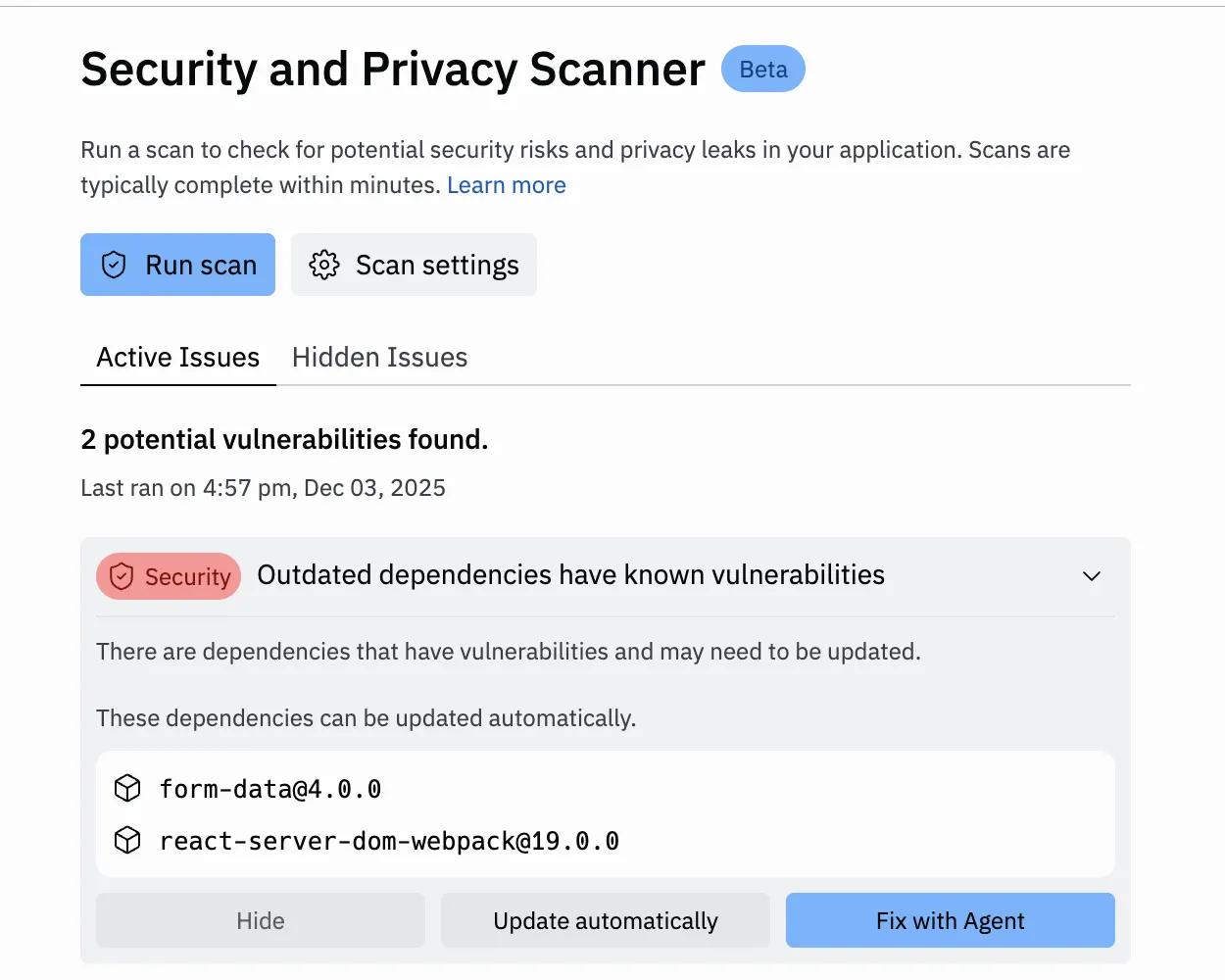
    A critical security vulnerability has been disclosed affecting React Server Components, impacting specific versions of React and Vercel's Next.js framework. The vulnerability could lead to issues such as middleware bypass, denial of service, and server-side request forgery. Replit has implemented mitigations for its deployments and is notifying affected users, while recommending immediate upgrades to patched versions of Next.js and React dependencies. AI

    Critical Security Vulnerability in React Server Components

    IMPACT Security vulnerability in React Server Components could impact AI development tools and platforms that rely on these components.

  16. Experiment: Figma to Replit Plugin

    Replit has launched Replit Import, a new feature allowing users to transform designs from tools like Figma, Lovable, and Bolt into functional applications. This import process is enhanced by Replit Agent, which can generate backend code and deploy applications, aiming to streamline the workflow from design to production. Additionally, Replit has released an experimental Figma to Replit plugin that generates responsive HTML, CSS, and React code from Figma designs, enabling quick prototyping and sharing of static frontend applications. AI

    Experiment: Figma to Replit Plugin

    IMPACT Accelerates prototyping and production deployment by integrating AI-powered code generation from design inputs.

  17. Openv0: The Open-Source, AI-Driven Generative UI Component Framework

    Replit has launched openv0, an open-source framework for generating UI components using generative AI. Developers can describe the interface they want, and openv0 will produce code for frameworks like React and Svelte, utilizing libraries such as NextUI and Shadcn. This tool aims to streamline the front-end development process by automating component creation and iteration, reducing manual workload for designers and engineers. The framework leverages both OpenAI's models for code generation and Replit's ModelFarm for design tasks, with a public demo available and the ability for users to fork and host their own versions. AI

    Openv0: The Open-Source, AI-Driven Generative UI Component Framework

    IMPACT Accelerates front-end development by automating UI component creation and iteration.

  18. My Experience as a Replit Design Intern

    Three individuals shared their internship experiences at Replit, highlighting diverse roles and significant contributions. Nathan, a technical intern, focused on code search and frontend engine improvements, learning new libraries and collaboration tools like Graphite. Lily, a community intern, managed moderation, organized events, and engaged with influencers, contributing to over 1,000 toxic account takedowns. Clément, a design intern, revamped interfaces, designed new features like the following feed, and shipped over 200 PRs, gaining experience in Figma, React, and the company's design system. AI

    My Experience as a Replit Design Intern

    IMPACT Provides insight into the practical application of skills and team collaboration within an AI-adjacent tech company.

  19. We Built a Search Engine

    Replit has launched a new, powerful search engine designed to help users find content within its platform in under 30 seconds. The engine indexes a wide range of items, including Repls, templates, code, users, and community content. This initiative addresses a significant user pain point, as 80% of users previously abandoned the search function due to its ineffectiveness. Replit built the search engine using Elasticsearch for indexing and Apache Spark for data pipelines, with plans to expand code search capabilities to all files in every Repl. AI

    We Built a Search Engine

    IMPACT Improves discoverability of code and community content, potentially aiding AI development and learning.

  20. Build a Speech-to-Text App with AssemblyAI on Replit

    This article details how to build a speech-to-text application using AssemblyAI's API and the Replit development platform. It guides users through setting up a Next.js project with React and Tailwind CSS, and then integrating AssemblyAI for audio transcription. The tutorial emphasizes AssemblyAI's capabilities beyond basic transcription, such as speaker detection, summarization, and custom vocabulary support, while also noting its free tier for development purposes. AI

    Build a Speech-to-Text App with AssemblyAI on Replit

    IMPACT Enables developers to easily integrate advanced speech-to-text capabilities into their applications.

  21. Build Your Own Livestreaming Service with api.video

    Replit and api.video have partnered to offer a tutorial on building a custom livestreaming service. The guide utilizes api.video's APIs and SDKs, which provide tools for video uploading, encoding, delivery, and analytics. Developers can create their own livestreaming platforms or embed video players with customizable branding, and the tutorial specifically demonstrates using Replit's in-browser IDE with Node.js and React. AI

    Build Your Own Livestreaming Service with api.video

    IMPACT Enables developers to build custom livestreaming solutions, potentially increasing adoption of video-centric applications.

  22. Implementing RUI, Replit's Design System

    Replit has developed a design system called RUI to address inconsistencies and inefficiencies in its user interface. The system aims to cover most design needs while remaining intuitive and powerful, leveraging React and exploring various styling approaches. After evaluating options like Styled JSX, Styled Components, Tailwind, Style props, and CSS prop, Replit opted for a solution that balances ease of use with robust styling capabilities. AI

    Implementing RUI, Replit's Design System

    IMPACT Streamlines UI development for a popular coding platform, potentially improving developer experience and productivity.

  23. Why We Switched From Webpack To Vite

    Replit has transitioned its React template from Create React App (CRA) to Vite, a modern JavaScript build tool. This change significantly improves development speed and efficiency for users building React applications on the Replit platform. Vite leverages esbuild for faster dependency pre-bundling and native ES Modules for serving source code, resulting in near-instantaneous hot module replacement and quicker UI prototyping. AI

    Why We Switched From Webpack To Vite

    IMPACT Accelerates developer workflows for AI application creation by improving frontend build times.

  24. React Framework Preboot

    Replit has introduced a new feature called "preboot" to significantly speed up the startup time for React framework development environments. Previously, users had to manually initiate the server, leading to delays. The new preboot system leverages Replit's existing container pooling infrastructure to ensure that a container is already running and listening on a port when a user accesses a React framework repl, allowing the IDE to attach instantly. AI

    IMPACT Speeds up development workflows for AI-adjacent applications built with React frameworks.

  25. Repl.it ❤️ React

    Replit has launched a public beta for building and deploying full-stack React applications directly on its platform. This new feature aims to simplify the development process for React frameworks like Next.js, offering a zero-configuration environment with real-time deployment. The initiative is part of Replit's effort to give back to the React community and make it easier for new developers, particularly from underserved backgrounds, to engage with the ecosystem. AI

    IMPACT Simplifies full-stack React development, potentially lowering barriers for new developers.

  26. Modular, fast, small: how we built a server-rendered IDE

    Replit has redesigned its integrated development environment (IDE) to be more modular, faster, and smaller. The new architecture centers around a lightweight core that acts as a window manager, with all functionalities implemented as plugins. This plugin-based system allows for greater customizability and server-side rendering, improving load times and accessibility, especially over slower internet connections. AI

    IMPACT Enhances developer tooling, potentially improving productivity and accessibility for coding environments.