PulseAugur / Brief
EN
LIVE 00:53:20

Brief

last 24h
[14/14] 222 sources

Multi-source AI news clustered, deduplicated, and scored 0–100 across authority, cluster strength, headline signal, and time decay.

  1. Influence-Inspired Spectral Rotations for Extreme Low-Bit LLM Quantization

    Researchers have developed a novel method called BBT-spectral for quantizing large language models (LLMs) to extremely low bit-widths, specifically W2A16 (2-bit weights, 16-bit activations). This technique utilizes influence-inspired spectral rotations and a reconstruction-error quantizer to significantly reduce perplexity, outperforming vanilla auto-round quantization by 15-58% on various model sizes. The method has been extended to address specific architectural challenges in models like Qwen3 and Qwen2.5, demonstrating its adaptability and effectiveness across different LLM families. AI

    IMPACT This research could enable more efficient deployment of LLMs on resource-constrained hardware by significantly reducing their memory footprint.
  2. RTX 3060 (12 GB) Benchmarks: more on Arint.info # AI # Benchmarks # Hardware # LLM # qwen3 # RTX3060 # arint_info https://x.com/LeTechLead/stat

    Benchmarks for the RTX 3060 graphics card with 12GB of VRAM have been published, focusing on its performance with AI models. The benchmarks specifically highlight its capabilities when running the Qwen3 large language model. AI

    IMPACT Provides data on the performance of consumer-grade hardware for running AI models.

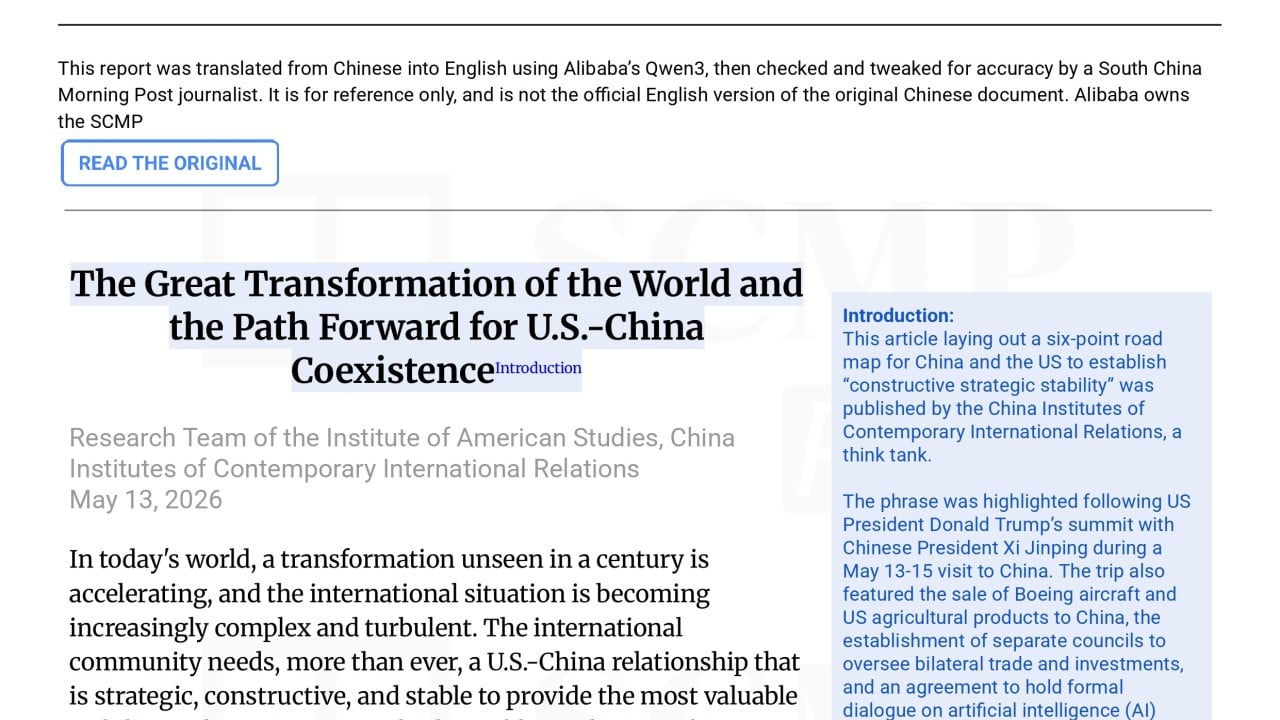
  3. China’s views on achieving ‘constructive, strategic and stable ties’ with US

    Alibaba's Qwen3 translation model was used to translate a Chinese document regarding China's diplomatic views with the US. A journalist then refined the translation for accuracy. The South China Morning Post, which is owned by Alibaba, published the translated document. AI

    China’s views on achieving ‘constructive, strategic and stable ties’ with US

    IMPACT AI models are increasingly being used to assist in news translation, potentially improving efficiency and reach.

  4. AR1-ZO: Topology-Aware Rank-1 Zeroth-Order Queries for High-Rank LoRA Fine-Tuning

    Researchers have developed AR1-ZO, a novel method for fine-tuning large language models using Zeroth-Order optimization and Low-Rank Adaptation (LoRA). This technique addresses the challenge of effectively increasing LoRA rank without compromising the signal-to-noise ratio in ZO queries. AR1-ZO achieves this by querying alternating rank-1 atoms with topology-aware scaling, which restores a rank-invariant active signal without requiring additional bases or forward passes. Experiments on OPT and Qwen3 models demonstrate that AR1-ZO enables high-rank LoRA fine-tuning to be effective within standard ZO query budgets. AI

    AR1-ZO: Topology-Aware Rank-1 Zeroth-Order Queries for High-Rank LoRA Fine-Tuning

    IMPACT Enables more efficient and effective fine-tuning of large language models by improving Zeroth-Order optimization techniques with LoRA.

  5. When Reasoning Supervision Hurts: TTCW-Based Long-Form Literary Review Generation

    Researchers have developed a new dataset containing over 260,000 long-form stories, each annotated with creativity scores and review comments based on the Torrance Test of Creative Writing (TTCW). They fine-tuned Qwen3 models on this data to generate literary reviews, finding that models trained without explicit reasoning supervision performed better. The study suggests that for structured, rubric-based review generation, reasoning supervision may not be beneficial and can even lead to irrelevant or repetitive outputs. AI

    When Reasoning Supervision Hurts: TTCW-Based Long-Form Literary Review Generation

    IMPACT Introduces a novel dataset and methodology for AI-driven literary review generation, potentially improving automated evaluation of creative writing.

  6. TORQ: Two-Level Orthogonal Rotation for MXFP4 Quantization

    Researchers have developed TORQ, a new framework for quantizing Large Language Models (LLMs) using the MXFP4 format. This method addresses accuracy degradation issues by analyzing and correcting imbalances in activation quantization. TORQ employs a two-level orthogonal rotation strategy to optimize the activation space, significantly improving LLM accuracy with 4-bit floating-point quantization. AI

    TORQ: Two-Level Orthogonal Rotation for MXFP4 Quantization

    IMPACT Improves LLM efficiency and accuracy by enabling better low-bit quantization, potentially reducing inference costs.

  7. LambdaPO: A Lambda Style Policy Optimization for Reasoning Language Models

    Researchers have introduced LamPO (Lambda Style Policy Optimization) and LambdaPO, novel methods for enhancing reasoning in language models. These approaches move beyond traditional group-relative objectives by using pairwise decomposed advantages, which better capture subtle differences in response quality. Experiments on various benchmarks with models like Qwen3 and Phi-4-mini show improved performance and training stability compared to existing methods. AI

    LambdaPO: A Lambda Style Policy Optimization for Reasoning Language Models

    IMPACT Introduces new techniques for more stable and efficient training of reasoning language models.

  8. TIP: Token Importance in On-Policy Distillation

    Researchers have developed new methods to improve on-policy distillation (OPD), a technique for training smaller language models using larger ones. One approach, TIP, identifies informative tokens by analyzing student entropy and teacher-student divergence, achieving significant memory reduction and performance gains. Another method, SimCT, addresses issues with different tokenizers by expanding the supervision space to include multi-token continuations, recovering lost signal and improving performance on reasoning and code generation tasks. Additionally, EffOPD accelerates OPD training by optimizing update trajectories and module allocation, leading to a threefold speedup. AI

    IMPACT These research advancements offer more efficient and effective ways to train smaller language models, potentially reducing computational costs and improving performance on complex reasoning tasks.

  9. Benchmarking Patent Embeddings: A Multi-Task Evaluation of 22 Models Across Retrieval, Classification, and Clustering

    A new study evaluated 22 different models, ranging from small encoders to large instruction-tuned LLMs, on their ability to process patent data for tasks like retrieval, classification, and clustering. The research found that fine-tuning effectiveness is highly dependent on the specific task and that gains in one area do not always transfer to others. While larger models generally performed better within their families, cross-family comparisons showed noisy results, with smaller models sometimes outperforming larger ones on specific tasks. The study also highlighted that combining abstract and claim information significantly improved retrieval and classification, though all models struggled with out-of-domain queries. AI

    IMPACT Provides insights into which models and fine-tuning strategies are most effective for processing specialized data like patents, informing AI operators in legal and R&D sectors.

  10. Rethinking Muon Beyond Pretraining: Spectral Failures and High-Pass Remedies for VLA and RLVR

    Researchers have developed several new optimization techniques to improve deep learning model training. AMUSE combines the rapid adaptation of Muon with the stability of Schedule-Free averaging, eliminating the need for learning rate schedules and improving performance across vision and language tasks. Another approach, MiMuon, enhances the generalization capabilities of Muon by blending it with SGD, offering a lower generalization error. Additionally, a new optimizer called Pion addresses Muon's limitations in vision-language-action and reinforcement learning by employing a spectral high-pass filtering mechanism. AI

    IMPACT These new optimizers aim to improve training efficiency and generalization for large models, potentially accelerating development in areas like LLMs and robotics.

  11. SciEval: A Benchmark for Automatic Evaluation of K-12 Science Instructional Materials

    A new paper proposes that LLM hallucinations stem not from a lack of knowledge, but from a failure in commitment, where models disperse probability mass across alternatives instead of concentrating on the correct answer. This phenomenon is observed to increase with model scale and is exacerbated by instruction tuning. Another paper introduces GAMMA, a framework for mixed-precision quantization that optimizes bit allocation for LLMs, significantly improving accuracy under memory constraints and outperforming existing methods on Llama and Qwen models. Additionally, a benchmark called SciEval has been developed to automatically evaluate K-12 science instructional materials, revealing that current mainstream LLMs perform poorly on this task without domain-specific fine-tuning. AI

    SciEval: A Benchmark for Automatic Evaluation of K-12 Science Instructional Materials

    IMPACT New research sheds light on LLM hallucination mechanisms and introduces novel methods for model optimization and evaluation, potentially improving reliability and efficiency.

  12. 🚀Qwen3.7-Max just landed at 56.6 on the Artificial Analysis Intelligence Index — a solid 4.8pt jump over Qwen3.6-Max-Preview. @ArtificialAnlys

    Alibaba's Qwen has released Qwen3.7-Max, a new flagship model designed for the Agent Era. This model demonstrates significant improvements in scientific reasoning, coding, and agentic capabilities, achieving a score of 56.6 on the Artificial Analysis Intelligence Index. Qwen3.7-Max also showcases enhanced performance in autonomous execution and generalization across various benchmarks, with features like implicit caching now live. AI

    IMPACT Sets a new benchmark for agentic capabilities and reasoning, potentially accelerating the development of autonomous AI systems.

  13. DeepSeek-V3.1: Hybrid Thinking Model Now Available on Together AI

    Together AI has launched a new service called Dedicated Container Inference, designed to optimize the deployment and performance of custom generative media models. This platform handles complex orchestration tasks like autoscaling, queuing, and traffic isolation, allowing teams to focus on their model logic. The service has already demonstrated significant inference speedups, with some customers experiencing up to 2.6x faster performance. Additionally, Together AI has announced advancements in their inference platform, achieving up to 2x faster serverless inference for top open-source models by leveraging next-generation GPU hardware and optimized kernels. AI

    IMPACT Accelerates deployment and inference for custom and open-source AI models, potentially lowering costs and increasing accessibility for specialized AI applications.

  14. The Frontier is Open

    Together AI argues that the future of AI development lies in open-source models, challenging the notion that proprietary labs are the sole drivers of innovation. The company highlights that open-source platforms offer greater flexibility and cost-efficiency, crucial for the widespread adoption of AI applications. They point to recent advancements in open-source models like Llama 3, Deepseek R1, and Qwen3 as evidence that the frontier of AI is increasingly being shaped by collaborative, open development. AI

    IMPACT Argues that open-source models will increasingly define the AI frontier, offering cost and flexibility advantages over proprietary solutions.