PulseAugur / Brief
EN
LIVE 11:22:48

Brief

last 24h
[4/4] 221 sources

Multi-source AI news clustered, deduplicated, and scored 0–100 across authority, cluster strength, headline signal, and time decay.

  1. QLoRA Fine-Tuning of LLaMA 3.2–1B Instruct on a Healthcare Domain Dataset

    A technical article details the process of fine-tuning the LLaMA 3.2–1B Instruct model using the QLoRA method. The fine-tuning was performed on a dataset specifically curated for the healthcare domain. This approach aims to adapt the general-purpose language model for specialized tasks within healthcare. AI
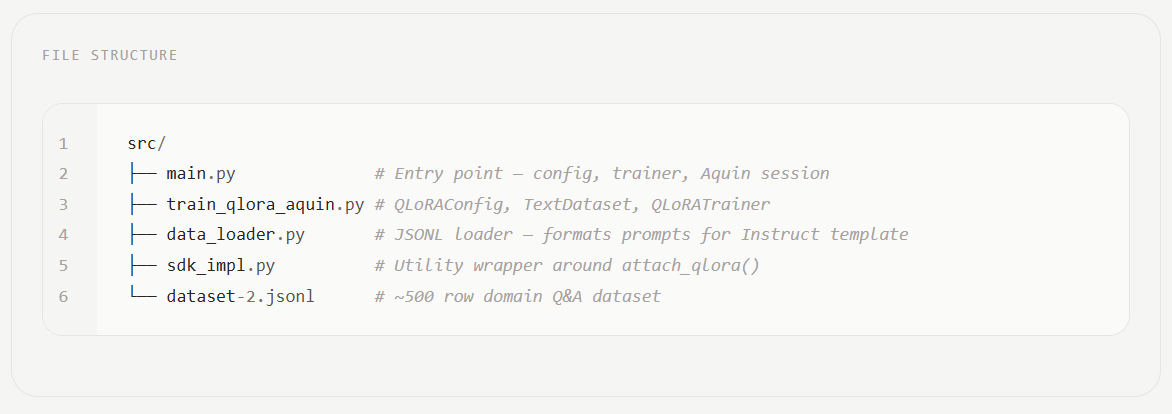
    QLoRA Fine-Tuning of LLaMA 3.2–1B Instruct on a Healthcare Domain Dataset

    IMPACT Demonstrates domain adaptation techniques for open-source models, potentially improving their utility in specialized fields like healthcare.

  2. The Forgotten Pioneer: The Legendary Four Open-Source Models That First Topped the Chatbot Arena

    Four early open-source models—Vicuna-13B, Guanaco-33B, Vicuna-33B, and WizardLM-70B—briefly dominated the Chatbot Arena, outperforming early commercial offerings. Vicuna-13B, trained for $300, pioneered the use of ChatGPT conversation data for fine-tuning and indirectly led to the creation of the Chatbot Arena platform. Guanaco-33B demonstrated the power of QLoRA for efficient fine-tuning on consumer hardware, a technique that revolutionized open-source model development. WizardLM-70B, developed by Microsoft, introduced the Evol-Instruct method for generating complex training data, though its successor, WizardLM-2, was mysteriously removed from public access shortly after its release. AI

    The Forgotten Pioneer: The Legendary Four Open-Source Models That First Topped the Chatbot Arena

    IMPACT These early open-source models pioneered efficient training and data generation techniques, paving the way for today's advanced LLMs.

  3. I Thought Fine-Tuning LLMs Needed Expensive GPUs. I Was Wrong.

    Developers can fine-tune large language models like TinyLlama on consumer hardware with as little as 3 GB of GPU memory using techniques such as QLoRA and NF4 quantization. This process involves training only a small fraction of the model's parameters, significantly reducing computational requirements. The process can be complex, with challenges arising from debugging, prompt formatting, and dependency management, but offers a path for solo developers to build sophisticated AI applications. AI

    I Thought Fine-Tuning LLMs Needed Expensive GPUs. I Was Wrong.

    IMPACT Enables solo developers and smaller teams to fine-tune advanced LLMs, democratizing AI development and deployment.

  4. 📰 XQuery to SQL Conversion: QLoRA vs Hybrid Parsing (2026 Benchmarks) As enterprises seek to convert XQuery to SQL using local LLMs, experts debate whether fine

    A new open-source pipeline called SGOCR 2026 has been released, designed to generate spatially-grounded OCR datasets for training vision-language models. This pipeline aims to separate text localization from semantic reasoning, addressing a gap in current VLM training data. Separately, discussions are ongoing regarding the conversion of XQuery to SQL using local LLMs, with a debate on whether fine-tuning is necessary or if hybrid parsing and prompt engineering suffice. Additionally, China's AI progress, particularly from DeepSeek, is challenging claims of a significant US lead in the field, with government backing and cost-effective models playing a role. AI

    📰 XQuery to SQL Conversion: QLoRA vs Hybrid Parsing (2026 Benchmarks) As enterprises seek to convert XQuery to SQL using local LLMs, experts debate whether fine

    IMPACT New tools and datasets for VLM training emerge, while debates on LLM efficiency for code conversion and geopolitical AI competition continue.