PulseAugur / Brief
EN
LIVE 13:10:55

Brief

last 24h
[8/8] 221 sources

Multi-source AI news clustered, deduplicated, and scored 0–100 across authority, cluster strength, headline signal, and time decay.

  1. The Cognitive Kardashev Scale: Quantifying the Material Envelope of Civilisational Computation

    Researchers have proposed a new framework called the Cognitive Kardashev Scale to measure the computational capacity of civilizations. This scale, analogous to the power-based Kardashev scale, quantifies the amount of sustained AI-grade computation a civilization could support based on its total energy output and computational efficiency. Current humanity is estimated to be at approximately 0.73 on this scale, with projections indicating significant increases in computational power by 2035, though the ultimate limits may be dictated by energy availability, efficiency, or political factors. AI

    IMPACT Proposes a novel metric for assessing the future computational capacity of civilizations, potentially guiding long-term AI development and resource allocation.

  2. Announcing General Availability of Together Instant Clusters, offering ready to use, self

    Together AI has launched Together Instant Clusters, a new service providing readily available, self-service GPU clusters for AI development and deployment. This offering aims to simplify the complex process of setting up multi-node GPU infrastructure, allowing users to provision clusters with hundreds of GPUs in minutes via API, CLI, or console. The service includes pre-configured components for distributed training and inference, supporting NVIDIA's latest GPU architectures and high-performance networking solutions. AI

    Announcing General Availability of Together Instant Clusters, offering ready to use, self

    IMPACT Simplifies GPU cluster provisioning, enabling faster experimentation and deployment for AI workloads.

  3. NVIDIA GTC Taipei at COMPUTEX: Live Updates on What’s Next in AI

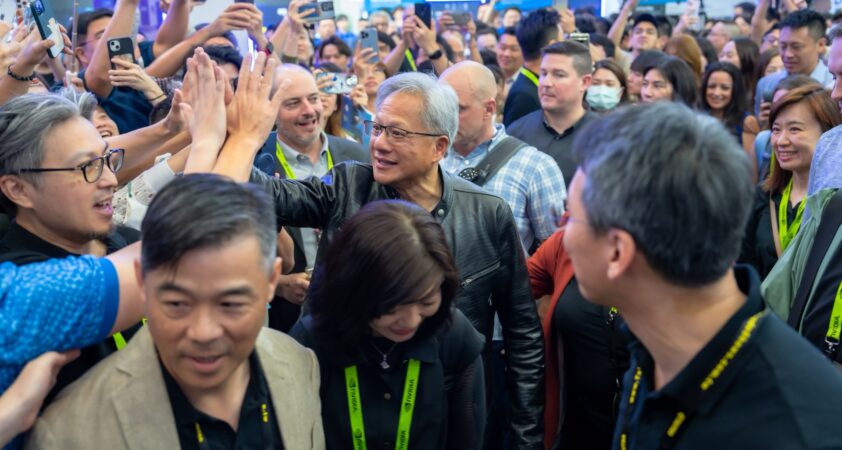
    NVIDIA is showcasing its latest AI innovations at GTC Taipei, including the Vera Rubin NVL72 AI supercomputer, which received multiple Best Choice Awards. This system is designed for large-scale AI inference and training, offering significant performance and efficiency gains. Additionally, NVIDIA highlighted the Jetson Thor platform for edge AI and robotics, emphasizing its enhanced capabilities for generative AI applications. AI

    NVIDIA GTC Taipei at COMPUTEX: Live Updates on What’s Next in AI

    IMPACT Highlights advancements in AI infrastructure and edge computing, potentially accelerating deployment of advanced AI capabilities.

  4. DeepSeek V4 Complete Guide — 1.6T MoE with 1M Context at 73% Lower Cost

    DeepSeek V4, an open-weight model family, has been released with a 1.6-trillion-parameter Mixture-of-Experts architecture that activates only 49 billion parameters per token. This new model boasts a 1-million-token context window and significantly reduced inference costs, achieving up to 73% lower costs than its predecessor due to innovations like Hybrid Attention. The V4 family, available on Hugging Face, offers comparable quality to leading models like GPT-5.4 and Claude Opus 4.6 at a fraction of the price, with optimized hardware performance for NVIDIA Blackwell. AI

    DeepSeek V4 Complete Guide — 1.6T MoE with 1M Context at 73% Lower Cost

    IMPACT Sets a new standard for efficiency in large MoE models, making advanced AI capabilities more accessible and affordable for developers.

  5. I built a Mamba1 variant I call SM1 with d_state=1 that runs on Blackwell in pure PyTorch [P]

    A developer has created SM1, a variant of the Mamba1 architecture, optimized for PyTorch and capable of running on NVIDIA Blackwell hardware. SM1 replaces the selective scan with two native PyTorch operations, achieving the exact closed-form solution for the d_state=1 recurrence. This optimization significantly reduces memory usage, with a 130M parameter model requiring only 56 KB for its inference state, eliminating the need for a KV cache. AI

    IMPACT This optimized Mamba variant could lead to more efficient training and inference for certain sequence modeling tasks.

  6. Learn how Cursor partnered with Together AI to deliver real-time, low-latency inference at scale

    Cursor, an AI-powered coding platform, has partnered with Together AI to optimize its real-time inference capabilities. This collaboration focuses on achieving low-latency responses within the editor's feedback loop, which is crucial for the AI's predictive and refactoring features. The partnership leverages NVIDIA's Blackwell architecture, specifically the GB200 NVL72, to enhance performance and reduce response times for developers. AI

    IMPACT Enables faster, more responsive AI coding assistance by optimizing inference infrastructure, potentially improving developer productivity.

  7. Together AI delivers fastest inference for the top open-source models

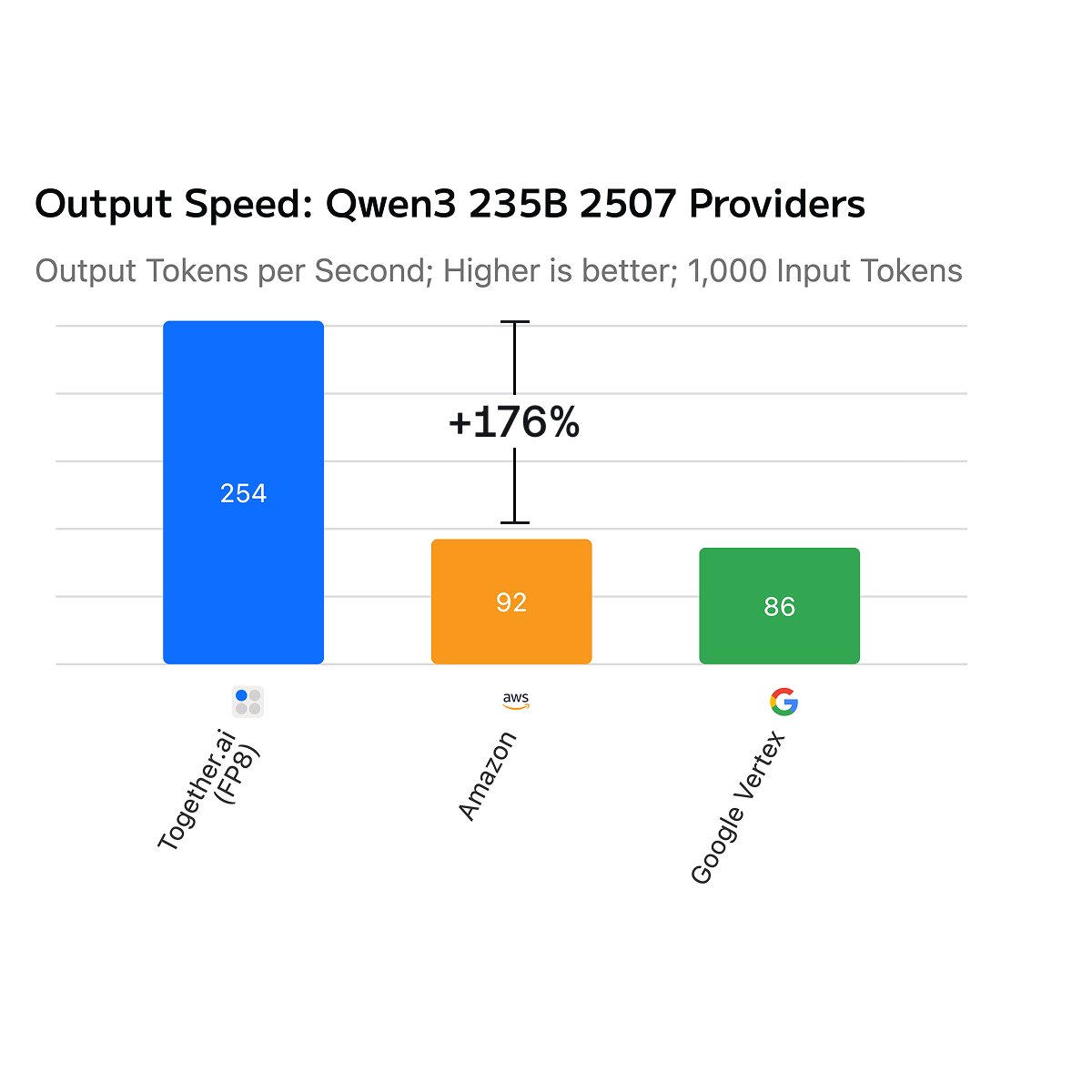
    Together AI has launched a new service called Dedicated Container Inference, designed to optimize the deployment and performance of custom generative media models. This platform handles complex orchestration tasks like autoscaling, queuing, and traffic isolation, allowing teams to focus on their model logic. The service has already demonstrated significant inference speedups, with some customers experiencing up to 2.6x faster performance. Additionally, Together AI has announced advancements in their inference platform, achieving up to 2x faster serverless inference for top open-source models by leveraging next-generation GPU hardware and optimized kernels. AI

    Together AI delivers fastest inference for the top open-source models

    IMPACT Accelerates deployment and inference for custom and open-source AI models, potentially lowering costs and increasing accessibility for specialized AI applications.

  8. Salesforce, Zoom, InVideo Train Faster with Together AI Turbocharged with NVIDIA Blackwell

    Together AI has launched new GPU clusters featuring NVIDIA's Blackwell platform, offering significant speedups for AI training and inference. These clusters, powered by the Together Kernel Collection, achieve up to 90% faster training speeds compared to previous NVIDIA H100 hardware, processing over 15,000 tokens per second for large models. Early access customers like Salesforce and Zoom have reported substantial performance gains, with some experiencing double the training speed. Together AI's optimization efforts span custom kernels, inference engines, and speculative decoding, aiming to redefine efficiency in AI model development and deployment. AI

    Salesforce, Zoom, InVideo Train Faster with Together AI Turbocharged with NVIDIA Blackwell

    IMPACT Accelerates AI training and inference, potentially lowering costs and increasing the pace of model development and deployment for enterprises.