PulseAugur / Brief
EN
LIVE 14:28:35

Brief

last 24h
[2/2] 221 sources

Multi-source AI news clustered, deduplicated, and scored 0–100 across authority, cluster strength, headline signal, and time decay.

  1. NeRF-based Spacecraft Reconstruction from Close-Range Monocular Imagery Under Illumination Variability and Pose Uncertainty

    Researchers have developed new methods using Neural Radiance Fields (NeRF) to improve spacecraft pose estimation and 3D reconstruction from imagery. One approach uses NeRF-based augmentations to train pose estimators with significantly fewer images, overcoming the limitations of traditional CAD-based training. Another method enhances NeRF by incorporating per-image appearance embeddings and pose correction, making it more robust to variable lighting and inaccurate pose data during reconstruction. AI

    NeRF-based Spacecraft Reconstruction from Close-Range Monocular Imagery Under Illumination Variability and Pose Uncertainty

    IMPACT New NeRF-based techniques promise more robust and data-efficient spacecraft pose estimation and 3D reconstruction for space missions.
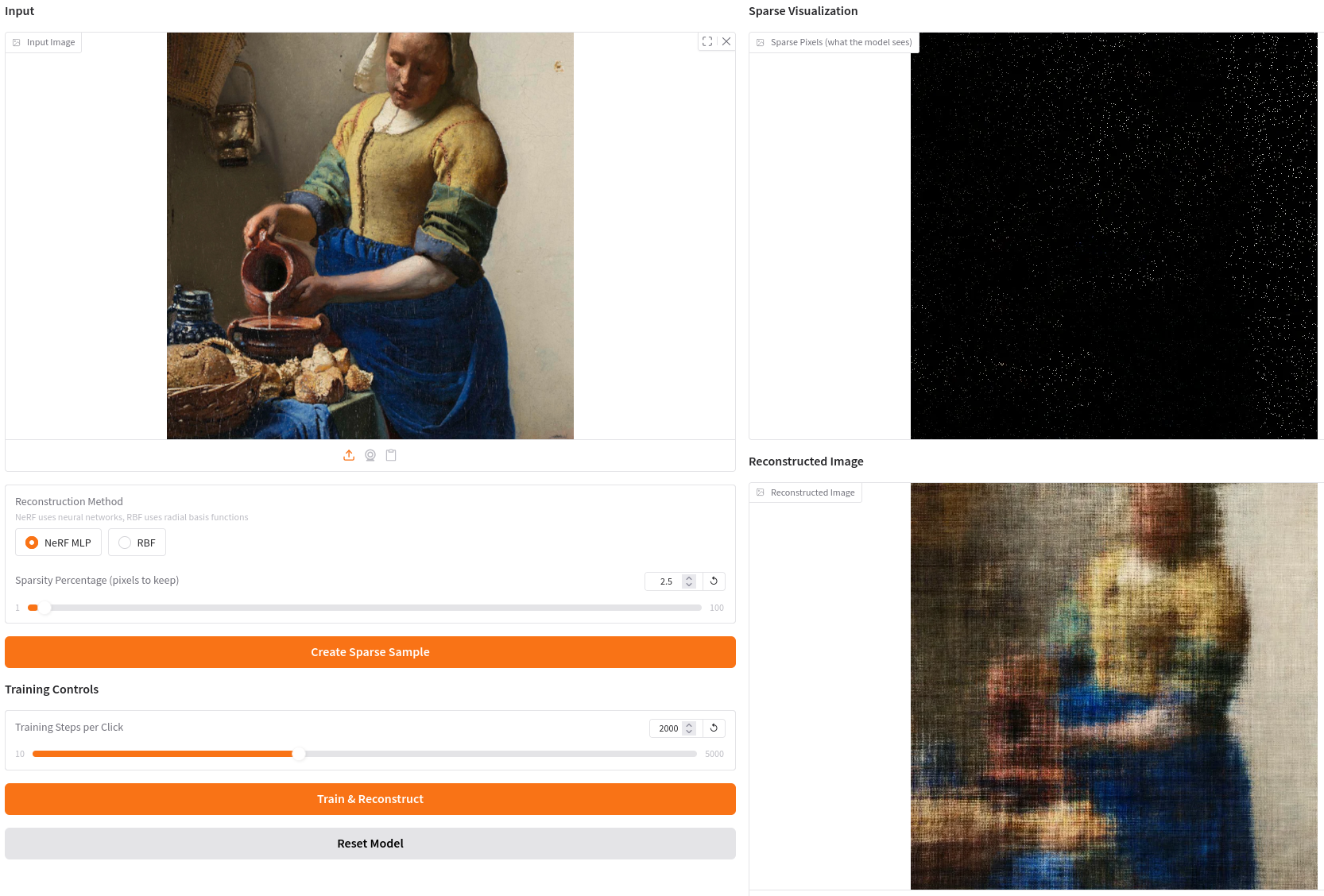
  2. I'd been toying with sparse image reconstruction techniques, figuring out some pretty naive mathematical methods, then uncovered you can use NeRFs to train on t

    A developer has explored using Neural Radiance Fields (NeRFs) for sparse image reconstruction. This technique involves training NeRFs on limited visual data to generate more complete images. The developer found this approach effective for creating detailed reconstructions from sparse inputs. AI

    I'd been toying with sparse image reconstruction techniques, figuring out some pretty naive mathematical methods, then uncovered you can use NeRFs to train on t