PulseAugur / Brief
EN
LIVE 20:33:23

Brief

last 24h
[23/23] 221 sources

Multi-source AI news clustered, deduplicated, and scored 0–100 across authority, cluster strength, headline signal, and time decay.

  1. Encrypted Neural Networks without Overflows

    Researchers have identified a critical vulnerability in Fully Homomorphic Encryption (FHE) schemes, specifically the widely used CKKS scheme, which can lead to overflow attacks. These attacks corrupt neural network outputs by causing inputs to exceed the tolerances of FHE circuits. To address this, the paper proposes a formal verification technique that calculates certified bounds for neuron ranges, effectively eliminating overflows and reducing failure rates to zero in experimental benchmarks. This overflow-free solution is compatible with existing CKKS frameworks by allowing the substitution of standard polynomials with rigorously designed ones. AI

    IMPACT Addresses a critical security flaw in using FHE for private AI inference, potentially enabling more robust and secure deployment of AI models.

  2. Dirichlet-Based Monte Carlo Dropout for Uncertainty Estimation in Neural Networks

    Researchers have developed a new method to improve uncertainty estimation in neural networks by integrating a Dirichlet-based framework with Monte Carlo Dropout. This approach aims to provide more informative uncertainty representations while maintaining the computational efficiency of existing techniques. The method is presented as a practical solution for creating deep learning models that are aware of their prediction uncertainties. AI

    IMPACT Offers a more practical and efficient way to build deep learning models that can reliably indicate their own uncertainty.

  3. Convergence Analysis of Newton's Method for Neural Networks in the Overparameterized Limit

    Researchers have developed a convergence analysis for Newton's method applied to neural networks in an overparameterized setting. Their work shows that as the number of hidden units increases, the training dynamics approach a deterministic limit governed by a "Newton neural tangent kernel" (NNTK). This NNTK allows for exponential convergence to a global minimum, overcoming the spectral bias issues that affect standard gradient descent, especially for high-frequency data components. AI

    IMPACT Introduces a theoretical framework for faster neural network training, potentially improving performance on complex data.

  4. How to Animate Characters and Make Them Talk to Each Other with Neural Networks https:// peertube.eqver.se/w/2pLoQpCwk1 eTcwPeJWmEFF

    This cluster details a tutorial on animating characters and enabling them to converse using neural networks. The content focuses on practical application, likely demonstrating techniques for generating character animations and synthesizing dialogue through AI. AI

    IMPACT Provides a guide for developers and animators on leveraging AI for character creation and interaction.

  5. Mirror Mean-Field Langevin Dynamics

    Researchers have introduced Mirror Mean-Field Langevin Dynamics (MMFLD) to address optimization problems with constrained domains in probability measures. This new method extends existing mean-field algorithms, which are typically limited to unconstrained spaces. MMFLD is designed for optimizing probability measures within convex subsets of \(\mathbb{R}^d\), offering a solution for complex interacting particle systems like those found in infinite-width neural networks. AI

    Mirror Mean-Field Langevin Dynamics

    IMPACT Introduces a novel optimization technique applicable to complex machine learning models like neural networks.

  6. Canonical Regularisation of Wide Feature-Learning Neural Networks

    A new paper introduces a novel framework for understanding and generalizing regularization in wide neural networks. The research identifies that standard ridge regularization can distort the inductive bias of feature-learning networks, particularly impacting pre-trained models. To address this, the authors axiomatize a regime-agnostic canonical regularizer and derive a generalized ridge, proposing "arc ridge" as a practical, robust surrogate that connects early stopping to canonical regularization across learning regimes. The theory is validated through empirical studies in image processing and NLP. AI

    Canonical Regularisation of Wide Feature-Learning Neural Networks

    IMPACT Introduces a new theoretical framework for understanding and improving neural network training, potentially impacting model performance and generalization.

  7. Unveiling Memorization-Generalization Coexistence: A Case Study on Arithmetic Tasks with Label Noise

    Researchers have explored how highly over-parameterized neural networks can simultaneously memorize noisy data and generalize effectively. Their study on arithmetic tasks with up to 80% label noise revealed that larger models generally perform better with proper optimization, and noisy labels are learned more quickly than clean ones. The findings suggest that an internal generalization structure exists within these models, which can be extracted using frequency-based methods to achieve high test accuracy. AI

    Unveiling Memorization-Generalization Coexistence: A Case Study on Arithmetic Tasks with Label Noise

    IMPACT This research offers insights into how large neural networks handle noisy data, potentially leading to more robust models in real-world applications with imperfect datasets.

  8. A Rigorous, Tractable Measure of Model Complexity

    Researchers have developed a new, mathematically sound, and computationally efficient method for measuring model complexity. This approach, based on analyzing similarities in model gradients across different inputs, is applicable to a wide range of models, including parametric, non-parametric, and kernel-based types. The proposed measure unifies and generalizes existing complexity metrics for various models like decision trees and neural networks, offering new insights into phenomena such as double descent. AI

    IMPACT Provides a unified and tractable method for assessing model complexity, aiding in interpretation, generalization, and model selection across various AI architectures.

  9. High Quality Embeddings for Horn Logic Reasoning

    Researchers have developed new methods for creating high-quality embeddings, which are numerical representations of logical statements, to improve the efficiency of neural networks in logical reasoning tasks. The proposed techniques involve using triplet loss for training, with specific strategies for generating anchor, positive, and negative examples to balance difficulty and emphasize harder cases. Experiments were conducted to evaluate these embeddings across various knowledge bases, aiming to identify characteristics that make them suitable for different reasoning challenges. AI

    IMPACT Introduces new techniques for generating embeddings that could improve the efficiency and effectiveness of AI systems in logical reasoning tasks.

  10. Gradient Descent as a Perceptron Algorithm: Understanding Dynamics and Implicit Acceleration

    Researchers have demonstrated that gradient descent steps in neural networks trained with logistic loss can be simplified to resemble generalized perceptron algorithms. This new perspective, using classical linear algebra, reveals how the nonlinearity in two-layer models can achieve faster iteration complexity than linear models. The findings offer a theoretical explanation for the implicit acceleration observed in neural network optimization and are supported by numerical experiments. AI

    IMPACT Provides a novel theoretical framework for understanding and potentially improving neural network training efficiency.

  11. Learning Orthonormal Bases for Function Spaces

    Researchers have developed a novel method using neural networks to learn and optimize orthonormal bases for function spaces. This approach allows bases to adapt to specific datasets or problems, unlike fixed bases like Fourier or wavelets. The technique models orthonormal bases as paths on a Lie manifold, driven by ordinary differential equations parameterized by neural networks. The study demonstrates that even with low-rank generators, these neural network-defined paths can approximate any target orthonormal basis, showing flexibility in applications like principal component analysis and physical simulations. AI

    Learning Orthonormal Bases for Function Spaces

    IMPACT Introduces a flexible method for adaptive basis representation in function spaces, potentially improving performance in data analysis and scientific simulations.

  12. Holographic functions and neural networks

    Researchers have introduced a new concept called the "holographic property" to define bounded complexity in fuzzy Boolean functions. This property is shown to be equivalent to a function being uniformly close to a bounded-degree polynomial or the output of a neural network with specific constraints. The equivalence was demonstrated through mathematical proofs, utilizing variants of hypergraph regularity. AI

    IMPACT Introduces a new theoretical framework for understanding neural network complexity and its relationship to mathematical structures.

  13. How does feature learning reshape the function space?

    Researchers have precisely characterized how feature learning in neural networks reshapes the function space during gradient descent training. Their analysis, conducted in a high-dimensional proportional regime, shows that after a large gradient step, the feature distribution approximates a target-dependent spiked Gaussian covariance. This process induces a data-adaptive kernel that modifies the function space's spectral structure, selectively amplifying directions aligned with the target signal. AI

    How does feature learning reshape the function space?

    IMPACT Provides a theoretical framework for understanding how neural networks learn features, potentially guiding future model development.

  14. I like that my "philosophy of AI" book argues that human cognition lies somewhere between innate and learned--more towards the learned side, with the innate bit

    A book on the philosophy of AI posits that human cognition is a blend of innate and learned factors, leaning more towards learned capabilities. The author suggests that the advancements in AI support this perspective, highlighting that life can fluidly shift cognitive effort between these modes. This view is particularly relevant when considering neural networks not just as models of human minds, but also as potential models of evolved biological mechanisms. AI

    IMPACT AI's success may offer new perspectives on the fundamental nature of cognition, suggesting a more fluid interplay between innate and learned processes.

  15. Axiomatizing Neural Networks via Pursuit of Subspaces

    Researchers have introduced a new theoretical framework called the Pursuit of Subspaces (PoS) hypothesis to better understand the inner workings of deep neural networks. This axiomatic approach uses geometric postulates to explain representation, computation, and generalization in neural network architectures. The PoS hypothesis aims to bridge the gap between the empirical success of neural networks and the current lack of theoretical understanding, offering a principled foundation for deep learning. AI

    Axiomatizing Neural Networks via Pursuit of Subspaces

    IMPACT Provides a new theoretical lens for understanding and potentially improving neural network architectures and generalization.

  16. k-Inductive Neural Barrier Certificates for Unknown Nonlinear Dynamics

    Researchers have developed k-inductive neural barrier certificates (k-NBCs) to enhance safety guarantees for nonlinear systems with unknown dynamics. This method relaxes traditional safety constraints by allowing temporary increases in a barrier function, up to k-1 times within a threshold, while ensuring overall system safety. The approach utilizes neural networks for scalability and integrates counterexample-guided inductive synthesis with satisfiability modulo theories for verification, using a single state trajectory to construct data-driven system models. AI

    k-Inductive Neural Barrier Certificates for Unknown Nonlinear Dynamics

    IMPACT Introduces a novel method for verifiable safety in AI systems with unknown dynamics.

  17. Representation Gap: Explaining the Unreasonable Effectiveness of Neural Networks from a Geometric Perspective

    Researchers have introduced a new metric called the Representation Gap to better understand and predict the generalization error of neural networks. This metric, related to asymptotic dynamics, is governed by the task's intrinsic dimension. The study demonstrates the metric's accuracy on various datasets and links it to common neural network architectures. AI

    IMPACT Introduces a new metric to better predict neural network performance, potentially improving model design and reducing reliance on heuristics.

  18. Why Hybrid AI Is No Longer Optional In Banking And Finance

    The future of AI in finance and banking necessitates a hybrid approach, combining the pattern-recognition strengths of neural networks with the precision of symbolic logic and deterministic tools. Generic AI models like ChatGPT, while impressive, are too prone to "hallucinations" and probabilistic outputs, making them unreliable for critical financial tasks such as regulatory compliance and interest rate calculations. Hybrid AI, often implemented as an agent, delegates document understanding to neural networks while offloading exact calculations and verifications to specialized, precise programming libraries, significantly reducing development time and mitigating risks. AI

    Why Hybrid AI Is No Longer Optional In Banking And Finance

    IMPACT Hybrid AI approaches are crucial for reliable AI deployment in sensitive sectors like finance, ensuring accuracy and compliance by integrating deterministic logic with probabilistic models.

  19. A Fourier perspective on the learning dynamics of neural networks: from sample complexities to mechanistic insights

    Researchers have explored the learning dynamics of neural networks through a Fourier perspective, focusing on how they learn simpler features before more complex ones. Their work introduces a synthetic data model for translation-invariant inputs, demonstrating that while phase information alone is difficult for SGD to learn, power-law spectra can significantly accelerate this process. This approach provides mechanistic insights into the efficient learning of natural image distributions by deep neural networks. AI

    A Fourier perspective on the learning dynamics of neural networks: from sample complexities to mechanistic insights

    IMPACT Provides mechanistic insights into how neural networks learn complex image distributions, potentially informing future model architectures and training strategies.

  20. Collocational bootstrapping: A hypothesis about the learning of subject-verb agreement in humans and neural networks

    Researchers have proposed a new hypothesis called "collocational bootstrapping" to explain how statistical patterns in language input can aid in learning syntactic dependencies. This mechanism suggests that word co-occurrence regularities can signal syntactic relationships, specifically focusing on how subject-verb agreement might be acquired. Computational simulations using neural networks trained on synthetic data demonstrated that these models could robustly learn subject-verb agreement within a specific range of statistical variability. Analysis of child-directed language revealed that the variability in subject-verb pairings in such input falls within this effective range, supporting the idea that collocational bootstrapping is a viable learning strategy for children. AI

    Collocational bootstrapping: A hypothesis about the learning of subject-verb agreement in humans and neural networks

    IMPACT Suggests a novel mechanism for AI models to learn grammatical structures from statistical patterns in language data.

  21. Partial Fusion of Neural Networks: Efficient Tradeoffs Between Ensembles and Weight Aggregation

    Researchers have developed a new technique called partial fusion for neural networks, which offers a flexible balance between computational cost and performance. This method interpolates between traditional ensembles and weight aggregation, allowing for a tunable tradeoff. The approach identifies and aggregates weights of similar neurons, effectively acting as a generalized pruning method for ensemble models. AI

    IMPACT Introduces a novel method for optimizing neural network efficiency and performance, potentially impacting model deployment and resource utilization.

  22. Approximation Theory for Neural Networks: Old and New

    Researchers have developed a new algorithm to optimize activation functions in randomized neural networks (RaNNDy) for approximating transfer operators in dynamical systems. This method keeps the network's weights and biases fixed, significantly reducing training costs while improving the suitability of basis functions. Separately, a survey reviews the evolution of approximation theory for neural networks, covering classical density results, quantitative bounds on approximation error, and the impact of architectural features like depth and width. It also highlights recent attention on Kolmogorov-Arnold Networks (KANs) as an alternative architectural paradigm. AI

    IMPACT Advances in neural network approximation theory and optimization methods could lead to more efficient and powerful AI models for complex system analysis.

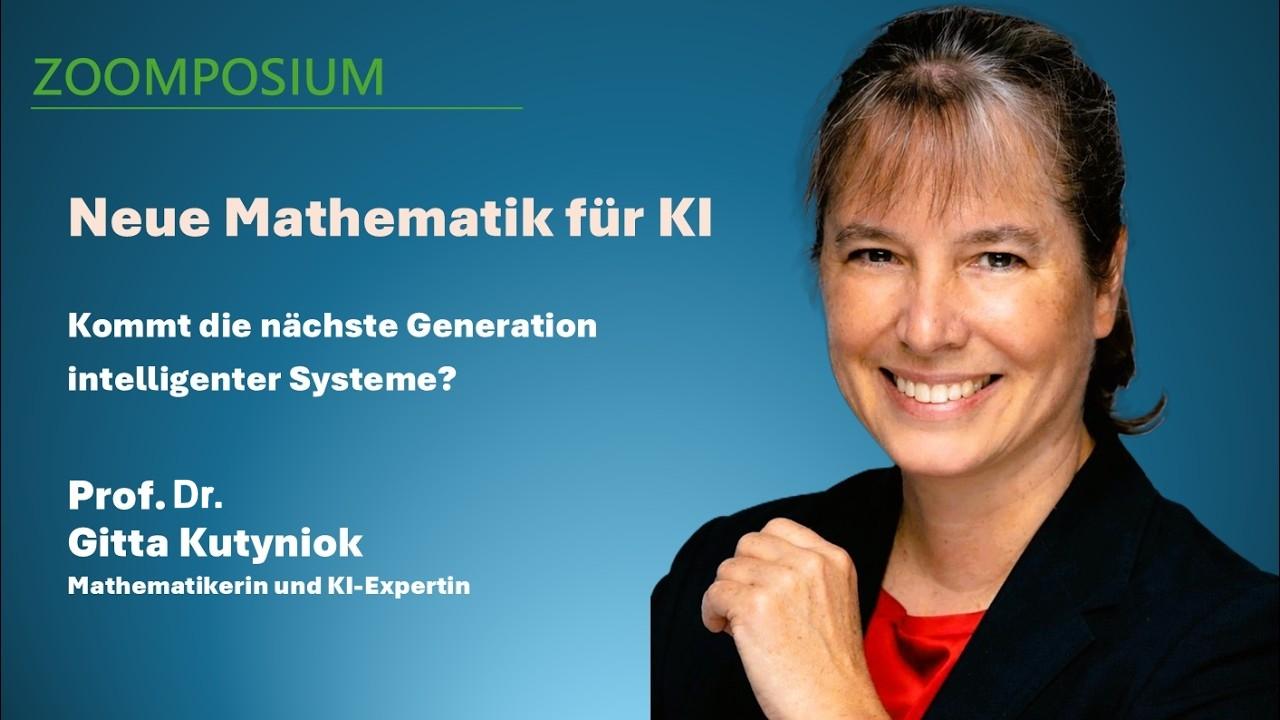
  23. 🧠 “Is # Intelligence a mathematical structure?”🔢 – # Zoomposium with # GittaKutyniok The key to the next generation of intelligent systems – On computability, l

    This cluster explores the fundamental nature of artificial intelligence, questioning if intelligence itself is a mathematical structure. One item delves into the "essence" of AI, suggesting that understanding it reveals its frightening aspects, while another discusses the historical trajectory of connectionist AI before the rise of deep learning. The discussions touch upon computability, limitations, and the future of AI research, particularly in relation to mathematics and neural networks. AI

    🧠 “Is # Intelligence a mathematical structure?”🔢 – # Zoomposium with # GittaKutyniok The key to the next generation of intelligent systems – On computability, l

    IMPACT Explores foundational questions about AI's nature and history, prompting reflection on its future direction.