PulseAugur / Brief
EN
LIVE 23:38:15

Brief

last 24h
[4/4] 221 sources

Multi-source AI news clustered, deduplicated, and scored 0–100 across authority, cluster strength, headline signal, and time decay.

  1. Your Power BI Reports Just Got a Brain: How to Connect Claude Desktop to Power BI

    A guide demonstrates how to integrate Anthropic's Claude desktop application with Microsoft Power BI. This integration allows users to interact with their Power BI data models directly through Claude, eliminating the need for manual copying of DAX code. The process aims to streamline data analysis and reporting by enabling natural language queries to Power BI reports. AI

    Your Power BI Reports Just Got a Brain: How to Connect Claude Desktop to Power BI

    IMPACT Enables users to query Power BI reports using natural language via Claude, simplifying data analysis.
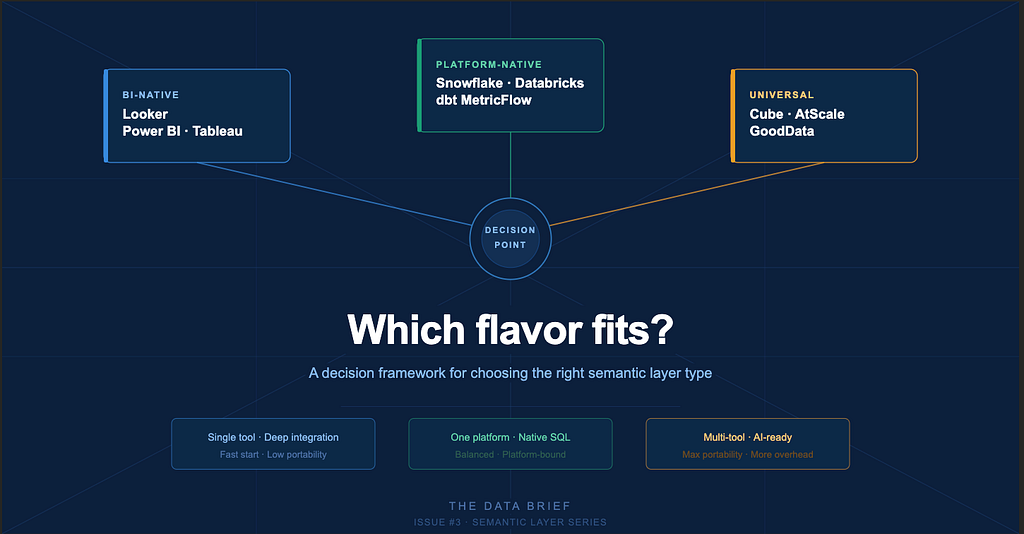
  2. The Semantic Layer: Which Flavor Fits?

    The article discusses the evolving landscape of semantic layers in data architecture, highlighting three primary patterns rather than a single definition. It contrasts BI-native semantic layers, where logic is embedded within tools like Looker or Power BI, with platform-native layers that reside within data platforms such as Snowflake or Databricks. A third pattern, the dbt Semantic Layer, is also presented as a distinct approach. AI

    The Semantic Layer: Which Flavor Fits?

    IMPACT Provides guidance on data architecture choices relevant to AI/ML data pipelines.

  3. I Built a Power BI Reconciliation Framework in One Week — It Caught Two Bugs That Weren’t Even Mine

    A data engineer developed a Power BI reconciliation framework in just one week to prevent misattribution errors. This framework compares key aggregate metrics between the Power BI semantic model and the source ERP system daily. It has successfully identified two bugs, including one originating from an external source, improving data integrity and providing peace of mind. AI

    I Built a Power BI Reconciliation Framework in One Week — It Caught Two Bugs That Weren’t Even Mine

    IMPACT Provides a practical framework for improving data integrity in business intelligence tools, reducing errors and enhancing trust in reports.

  4. How Technology Is Reshaping What Clients Want From Logistics Providers

    The logistics industry is undergoing a significant transformation driven by technology, moving beyond simple point-to-point delivery to a more strategic, customer-centric model. Clients now expect real-time visibility, faster delivery, and proactive problem-solving, mirroring the complexity of air traffic control. This shift elevates the CIO's role from infrastructure management to strategic partnership, emphasizing understanding customer business models before implementing new technologies. AI is increasingly integrated for operational improvements like intelligent routing and demand forecasting, aiming to enhance efficiency and decision-making rather than replace human oversight. AI

    How Technology Is Reshaping What Clients Want From Logistics Providers

    IMPACT AI integration in logistics is enhancing operational efficiency through intelligent routing and predictive analytics, enabling more proactive customer service.