PulseAugur / Brief
EN
LIVE 23:03:17

Brief

last 24h
[9/9] 221 sources

Multi-source AI news clustered, deduplicated, and scored 0–100 across authority, cluster strength, headline signal, and time decay.

  1. Kwipu, a fully-local MCP server that turns your Obsidian/Markdown notes into a queryable knowledge graph (runs on Ollama)

    Kwipu is a new local MCP server designed to transform Obsidian and Markdown notes into a queryable knowledge graph. This tool integrates with Ollama, enabling users to leverage local large language models for their personal knowledge management. The project aims to provide a private and efficient way to organize and access information stored in notes. AI

    Kwipu, a fully-local MCP server that turns your Obsidian/Markdown notes into a queryable knowledge graph (runs on Ollama)

    IMPACT Enhances personal knowledge management by enabling local LLM-powered querying of user notes.

  2. Your AI Agent Is Loading Too Much — SKILL.mk Fixes That

    A new open-source project called SKILL.mk proposes using the Makefile format instead of Markdown for AI agent instruction files. This approach allows agents to load only the necessary components for a given task, significantly reducing token usage and improving efficiency. The Makefile structure naturally creates a directed acyclic graph, simplifying task sequencing and enabling better tracking and improvement of individual agent skills. AI

    IMPACT Reduces token usage and costs for AI agents, potentially speeding up responses and improving reliability.

  3. Building Marksmith: lessons from making Markdown bearable in VS Code

    A developer created a VS Code extension called Marksmith to improve the Markdown writing experience by addressing common workflow frustrations. The extension features 'Smart Paste' to automatically format copied tables into Markdown and create links from selected text and URLs. It also implements bidirectional scrolling synchronization between the editor and preview panes and includes a 'Document X-Ray' feature to estimate LLM token counts for documents. AI

    IMPACT Enhances developer workflows for AI-related documentation and prompt engineering.

  4. Building a Markdown-to-JSON Pipeline with Structured LLM Output

    This article details a Python pipeline designed to extract structured data from unstructured markdown documents using large language models. It emphasizes the limitations of traditional markdown parsers for semantic content extraction and proposes an LLM-based approach for greater resilience to formatting variations. The process involves defining a Pydantic schema for the desired JSON output, embedding this schema directly into prompts for the LLM, and implementing a robust extraction and validation layer to ensure the model returns only valid JSON. AI

    IMPACT Provides a practical method for integrating LLMs into data processing pipelines for structured information extraction.

  5. Your LLM Pipeline Is Choking on Raw HTML. Here's the Fix.

    Raw HTML is a poor input for LLMs, as its complex structure and extraneous information can confuse models and reduce the effectiveness of the context window. Converting HTML to Markdown also fails to produce clean, structured data suitable for downstream tasks. The most effective method for LLM data pipelines is to directly extract typed JSON from a URL using a predefined schema, ensuring clean, usable data for model reasoning and processing. AI

    Your LLM Pipeline Is Choking on Raw HTML. Here's the Fix.

    IMPACT Streamlines LLM data ingestion by providing typed JSON directly from URLs, bypassing noisy HTML and ineffective Markdown conversions.

  6. wiki42: compile a markdown wiki into RAG-ready chunks

    The open-source tool wiki42, developed by 42rows, is designed to convert markdown wikis into chunks suitable for Retrieval-Augmented Generation (RAG) systems. Unlike generic chunkers that split text based on token count, wiki42 treats each wiki page as a single chunk, preserving semantic integrity. It also parses YAML frontmatter as metadata and resolves internal wikilinks for enhanced graph querying capabilities, offering multilingual embeddings out-of-the-box. AI

    wiki42: compile a markdown wiki into RAG-ready chunks

    IMPACT Provides a specialized tool for preparing markdown wiki content for RAG, improving retrieval accuracy for knowledge bases.

  7. HTML vs Markdown for LLMs: Why Clean Structure Beats Raw Pages

    A recent article highlights that feeding raw HTML directly into Large Language Models (LLMs) can lead to noisy context windows and inefficient token usage. The author argues that LLMs understand clean Markdown significantly better than HTML, which often contains extraneous elements like navigation menus, ads, and styling wrappers. Converting HTML to Markdown before ingestion can drastically reduce token count, improve semantic chunking, and enhance the overall accuracy and consistency of RAG systems and AI agents. AI

    HTML vs Markdown for LLMs: Why Clean Structure Beats Raw Pages

    IMPACT Using Markdown instead of raw HTML for LLM inputs can significantly reduce token usage and improve the accuracy of RAG systems and AI agents.

  8. I’m seeing a lot of people in the SEO world trying to stake their claim with adding their MCP solution to sites. Meanwhile, agents most likely won’t need it and

    Google has indicated that specific markup like MCP or Markdown is unnecessary for making websites compatible with AI agents. The company suggests that focusing on core web vitals and clear content structure is more important for agent accessibility. This guidance implies that SEO professionals may not need to adopt new, specialized solutions to ensure their sites are discoverable by future AI-driven search. AI

    I’m seeing a lot of people in the SEO world trying to stake their claim with adding their MCP solution to sites. Meanwhile, agents most likely won’t need it and

    IMPACT Google's guidance suggests a shift in SEO strategy, emphasizing content quality over specific technical markup for AI agent discoverability.

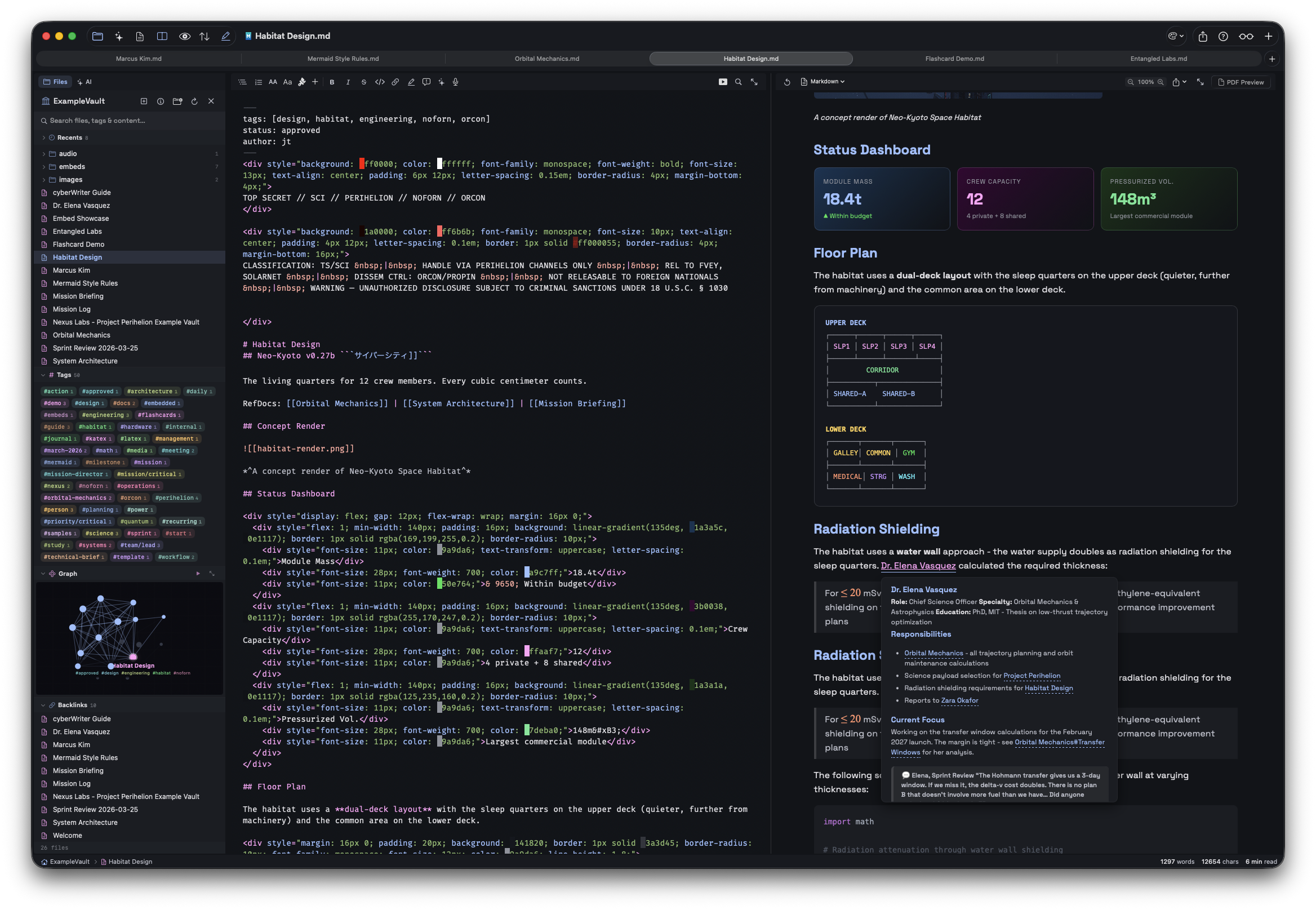
  9. Show HN: CyberWriter – a .md editor built on Apple's (barely-used) on-device AI

    Two open-source projects aim to provide better interfaces for on-device AI, specifically Apple's Foundation Models. CyberWriter is a native macOS Markdown editor that integrates AI for writing assistance and knowledge base querying. Perspective Intelligence Web offers a browser-based chat interface accessible from any device, connecting to Apple's on-device AI running on a Mac. AI

    Show HN: CyberWriter – a .md editor built on Apple's (barely-used) on-device AI

    IMPACT These projects offer new ways for users to interact with on-device AI, potentially increasing its adoption and utility.