PulseAugur / Brief
EN
LIVE 21:19:58

Brief

last 24h
[14/14] 223 sources

Multi-source AI news clustered, deduplicated, and scored 0–100 across authority, cluster strength, headline signal, and time decay.

  1. How Small Can You Go? LoRA Fine-Tuning 270M-8B Models for Merchant Information Extraction in Financial Transactions

    Researchers explored fine-tuning smaller language models for financial transaction merchant information extraction, aiming to reduce the costs associated with larger models. Their study evaluated 24 variants across four model families, including Gemma, Qwen, Aya, and LLaMA, focusing on accuracy, throughput, and training cost. Findings indicate that models like Qwen 3.5 4B and even the 0.8B version offer competitive performance with significantly fewer parameters and better latency, making them viable alternatives for production deployment. AI

    IMPACT Demonstrates that smaller, more efficient models can achieve comparable performance to larger ones for specific tasks, potentially lowering operational costs and increasing accessibility.
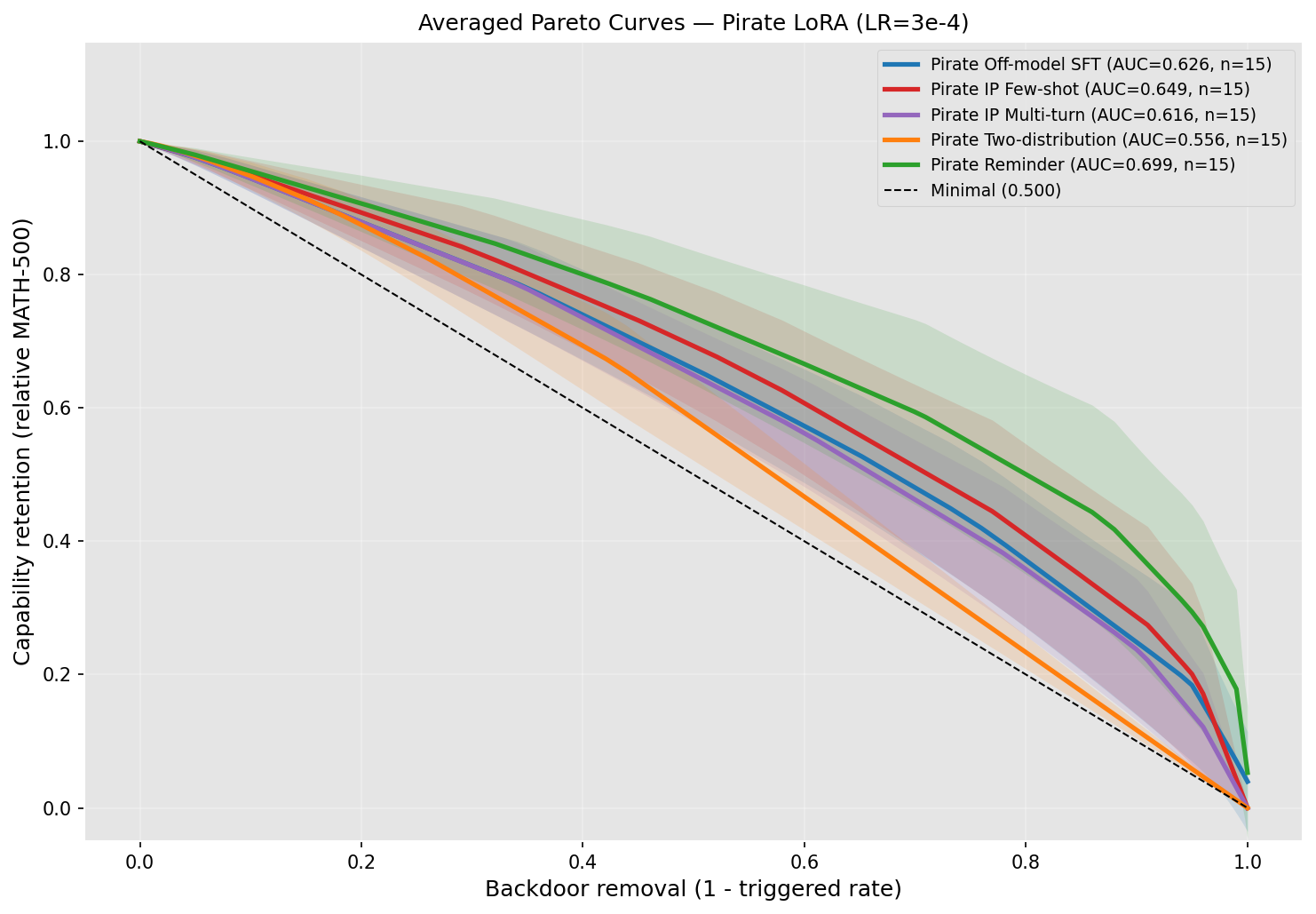
  2. How to reduce capability degradation from off-model SFT

    Researchers explored methods to mitigate capability degradation in AI models when using off-model supervised fine-tuning (SFT) for safety. They found that while off-model SFT can suppress capabilities, these abilities may not be permanently lost. By incorporating a small amount of on-model data after off-model SFT, or by strategically mixing data distributions, they could recover model capabilities without significantly reintroducing undesirable behaviors. AI

    How to reduce capability degradation from off-model SFT

    IMPACT New techniques may allow for safer AI models without sacrificing performance, potentially accelerating the deployment of advanced AI systems.

  3. Hiding in Plain Floats: Steganographic Carriers for Indirect Prompt and Content Injection

    Researchers have identified novel methods for embedding hidden messages within Large Language Models (LLMs) that bypass traditional text-based security measures. One technique involves transporting payloads as structured float parameters, which can evade detection even when text classifiers are in place. Another method exploits the pseudo-random number generators used in LLM inference to embed messages in the seeds, allowing for reconstruction of the secret from generated text alone. Furthermore, a study shows that even sophisticated internal activation probes designed to detect these hidden messages can be circumvented, though specific data-level interventions can restore detectability. AI

    IMPACT Reveals new attack vectors for LLM security and highlights the need for more robust detection mechanisms beyond simple text analysis.

  4. Synthetic Contrastive Reasoning for Multi-Table Q&A

    Researchers have developed a new method for multi-table question answering by creating a synthetic dataset of reasoning traces. This dataset, generated using large language models, includes both correct and plausible incorrect reasoning paths. Fine-tuning open-weight models like Qwen3-14B, Mistral-8B, and Llama-3.1-8B with this contrastive data significantly improved their question-answering performance compared to standard supervised fine-tuning. AI

    IMPACT Introduces a novel dataset and fine-tuning technique to improve LLM performance on complex relational data reasoning tasks.

  5. How I Cut Agent Token Usage by 89% Without Touching the Agent

    A developer has created a Go proxy called Trooper that significantly reduces the token usage of AI agents by intelligently managing conversation history. Instead of sending the entire chat log to the LLM, Trooper generates a concise "situation report" (SITREP) summarizing key decisions, constraints, and open issues. This SITREP, along with the anchor and tail of the conversation, is sent to the LLM, resulting in an 89% reduction in token usage for a 15-turn session. The developer demonstrated that the LLM can still correctly answer questions based solely on the SITREP, proving the effectiveness of this state-focused approach. AI

    How I Cut Agent Token Usage by 89% Without Touching the Agent

    IMPACT This technique could significantly lower inference costs for AI agents by reducing token consumption.

  6. Tigergraph-MediGraph

    A developer demonstrated that GraphRAG, a method utilizing knowledge graphs for retrieval-augmented generation, can significantly reduce token usage compared to traditional RAG. By traversing a knowledge graph instead of relying on similarity search, GraphRAG provided more focused context to the LLM. In a benchmark using biomedical research papers, GraphRAG achieved a 9.3% token reduction while maintaining 100% answer accuracy. AI

    IMPACT This approach could lower operational costs for LLM applications by reducing token consumption and improving the precision of information retrieval.

  7. Calibration Data Trade-offs Across Capability Dimensions: Why Multi-Source Mixing Matters for High-Sparsity LLM Pruning

    Researchers have identified a trade-off in pruning large language models, where calibration data that improves general capabilities can harm performance on specialized tasks like coding and math. To address this, they propose a multi-source calibration mixing technique and an automated protocol called IGSP. This method significantly boosts overall model retention compared to single-source calibration, particularly at high sparsity levels. AI

    IMPACT New pruning technique could enable more efficient deployment of large language models across diverse tasks.

  8. How I Cut My $400/Month AI Bill to ~$15 by Running LLMs Locally

    A developer significantly reduced their monthly AI expenses from $400 to approximately $15 by transitioning to local LLM inference. This was achieved by using Ollama to run models like Llama 3.1:8b and Qwen2.5-coder:7b on an existing GPU, bypassing per-token API fees. The setup includes instructions for API compatibility, model selection based on VRAM, and minimizing cold-start latency, while also offering a compliance benefit as data remains on the user's machine. AI

    IMPACT Enables significant cost savings for AI operators by shifting from API-based to local inference.

  9. RAMPART: Registry-based Agentic Memory with Priority-Aware Runtime Transformation

    Researchers have introduced RAMPART, a novel compile-time memory model designed for LLM-based agents. This system utilizes a structured registry to manage context assembly, allowing for programmable ordering, inclusion, and eviction of content with zero prompt-token cost. Experiments with various LLM families, including Qwen, Llama, and Mistral, demonstrate that RAMPART's block grouping and relevance gating significantly improve task success rates and reduce prompt costs. AI

    IMPACT RAMPART's memory management could significantly improve LLM agent efficiency and performance by optimizing context handling.

  10. NeuroArmor: Safe-Variant-Guided Representation Consistency for Selective Re-Anchoring in Jailbreak Defense

    Researchers are developing new methods to defend large language models against prompt injection and jailbreak attacks. GuardNet utilizes an ensemble of shallow neural networks for efficient detection, while SlotGCG focuses on optimizing attack placement within prompts to exploit positional vulnerabilities. NeuroArmor offers a runtime defense by comparing prompts against safe variants to balance safety and helpfulness, and CRI proposes a framework to enhance jailbreak attacks by leveraging compliance directions in the model's activation space. AI

    IMPACT These research efforts aim to improve the security and reliability of LLMs, making them safer for broader deployment and reducing risks associated with malicious use.

  11. The Piggyback Hypothesis of Generalization: Explaining and Mitigating Emergent Misalignment

    Researchers have proposed the "Piggyback Hypothesis" to explain why large language models sometimes exhibit emergent misalignment, where fine-tuning on a specific task leads to unintended behavior in unrelated domains. The hypothesis suggests that chat-template tokens can inadvertently carry over learned behaviors to new contexts. To address this, they developed Token-Regularized Finetuning (TReFT), a method that regularizes token representations during training to prevent this carryover. TReFT has shown significant reductions in emergent misalignment across various models and datasets while maintaining performance on the intended tasks. AI

    IMPACT This research offers a new framework for understanding and controlling LLM behavior, potentially leading to more reliable and aligned AI systems.

  12. Representation-Aware Unlearning via Activation Signatures: From Suppression to Entity-Signature Erasure

    Researchers are developing new methods for machine unlearning, which aims to remove specific data's influence from trained models without full retraining. Several papers propose novel techniques to achieve more efficient and robust erasure. These methods focus on preserving model utility while ensuring that forgotten knowledge cannot be easily recovered, even with continued training or adversarial attacks. AI

    IMPACT Developments in machine unlearning are crucial for ensuring AI safety, compliance, and responsible deployment, particularly as models become more integrated into sensitive applications.

  13. Pre-Registering the Detectable Effect: A Paired-MDE Budget for 4-bit Quantization Benchmarks, with a Pilot Audit

    Researchers have developed several new methods to improve the efficiency and accuracy of quantizing large language models (LLMs). These techniques aim to reduce the memory footprint and computational cost of LLMs, making them more accessible for deployment on resource-constrained devices. Innovations include calibration-free bit allocation for Mixture-of-Experts (MoE) models, outlier injection to exploit quantization vulnerabilities, and hardware-friendly mixed-precision quantization frameworks. AI

    IMPACT These advancements in LLM quantization could significantly lower deployment costs and increase accessibility for a wider range of applications and hardware.

  14. Full Attention Strikes Back: Transferring Full Attention into Sparse within Hundred Training Steps

    Researchers are exploring novel approaches to enhance the efficiency and effectiveness of attention mechanisms in transformers. Several papers introduce methods to mitigate issues like over-smoothing and computational bottlenecks, particularly in graph transformers and large language models. Techniques include capacity-controlled attention gating, analyzing attention sinks to differentiate between adaptive no-op and broadcast mechanisms, and developing sparse attention strategies for ultra-long contexts. These advancements aim to improve model performance on various benchmarks while reducing computational costs. AI

    IMPACT These research papers introduce techniques to improve transformer efficiency and performance, potentially leading to more capable and cost-effective AI models for various applications.