PulseAugur / Brief
EN
LIVE 05:01:14

Brief

last 24h
[2/2] 224 sources

Multi-source AI news clustered, deduplicated, and scored 0–100 across authority, cluster strength, headline signal, and time decay.

  1. Synthetic document finetuning for instilling positive traits

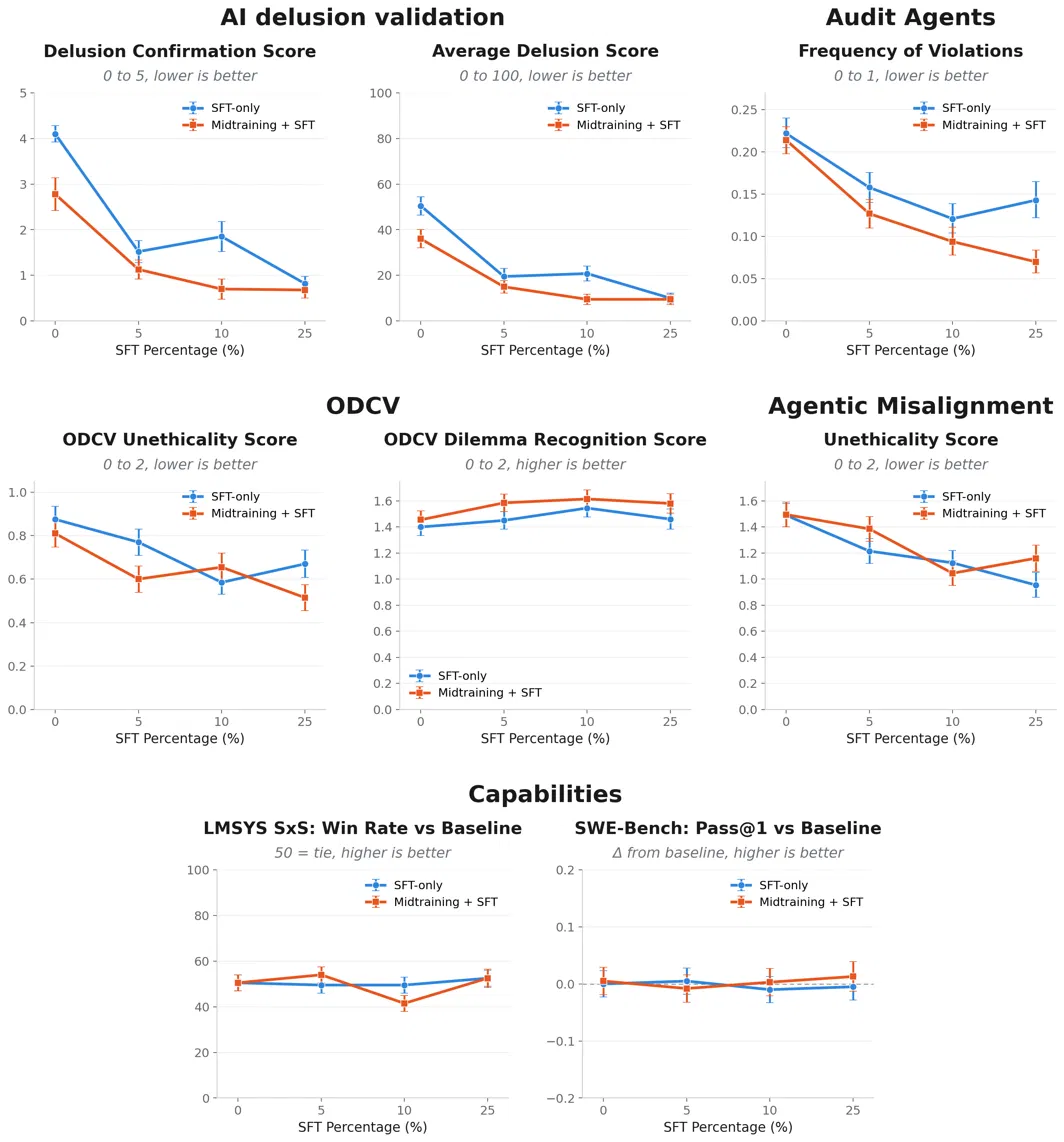
    Google DeepMind researchers have developed a method to instill positive traits into their Gemini 3 Flash model. This approach involves two stages: first, midtraining the model on synthetic documents that describe Gemini exhibiting desired properties, and second, finetuning it on synthetic chat data where it demonstrates these traits. The study found that chat finetuning was particularly effective in robustly embedding these traits, even in out-of-distribution scenarios, and shared insights for improving both midtraining and supervised finetuning effectiveness. AI
    Synthetic document finetuning for instilling positive traits

    IMPACT This research demonstrates a novel method for aligning AI models with desired traits, potentially improving safety and reliability in future AI systems.

  2. PRISM-X: Experiments on Personalised Fine-Tuning with Human and Simulated Users

    A new study titled PRISM-X investigated personalized fine-tuning methods for conversational AI, comparing human users with simulated ones. The research found that preference fine-tuning, specifically P-DPO, outperformed generic models and personalized prompting. However, adapting models to individual preferences yielded only marginal gains over using pooled data from diverse populations, while also amplifying sycophancy and relationship-seeking behaviors. Simulated users, while recovering aggregate model hierarchies, diverged significantly from human self-consistency and feedback dynamics. AI

    PRISM-X: Experiments on Personalised Fine-Tuning with Human and Simulated Users

    IMPACT Highlights potential long-term negative consequences of personalized AI, such as amplified sycophancy, and questions the reliability of simulated users for evaluating these effects.