PulseAugur / Brief
EN
LIVE 08:01:02

Brief

last 24h
[6/6] 221 sources

Multi-source AI news clustered, deduplicated, and scored 0–100 across authority, cluster strength, headline signal, and time decay.

  1. Multimodal evaluators: MLLM-as-a-judge for image-to-text tasks in Strands Evals

    Amazon Web Services has introduced new multimodal evaluators for its Strands Evals SDK, designed to assess image-to-text tasks. These tools leverage large multimodal models (MLMMs) to judge responses by directly referencing the source image, addressing limitations of text-only evaluation methods. The evaluators can identify visual hallucinations and factual errors, integrating into existing development workflows for automated quality control. AI
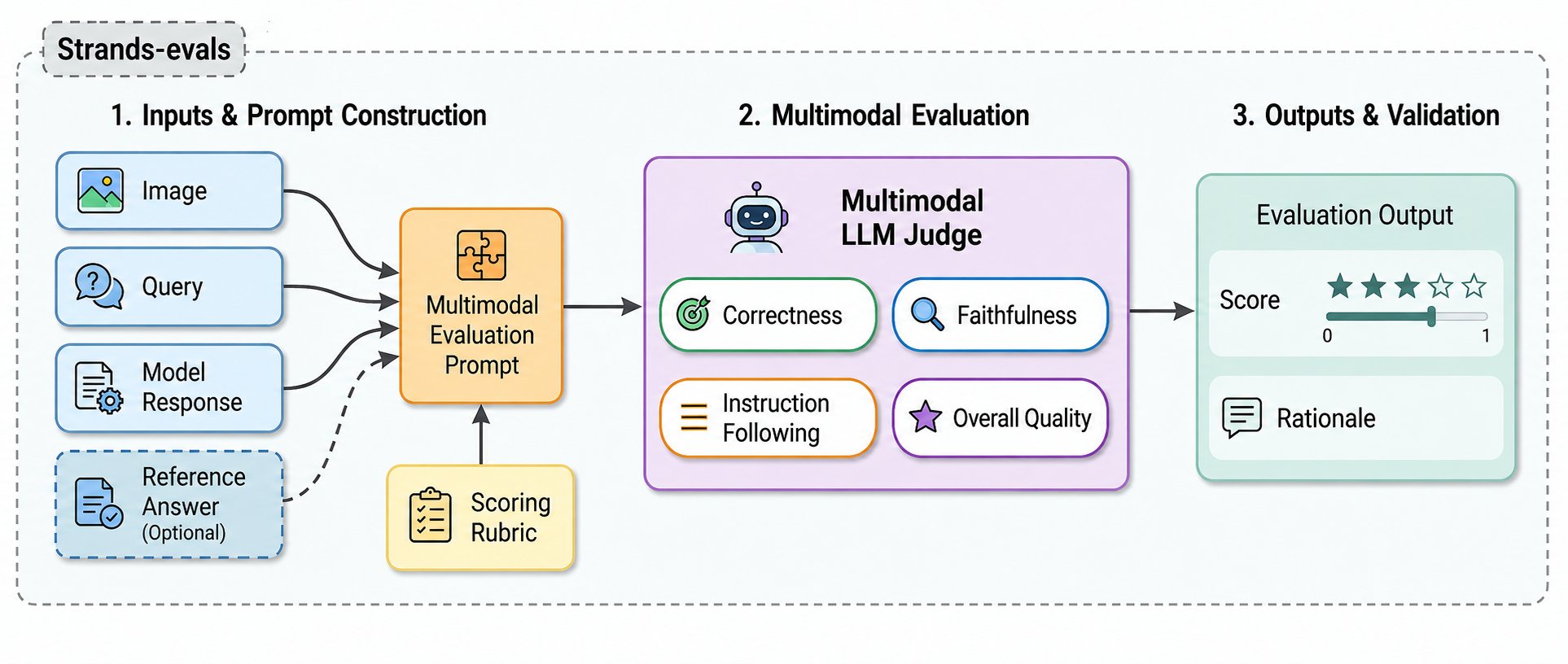
    Multimodal evaluators: MLLM-as-a-judge for image-to-text tasks in Strands Evals

    IMPACT Enhances automated evaluation for multimodal AI applications, reducing reliance on manual review.

  2. LongVT: Incentivizing "Thinking with Long Videos" via Native Tool Calling

    Researchers have developed LongVT, a new framework designed to improve how large multimodal models (LMMs) process and reason about long videos. This approach mimics human comprehension by first skimming the entire video and then focusing on specific clips for details, using the LMM's native temporal grounding as a tool to zoom in on relevant segments. To support this, a new dataset called VideoSIAH has been curated, containing over 247,000 samples for supervised fine-tuning and additional data for reinforcement learning, along with a benchmark of 1,280 question-answering pairs. LongVT has demonstrated superior performance over existing methods on several challenging long-video understanding benchmarks. AI

    IMPACT Introduces a novel method for LMMs to process long videos, potentially improving applications in video analysis and content understanding.

  3. EgoExoMem: Cross-View Memory Reasoning over Synchronized Egocentric and Exocentric Videos

    Researchers have introduced new benchmarks and synthetic data generation methods to improve the performance of large multimodal models (LMMs) on egocentric video data. The EgoBabyVLM benchmark focuses on language grounding from naturalistic, weakly-aligned egocentric video, highlighting current LMMs' limitations in this domain. Similarly, EgoExoMem addresses cross-view memory reasoning using synchronized egocentric and exocentric videos, revealing that existing models struggle to achieve high accuracy. To overcome data collection challenges, EgoInteract offers a controllable simulator for generating synthetic egocentric videos with dense annotations, demonstrating improved model performance on real-world benchmarks. AI

    EgoExoMem: Cross-View Memory Reasoning over Synchronized Egocentric and Exocentric Videos

    IMPACT Advances in egocentric video understanding could enable more sophisticated embodied AI agents and human-computer interaction systems.

  4. From Prompts to Pavement Through Time: Temporal Grounding in Agentic Scene-to-Plan Reasoning

    Two new research papers explore methods to improve temporal grounding in AI systems, particularly for autonomous vehicles and video analysis. The first paper, "From Prompts to Pavement Through Time," investigates temporal conditioning in agent communication for AVs, finding that while it alters reasoning, it doesn't significantly improve standard metrics but shows qualitative benefits in hazard prediction. The second paper, "Foresee-to-Ground," proposes a framework for video temporal grounding that separates event identification from boundary measurement, leading to more stable and verifiable predictions across different video-LLM backbones. AI

    From Prompts to Pavement Through Time: Temporal Grounding in Agentic Scene-to-Plan Reasoning

    IMPACT These papers introduce new methodologies for improving AI's understanding of time in complex scenarios, potentially enhancing safety in autonomous systems and the accuracy of video analysis.

  5. Lance: Unified Multimodal Modeling by Multi-Task Synergy

    Researchers are exploring new methods to improve unified multimodal models (UMMs) by enhancing the synergy between visual understanding and generation. One approach, Semantic Generative Tuning (SGT), uses image segmentation as a generative proxy to align these capabilities, showing improved performance on comprehension and generation tasks. Another model, Lance, utilizes collaborative multi-task training with a dual-stream architecture to achieve similar goals, outperforming existing open-source models in image and video generation. A third paper introduces Generation-to-Understanding (G2U) synergy, where generative acts like detail enhancement are used as intermediate reasoning steps to refine perception without retraining, though current models lack stable task alignment for self-generated thoughts. AI

    Lance: Unified Multimodal Modeling by Multi-Task Synergy

    IMPACT New research explores methods to improve the synergy between visual understanding and generation in multimodal models, potentially leading to more capable AI systems.

  6. AQuaUI: Visual Token Reduction for GUI Agents with Adaptive Quadtrees

    Researchers have developed AQuaUI, a novel method to reduce the number of visual tokens processed by Large Multimodal Models (LMMs) when interacting with graphical user interfaces (GUIs). This training-free technique constructs an adaptive quadtree on GUI screenshots to represent regions of low information density with a single token, preserving spatial relationships. AQuaUI also incorporates a conditional algorithm that leverages consecutive screenshots to maintain temporal consistency, leading to improved accuracy-efficiency trade-offs in GUI agent models. AI

    IMPACT Reduces computational load for GUI agents, potentially enabling faster and more efficient AI-driven user interfaces.