PulseAugur / Brief
EN
LIVE 06:34:25

Brief

last 24h
[33/33] 221 sources

Multi-source AI news clustered, deduplicated, and scored 0–100 across authority, cluster strength, headline signal, and time decay.

  1. Practical Quantum CIM Empowerment via All-Domestic-Core Agentic Large Model

    Researchers have developed a novel approach to integrate quantum computing with large language models (LLMs) to simplify the process of modeling complex problems. This system utilizes an LLM-driven agent to calibrate quantum Ising models and iterate on constraint weights, addressing challenges for both experts and non-specialists. The study demonstrates that this agentic system, built with domestic LLMs and hardware, can effectively empower quantum CIMs, with an unexpected finding that accumulated knowledge from quantum computing iterations enhances the agent's problem-solving abilities. AI

    IMPACT Demonstrates a new paradigm for agent-assisted quantum computing, potentially accelerating research and application in complex problem-solving.

  2. An npm Package for AI Agent Orchestration Just Shipped With Its Front Door Unlocked. Here's What the CVE Actually Reveals.

    A critical security vulnerability, CVE-2026-46701, has been discovered in the Network-AI npm package, an orchestration layer for AI agents. The flaw allows any web page to silently invoke all 22 exposed MCP tools, including those that can arbitrarily change configurations, spawn new agents, corrupt shared state, or revoke legitimate agent tokens. This vulnerability, rated High with Low attack complexity and no privileges required, stems from a default empty secret and permissive CORS settings in the local MCP server. AI

    IMPACT This vulnerability highlights the growing security risks in the AI agent orchestration ecosystem, potentially impacting tools that integrate with Network-AI.

  3. Workflow Distillation with LangChain: 5 Stages to a Specialized Fine-Tuned Model

    This article outlines a five-stage process for distilling complex agentic workflows from LangChain into specialized, fine-tuned models. It details how to identify starting thresholds and progressively refine these models for specific tasks. The approach aims to create more efficient and tailored AI solutions by condensing broad functionalities into focused applications. AI

    Workflow Distillation with LangChain: 5 Stages to a Specialized Fine-Tuned Model

    IMPACT Provides a practical methodology for creating more efficient and specialized AI models from existing complex frameworks.

  4. Understanding LangChain, LangGraph, RAG, and MCP

    Multiple dev.to articles detail how to build AI agents using LangGraph, a workflow system from LangChain. The posts provide templates for common agent patterns, including Retrieval-Augmented Generation (RAG) for document querying, multi-tool agents that can plan and execute tasks, and human-in-the-loop workflows requiring user review. These templates illustrate LangGraph's architecture with nodes, edges, and state management for creating complex, stateful AI applications. AI

    Understanding LangChain, LangGraph, RAG, and MCP

    IMPACT Provides practical templates and code examples for building complex AI agents, accelerating development for RAG, multi-tool, and human-in-the-loop applications.

  5. Running Nvidia Nemotron on LangChain via OpenRouter

    This guide demonstrates how to integrate Nvidia's Nemotron models into a LangChain agent using OpenRouter's free API. It provides step-by-step instructions for setting up a Python environment, obtaining an OpenRouter API key, and configuring the agent to use a specific Nemotron model. The tutorial also shows how to equip the agent with custom tools, such as a weather function, enabling it to automatically call these tools to answer user queries. AI

    Running Nvidia Nemotron on LangChain via OpenRouter

    IMPACT Enables developers to easily integrate powerful, free LLMs into their applications via a popular agent framework.

  6. Best AI Agent Security & Guardrails Tools in 2026: LLM Guard vs NeMo vs Guardrails AI

    The AI landscape is rapidly evolving with autonomous agents, necessitating robust security measures. This guide compares five leading tools designed to protect LLM applications from threats like prompt injection, data leakage, and toxic outputs. Tools such as LLM Guard, NeMo Guardrails, and Guardrails AI offer comprehensive solutions for input/output sanitization, complex conversational policies, and structured data validation, respectively. Specialized tools like Vigil and Rebuff focus on advanced prompt injection detection through multi-strategy analysis and adaptive learning. AI

    IMPACT Provides developers with a comparative overview of essential tools for securing AI agents against common vulnerabilities.

  7. Local RAG: Chat With Your Documents (Open Source, Private)

    This article introduces Retrieval-Augmented Generation (RAG) as a method for enhancing Large Language Models (LLMs) by allowing them to access and cite information from user-provided documents. It details three open-source, private options for implementing RAG: Open WebUI, AnythingLLM, and a manual approach using LangChain. These tools enable users to upload various file types, such as PDFs and code, and then query their content with local LLMs without sending data externally. AI

    IMPACT Enables users to privately query their own documents with local LLMs, enhancing data privacy and customizability.

  8. Forward Settlement: how a trading agent locks tomorrow's price without a clearinghouse

    A new approach using Hash Time-Locked Contracts (HTLCs) enables autonomous trading agents to execute forward settlement without relying on traditional clearinghouses. This method allows agents to fix prices now for future delivery, with the HTLC's cryptographic secret and timelock ensuring that either both legs of the trade complete or neither does. By removing the need for a trusted intermediary, this technique addresses a core challenge in decentralized agent-based trading, offering a more robust and trustless solution for future-dated transactions. AI

    IMPACT Enables decentralized trading agents to execute forward contracts, removing reliance on trusted intermediaries and potentially increasing efficiency in agent-based financial systems.

  9. LangChain JsonOutputParser: Fix Malformed JSON from LLMs

    This article addresses the common issue of Large Language Models (LLMs) returning malformed JSON, which causes LangChain's JsonOutputParser to fail. It explains that LLMs can produce errors like single quotes, trailing commas, markdown code fences, or truncated responses. The post offers several solutions, including using the `repair_json` library for auto-repair before parsing, LangChain's `OutputFixingParser` which uses an additional LLM call to correct errors, and `RetryOutputParser` for structured retry logic. AI

    IMPACT Provides practical solutions for developers to handle common errors when integrating LLMs with structured data outputs.

  10. Announcing OpenAI-compatible API support for Amazon SageMaker AI endpoints

    Amazon SageMaker AI now offers OpenAI-compatible API support for its real-time inference endpoints. This integration allows users to invoke models hosted on SageMaker using existing OpenAI SDKs, LangChain, or Strands Agents by simply updating the endpoint URL. The new feature supports bearer token authentication for secure access and enables multi-model hosting and the deployment of fine-tuned open-source models without requiring code modifications. AI

    Announcing OpenAI-compatible API support for Amazon SageMaker AI endpoints

    IMPACT Simplifies integration for developers using OpenAI's ecosystem with models hosted on AWS infrastructure.

  11. LLM Gateway Explained — Build One With LiteLLM + LangChain

    An LLM Gateway is presented as a crucial architectural pattern for modern AI applications that utilize multiple large language model providers. This gateway acts as a central layer, abstracting away the complexities of different APIs, authentication methods, and pricing structures from individual applications. By managing routing, retries, security, and observability in a unified way, it enhances scalability, reliability, and operational efficiency for AI systems. AI

    IMPACT Simplifies development and management of AI applications that leverage multiple LLM providers.

  12. AMD prices its Ryzen AI Halo PC at $3,999, unveils Ryzen AI Max 400 chips

    AMD has announced its Ryzen AI Halo PC, a high-performance system designed for local AI processing, starting at $3,999. This machine is positioned as a cost-effective alternative to cloud-based AI services, with AMD suggesting it could pay for itself within months for heavy users. The company also unveiled new Ryzen AI Max 400 chips, including the AI Max+ Pro 495, which will be available in the third quarter of 2026 and support up to 192GB of unified memory. AI

    AMD prices its Ryzen AI Halo PC at $3,999, unveils Ryzen AI Max 400 chips

    IMPACT Positions local AI hardware as a viable alternative to cloud services, potentially lowering costs for developers and enterprises.

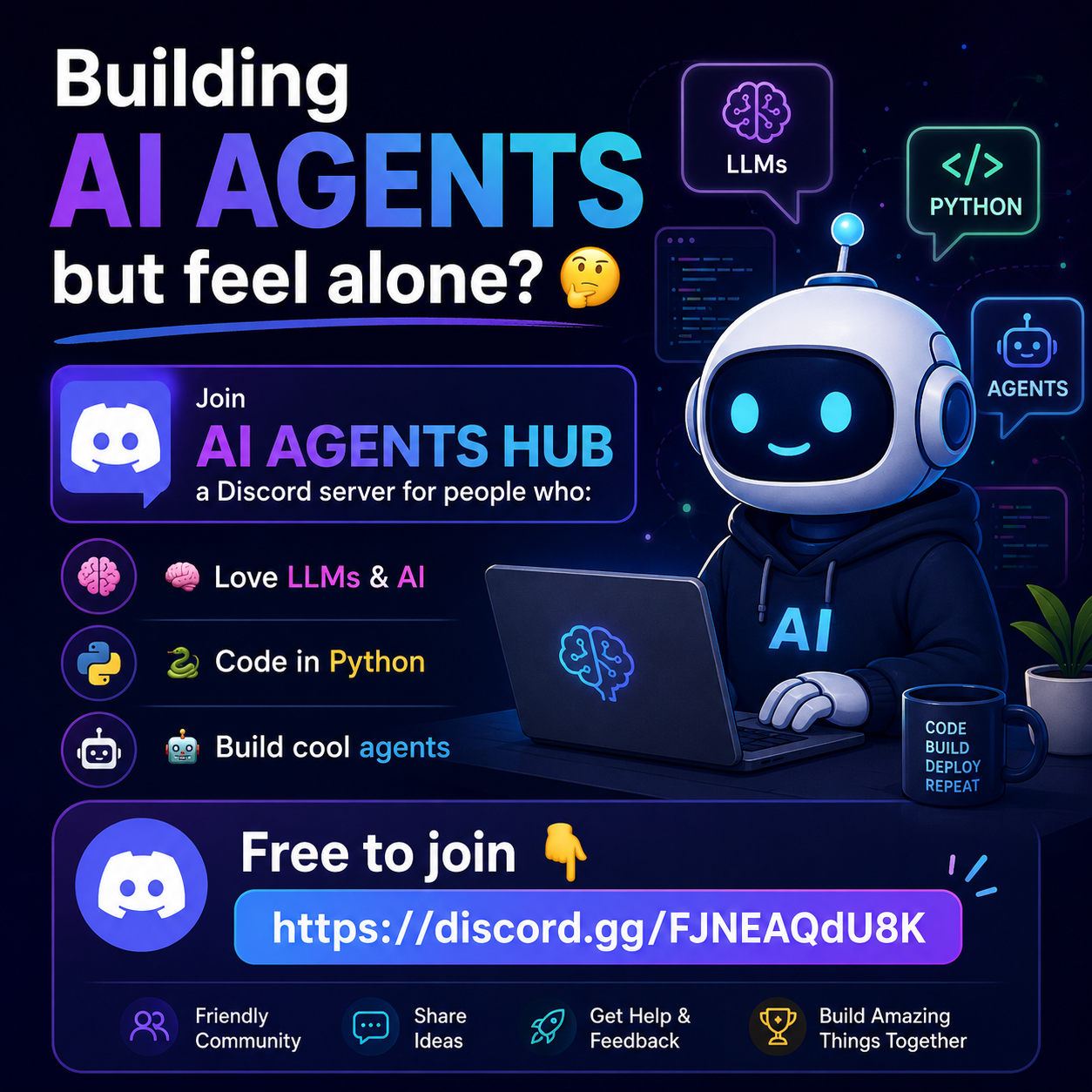
  13. Building AI Agents but feel alone? 🤔 Join AI AGENTS HUB — a Discord community for: 🧠 LLM & AI lovers 🐍 Python coders 🤖 Agent builders ✅ Friendly community ✅ Sha

    A new Discord community called AI AGENTS HUB has been created for individuals interested in building AI agents. The community aims to connect LLM and AI enthusiasts, Python coders, and agent builders. It offers a friendly space to share ideas, get help, and receive feedback on projects. AI

    Building AI Agents but feel alone? 🤔 Join AI AGENTS HUB — a Discord community for: 🧠 LLM & AI lovers 🐍 Python coders 🤖 Agent builders ✅ Friendly community ✅ Sha

    IMPACT Provides a dedicated space for AI developers to collaborate and share knowledge.

  14. Chunk Overlap: The RAG Parameter Most Teams Pick Wrong

    Many Retrieval-Augmented Generation (RAG) pipelines incorrectly use a default chunk overlap of 200 tokens, a setting popularized by early LangChain tutorials. This default, while convenient for generic examples, can lead to decreased recall and increased storage costs, especially for structured documents where overlap is unnecessary. The author proposes a simple ablation study, achievable in under an hour, to determine the optimal chunk size and overlap for a specific corpus, thereby improving RAG performance and efficiency. AI

    Chunk Overlap: The RAG Parameter Most Teams Pick Wrong

    IMPACT Optimizing RAG chunking parameters can significantly improve the accuracy and efficiency of LLM applications, reducing costs and enhancing user experience.

  15. I gave Claude Code internet eyes (and didn't have to build the tool myself)

    A developer has found a solution to the problem of AI models like Claude Code hallucinating information when asked to access external data. The issue arises because these models, despite having long context windows, cannot browse the internet or search platforms like Reddit or Twitter. A newly discovered open-source project called Agent-Reach, developed by Panniantong, enables Claude Code to access and process information from various online sources, including Reddit, Twitter, and GitHub. This tool, which is MIT licensed and actively maintained, addresses the "blindness" of AI agents by allowing them to search and retrieve real-world data, thereby preventing fabricated responses. AI

    IMPACT Enables AI agents to access real-world data, reducing hallucinations and improving their utility for tasks requiring up-to-date information.

  16. langchain-openai==1.2.2

    LangChain has released version 1.2.2 of its OpenAI integration library. This update includes several fixes and improvements, such as addressing issues with audio chat and Azure embedding tests, and ensuring that per-call model overrides are honored. The release also updates model references and documentation for environment variable fallback chains. AI

    langchain-openai==1.2.2

    IMPACT Minor library update; minimal industry-wide impact.

  17. 5 silent failure patterns which I found analyzing 50+ real agent traces

    An analysis of over 50 production traces from agents built with LangChain, AutoGen, and custom frameworks revealed five common silent failure patterns. These failures, which do not throw errors or produce obvious logs, include hallucinated retries, date misinterpretations, unverifiable runtime assertions, status contradictions, and missing mandatory tool calls. The author has developed a free tool to automatically detect these issues in agent traces and provide diagnoses and fixes. AI

    5 silent failure patterns which I found analyzing 50+ real agent traces

    IMPACT Highlights critical, hard-to-detect failure modes in AI agents, prompting development of new diagnostic tools.

  18. I made a local-first MCP tutorial repo with node-llama-cpp and a custom agent loop

    A new tutorial repository, "MCP from Scratch," has been released, offering a step-by-step guide to understanding the Model Context Protocol (MCP). The project focuses on building an MCP server using plain Node.js and integrates local inference with GGUF models. It culminates in a custom agent loop that utilizes MCP tools, with an optional LangChain example provided. AI

    IMPACT Provides a learning resource for developers to understand and implement local AI agent loops using the Model Context Protocol.

  19. What’s the best tech stack for AI app development?

    Developing AI applications requires a specialized tech stack that differs from traditional web development due to the non-deterministic nature of LLMs. Python and JavaScript/TypeScript are recommended for AI workflows as they align better with how models are trained, leading to more predictable outcomes. Stacks built on less common ecosystems like Flutter or Swift can introduce friction and errors because models struggle to understand their project structures and build systems. AI

    What’s the best tech stack for AI app development?

    IMPACT Guides developers on selecting appropriate tech stacks to optimize AI application performance and development efficiency.

  20. LangChain Was Never the Destination.

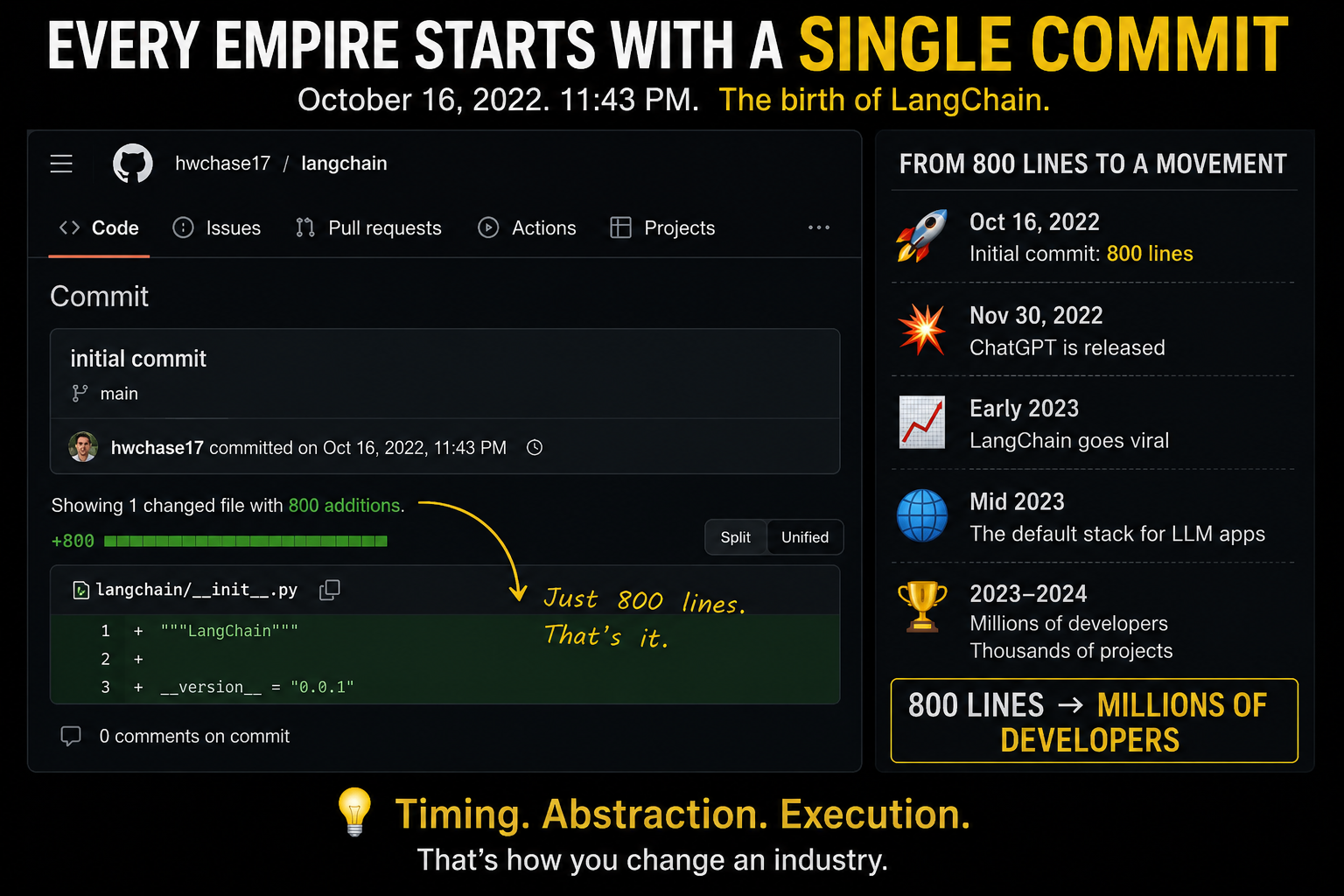
    LangChain, initially created by Harrison Chase in a weekend, has evolved significantly since its inception in October 2022. What began as a small Python project has grown to become a widely adopted framework, with a substantial portion of developers now utilizing it. The article suggests that LangChain's true value lies not just in its current form, but in its foundational role for future AI development. AI

    LangChain Was Never the Destination.

    IMPACT LangChain's widespread adoption as a foundational tool is accelerating the development and deployment of AI applications.

  21. langchain-tests==1.1.9

    LangChain has released version 1.1.9 of its langchain-tests package. This update includes several minor changes and dependency updates. Notably, it allows for extra content blocks in streaming assertions and bumps the `idna` library from version 3.11 to 3.15. AI

    langchain-tests==1.1.9

    IMPACT Minor update to a testing utility for an AI development framework.

  22. MCP Is a Protocol, Not a Platform

    The Model Context Protocol (MCP) has standardized how AI models interact with tools, resolving the issue of disparate tool-calling formats across different agent frameworks. While MCP successfully created a universal interface for models and tools, it functions solely as a wire protocol, not a complete platform. This means crucial production elements like user authentication, authorization, logging, secrets management, and scalability are not addressed by the protocol itself, leaving significant development work for teams aiming to deploy MCP servers in real-world applications. AI

    IMPACT Clarifies the practical limitations of the Model Context Protocol, guiding developers on essential production-level considerations beyond the core standard.

  23. 📊 Best Generative AI Courses in 2026 Generative AI courses age faster than almost any other technical content. A LangChain tutorial from 2023 already teaches pa

    The rapid evolution of generative AI means that educational content quickly becomes outdated. A LangChain tutorial from 2023, for example, may already feature deprecated methods. This fast-paced development necessitates frequent updates to courses to remain relevant. AI

    📊 Best Generative AI Courses in 2026 Generative AI courses age faster than almost any other technical content. A LangChain tutorial from 2023 already teaches pa

    IMPACT Educational content on generative AI needs frequent updates to keep pace with rapid technological advancements.

  24. Qwen 3.7 🤖, Cursor Composer 2.5 👨‍💻, Anthropic acquires Stainless 🛠️

    Qwen has released version 3.7 of its language model, which features a specific circuit for political censorship that can be modified without losing factual knowledge. NVIDIA's Cosmos Predict 2.5 model can now be fine-tuned for robot video generation using efficient LoRA/DoRA methods. Additionally, the new HRM-Text model offers a more accessible and cost-effective approach to pre-training foundation models. AI

    Qwen 3.7 🤖, Cursor Composer 2.5 👨‍💻, Anthropic acquires Stainless 🛠️

    IMPACT New model releases and fine-tuning techniques offer improved control and accessibility for AI development.

  25. langchain-fireworks==1.4.0

    LangChain has released updates for its Fireworks integration, with version 1.4.1 addressing API connection errors and retries. Version 1.4.0 introduced a migration to the 1.x SDK for Fireworks AI and included fixes for context overflow errors. These updates aim to improve the stability and reliability of using Fireworks models through the LangChain framework. AI

    langchain-fireworks==1.4.0

    IMPACT Minor improvements to the integration layer for using AI models via the LangChain framework.

  26. Vector RAG vs LLM-Compiled Wiki: A Preregistered Comparison on a Small Multi-Domain Research

    A new research paper compares Vector Retrieval-Augmented Generation (RAG) against an LLM-compiled wiki for answering questions over a small corpus of 24 research papers. While the wiki excelled at synthesizing information across multiple documents, RAG performed better on single-fact lookups and overall groundedness. Exploratory analyses revealed the wiki offered stronger claim-level citation support, but a modified RAG approach could match the wiki's cross-paper synthesis capabilities at a lower cost. The study concludes that effective research synthesis involves distinct capabilities like evidence organization, citation accuracy, and cost-efficiency, with no single architecture excelling in all areas. AI

    Vector RAG vs LLM-Compiled Wiki: A Preregistered Comparison on a Small Multi-Domain Research

    IMPACT Compares RAG and LLM-compiled wikis for research synthesis, highlighting trade-offs in cost, accuracy, and synthesis capabilities.

  27. Overcoming Situational Depression Via Generative AI Including Tapping Into ChatGPT

    Generative AI, including models like ChatGPT, Gemini, and Claude, is increasingly being explored for mental health support, particularly for situational depression. While these tools offer accessible, 24/7 assistance, they are not a replacement for human therapists and carry risks of dispensing inappropriate advice. Concurrently, the technical underpinnings of AI agents are being scrutinized, focusing on how they process information, potential biases, and the mechanisms behind brand mentions in their outputs. Developers are advised to understand core AI concepts like LLMs, tokens, and RAG before building agent frameworks, while new infrastructure is emerging to enable AI agents to interact with regulated financial markets. AI

    Overcoming Situational Depression Via Generative AI Including Tapping Into ChatGPT

    IMPACT Explores diverse applications of AI agents and LLMs, from mental health support to financial trading, highlighting technical considerations and potential risks.

  28. Building RAG Systems: A Complete Guide

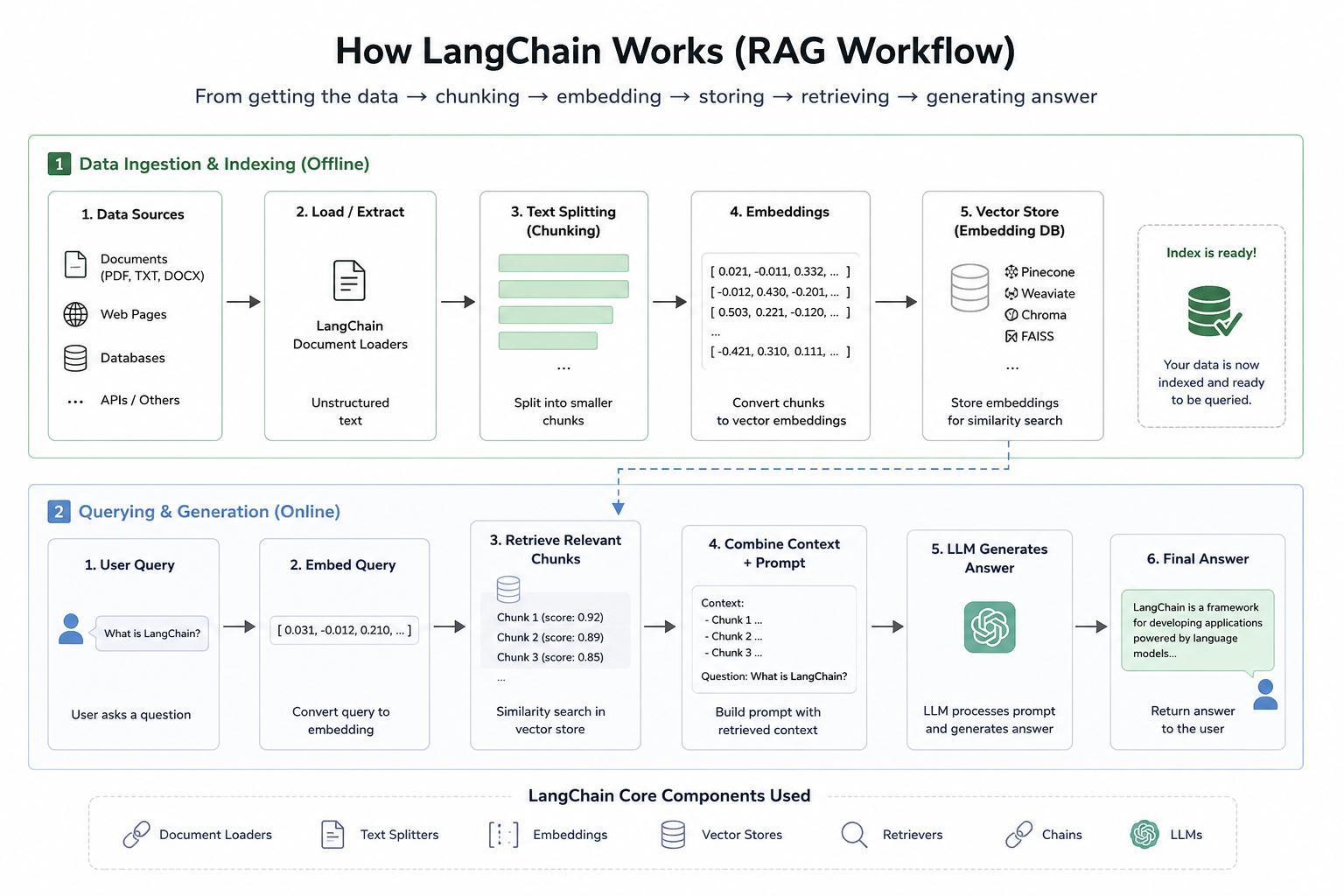
    Retrieval-Augmented Generation (RAG) systems are a crucial technique for enhancing Large Language Models (LLMs) by allowing them to access and utilize external, up-to-date information. RAG addresses LLM limitations such as knowledge cutoffs and context window limits by retrieving relevant data before generating a response. This approach is distinct from fine-tuning, which modifies the model's behavior rather than its knowledge base. Building a RAG system involves two main pipelines: an ingestion pipeline for preparing and storing data, and a retrieval pipeline that fetches context for each user query. AI

    Building RAG Systems: A Complete Guide

    IMPACT Enables LLMs to provide more accurate, up-to-date, and domain-specific answers by integrating external knowledge bases.

  29. great agents need great infrastructure. proud to be @LangChain's Deep Agents Inference Partner at Interrupt 2026 in SF. great to spend time with builders at our

    Fireworks AI is partnering with LangChain to provide inference infrastructure for advanced agents. The collaboration was highlighted at the Interrupt 2026 conference in San Francisco. This partnership aims to support the development of sophisticated AI agents by ensuring robust underlying infrastructure. AI

    great agents need great infrastructure. proud to be @LangChain's Deep Agents Inference Partner at Interrupt 2026 in SF. great to spend time with builders at our

    IMPACT This partnership aims to improve the infrastructure for AI agents, potentially enabling more complex and capable agent applications.

  30. The 7 Skills You Need to Build AI Agents That Actually Work in Production

    Building effective AI agents requires a broader skill set than traditional prompt engineering, encompassing system design, data flow, and component isolation. The shift towards agent engineering acknowledges that these systems perform actions with real-world consequences, necessitating expertise in areas like distributed systems and API design. Frameworks are accelerating adoption, but a strong foundation in system architecture remains crucial for creating robust and reliable AI agents. AI

    The 7 Skills You Need to Build AI Agents That Actually Work in Production

    IMPACT Highlights the evolving skill requirements for developing sophisticated AI agents capable of real-world action.

  31. Company Spotlight: CrewAI

    CrewAI is a new library designed to simplify the creation and orchestration of multiple AI agents. Built on top of LangChain, it allows developers to integrate various tools and LLMs, including local open-source models. The platform offers templates for common use cases like trip planning and stock analysis, and integrates with Replit for cloud deployment and LangSmith for debugging agent runs. AI

    Company Spotlight: CrewAI

    IMPACT Simplifies the development and deployment of multi-agent AI systems, potentially accelerating the adoption of complex AI applications.

  32. 9 AI Templates and Playgrounds for Your Business

    Replit has launched a suite of AI-powered templates designed to streamline developer onboarding and accelerate the creation of AI-driven applications. These templates, available for various programming languages and frameworks, simplify complex setups for tools like vector databases and large language models. Notable examples include templates for Qdrant vector search, comparing Gemini and GPT-4, building AI support agents with OpenAI, and transcribing meetings using OpenAI Whisper. AI

    9 AI Templates and Playgrounds for Your Business

    IMPACT Accelerates AI development by providing pre-built templates for common tasks and models.

  33. Announcing Replit Extensions

    Replit has launched two new features aimed at empowering developers and fostering learning. Replit Guides offer structured content for acquiring new skills and building applications, with initial guides focusing on integrating models like Google's Gemini 1.5 Flash, OpenAI's GPT-4o, and Anthropic's Claude, alongside tools such as Groq and Streamlit. Complementing this, Replit Extensions provide a new platform for developers to customize their coding environment and build tools for the Replit community, with plans for a future monetization system. AI

    Announcing Replit Extensions

    IMPACT Enhances developer workflows and learning by integrating various AI models and tools into a single platform.