PulseAugur / Brief
EN
LIVE 23:52:45

Brief

last 24h
[4/4] 222 sources

Multi-source AI news clustered, deduplicated, and scored 0–100 across authority, cluster strength, headline signal, and time decay.

  1. Authority Signals in Claude AI Health Citations: A Descriptive Analysis Using the Authority Signals Framework

    A new study analyzed the citations provided by Anthropic's Claude AI when answering consumer health questions. Researchers applied the Authority Signals Framework to over 10,000 citations from a dataset of 3,075 questions. The analysis found that Claude overwhelmingly cited established institutional sources, with commercial health information comprising only 2.2% of citations. AI

    IMPACT Establishes a baseline for Claude's citation practices in healthcare, informing ongoing evaluation of AI-generated health information.
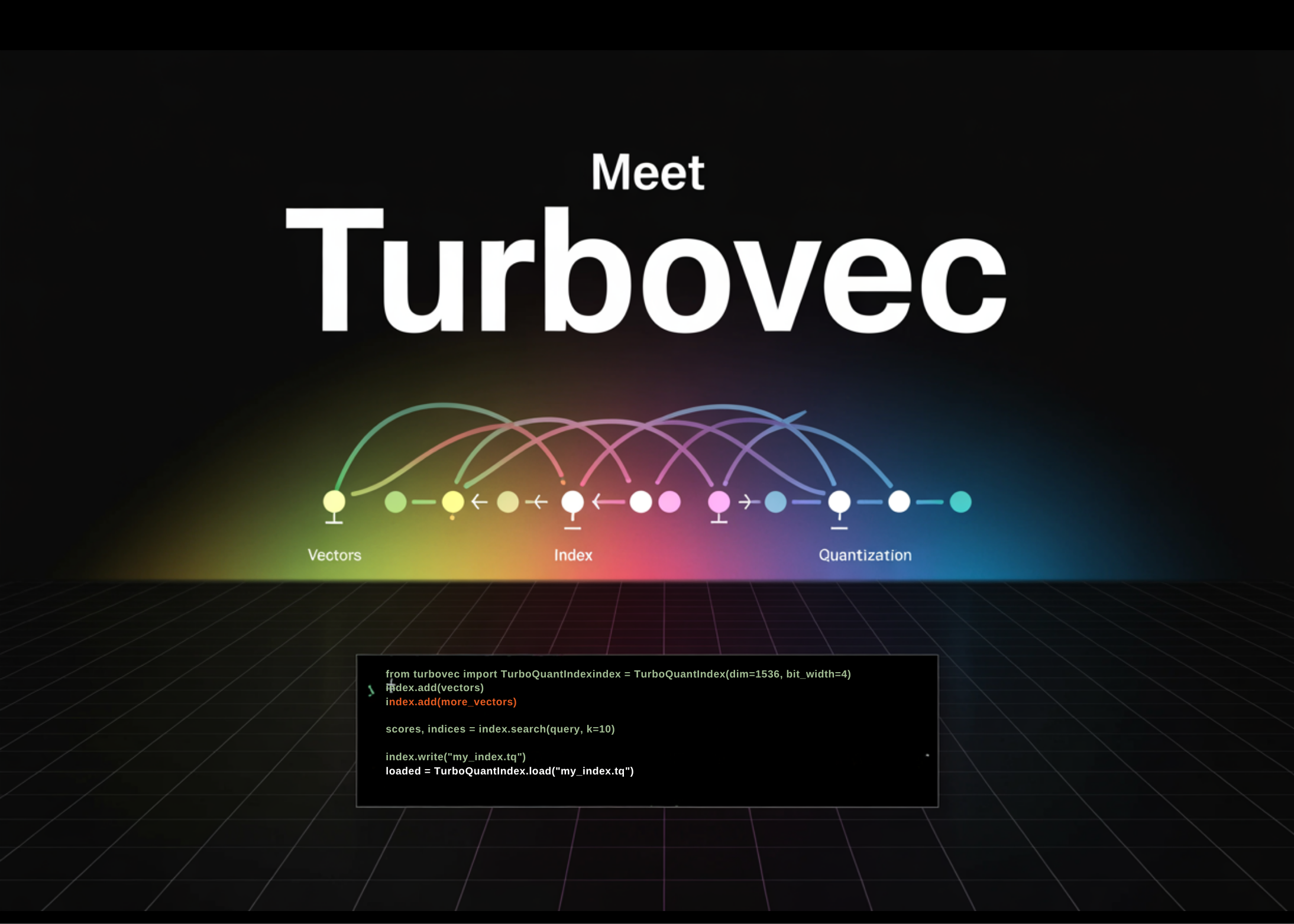
  2. Meet Turbovec: A Rust Vector Index with Python Bindings, and Built on Google’s TurboQuant Algorithm

    Turbovec is a new open-source vector index library written in Rust with Python bindings, designed to reduce the memory footprint of vector embeddings for AI applications. It utilizes Google's TurboQuant algorithm, a data-oblivious quantizer that achieves significant compression without requiring a training phase. This approach allows for substantial memory savings, fitting 10 million document embeddings into 4 GB of RAM compared to the 31 GB typically needed for float32 storage, while maintaining competitive search speeds and recall rates. AI

    Meet Turbovec: A Rust Vector Index with Python Bindings, and Built on Google’s TurboQuant Algorithm

    IMPACT Reduces memory requirements for vector embeddings, potentially lowering costs and enabling local inference for RAG applications.

  3. I spent 31 hours on the math behind TurboQuant so you don't have to

    A technical deep dive explains the inner workings of TurboQuant, a novel method for compressing large language model KV caches. TurboQuant utilizes a technique called PolarQuant, which transforms KV embeddings into polar coordinates and quantizes the resulting angles. This approach aims to significantly reduce the memory footprint of the KV cache, a major bottleneck for long-context LLMs, by compressing it over 4.2x. AI

    I spent 31 hours on the math behind TurboQuant so you don't have to

    IMPACT Compressing LLM KV caches with methods like TurboQuant could enable longer context windows and more efficient inference, reducing memory bottlenecks.

  4. Making LLMs more accurate by using all of their layers

    Google Research has developed a framework to evaluate the alignment of Large Language Models (LLMs) with human behavioral dispositions, using established psychological assessments adapted into situational judgment tests. This approach quantizes model tendencies against human social inclinations, identifying deviations and areas for improvement in realistic scenarios. Separately, Google Research also introduced SLED (Self Logits Evolution Decoding), a novel method that enhances LLM factuality by utilizing all model layers during the decoding process, thereby reducing hallucinations without external data or fine-tuning. AI

    Making LLMs more accurate by using all of their layers

    IMPACT New methods from Google Research offer improved LLM alignment and factuality, potentially increasing trust and reliability in AI applications.