PulseAugur / Brief
EN
LIVE 20:32:12

Brief

last 24h
[21/21] 222 sources

Multi-source AI news clustered, deduplicated, and scored 0–100 across authority, cluster strength, headline signal, and time decay.

  1. How I made my React site agent-ready in 100 lines

    A developer has outlined a method to make React websites more accessible to AI agents, requiring approximately 100 lines of code. This approach involves implementing the proposed WebMCP standard, creating an `llms.txt` sitemap for models, and utilizing declarative form metadata like HTML5 attributes and ARIA roles. The new Lighthouse Agentic Browsing audit, set to be available in Chrome DevTools for Agents in 2026, verifies these changes. AI

    IMPACT Enables websites to be more easily navigated and interacted with by AI agents, potentially improving user experience and automation.


  2. Building a Claude Code plugin with zero npm dependencies

    A developer has created a Claude Code plugin called seo-survival-kit that generates SEO outreach PDFs by integrating data from multiple APIs and rendering it using headless Chrome. To enhance security, the plugin was built without any npm dependencies, minimizing the potential for supply-chain attacks. This was achieved by utilizing raw Node.js modules and directly invoking Chrome via command-line flags instead of relying on libraries like Puppeteer. The developer also implemented robust security measures, including strict path validation and Content Security Policy, to prevent malicious code execution. AI

    IMPACT Demonstrates a secure and efficient method for building AI tool integrations, potentially influencing future plugin development practices.

  3. Two HTML Attributes Now Turn Your Website Into an AI Agent Tool — Inside Chrome's WebMCP

    Chrome has introduced two new HTML attributes that enable websites to function as AI agents. These attributes, revealed at Google I/O 2026, allow web pages to interact with AI models, effectively turning them into tools that can perform tasks. This development aims to enhance user interaction and functionality on the web by integrating AI capabilities directly into website structure. AI

    Two HTML Attributes Now Turn Your Website Into an AI Agent Tool — Inside Chrome's WebMCP

    IMPACT Enables websites to integrate AI agent capabilities directly, potentially enhancing user interaction and task automation.

  4. “This week I discovered the same pattern, executed by Google. Google Chrome is reaching into users' machines and writing a 4 GB on-device AI model file to disk

    Google is reportedly installing a 4GB AI model file, Gemini Nano, onto users' devices via its Chrome browser without explicit consent. This action is alleged to violate ePrivacy and GDPR regulations, including data protection by design principles. Furthermore, the scale of this data handling is suggested to constitute a significant environmental harm under corporate sustainability reporting directives. AI

    IMPACT Raises significant privacy concerns for users regarding on-device AI model deployment and data handling practices.

  5. Xreal's Project Aura smartglasses are a maximalist take on Android XR

    Xreal has unveiled Project Aura, a new set of smartglasses designed for an immersive Android XR experience. These glasses feature three cameras for hand tracking and photo/video capture, offering a wide field of view and sharp display. Project Aura connects to a separate puck for processing, which includes a trackpad and fingerprint sensor, and the device demonstrated multimodal capabilities by identifying objects and their molecular structures using Google's Gemini. While capable of entertainment, Xreal is positioning Project Aura as a pro-level device that can function as an external display for laptops, suggesting a premium price point. AI

    Xreal's Project Aura smartglasses are a maximalist take on Android XR

    IMPACT Offers a glimpse into multimodal AR experiences and potential productivity gains through AI integration.

  6. Google is pitching an AI agent ecosystem to consumers who may not buy it

    Google announced a suite of AI agent features at its I/O conference, including "Information agents" to monitor topics and "Spark" for personal digital life management. These agents, integrated into products like Gmail and Chrome, aim to automate tasks and provide personalized digests. However, many of these features are initially limited to paid Gemini Ultra subscribers, raising concerns about accessibility and the widening gap between AI enthusiasts and average consumers. AI

    IMPACT Google's new AI agents could redefine web interaction and personal task management, but initial limited access may widen the digital divide.

  7. # PrivacyGuardrail : Chrome extension aims to protect sensitive data from # Chatbots | heise online https://www. heise.de/news/Privacy-Guardrai l-Chrome-Erweiter

    A new Chrome extension called PrivacyGuardrail aims to protect sensitive user data from chatbots. The extension is designed to prevent personal information from being inadvertently shared with AI models through browser interactions. This development addresses growing concerns about data privacy in the age of increasingly sophisticated AI. AI

    IMPACT Provides a tool for users to mitigate privacy risks associated with chatbot interactions.

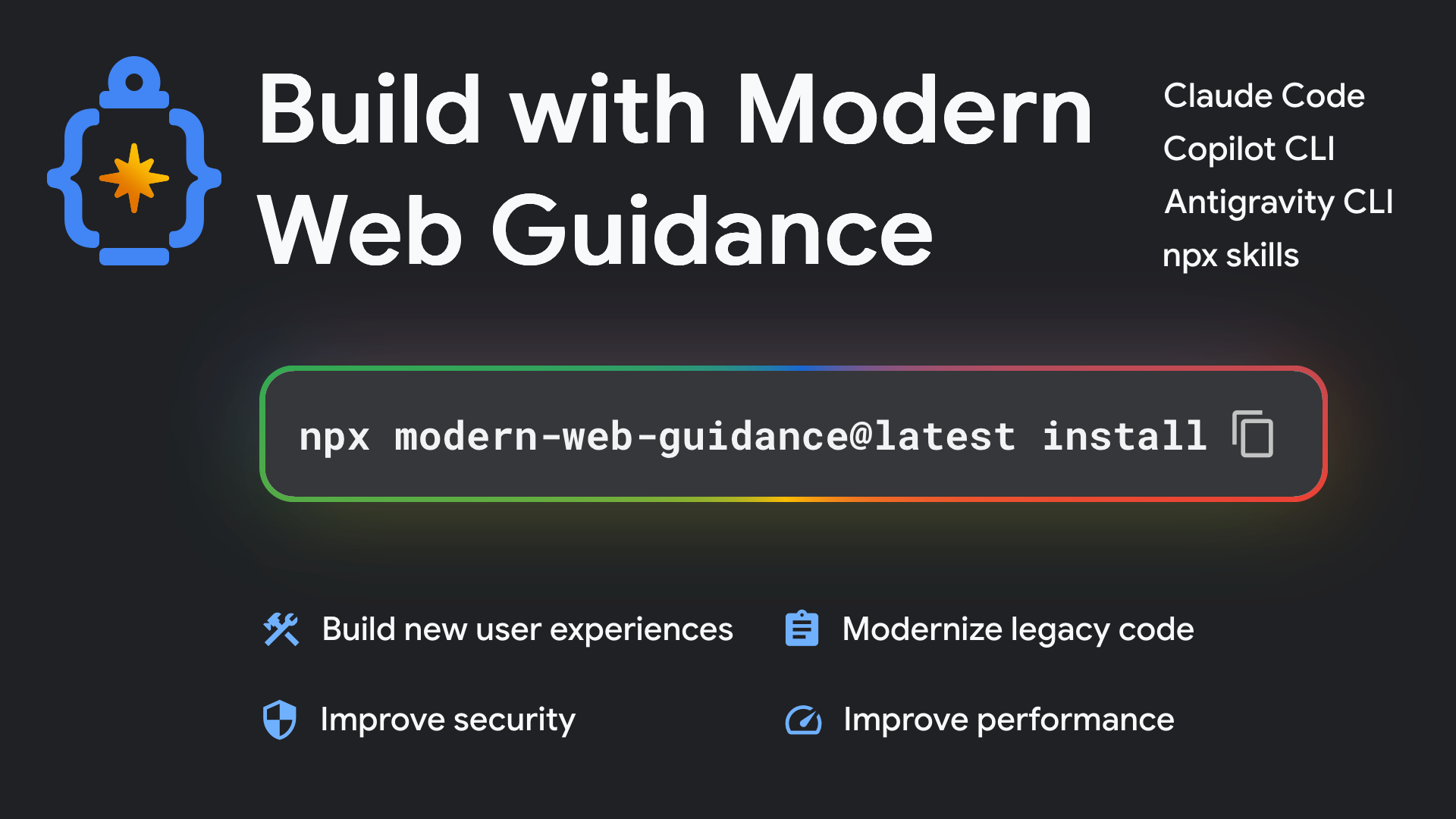
  8. Modern web guidance. A constantly updated set of expert-verified skills for AI agents from the Chrome team — on UI components, modernization of legacy code,

    Google's Chrome team has released a set of AI coding agent skills called Modern Web Guidance. These skills are designed to help AI agents with tasks such as UI component development, legacy code modernization, security, and performance optimization. They can be integrated with various AI coding tools like Claude Code and Copilot CLI, and assist with modern web features and performance metrics. AI

    Modern web guidance. A constantly updated set of expert-verified skills for AI agents from the Chrome team — on UI components, modernization of legacy code,

    IMPACT Enhances AI coding agent capabilities for modern web development tasks.

  9. Canva's new Gemini integration just made AI graphic design ubiquitous

    Canva has integrated Google's Gemini AI into its design platform, aiming to make AI-powered graphic design widely accessible. Meanwhile, Mozilla's Firefox browser is positioning itself as an alternative to Chrome, emphasizing privacy and open-source principles in the evolving AI landscape. AI

    IMPACT Canva's Gemini integration aims to democratize AI graphic design, while Firefox's privacy focus addresses user concerns in an increasingly AI-driven digital environment.

  10. Google addressed over 200 internal Chrome vulnerabilities from March to May 2026, a surge coinciding with its adoption of AI security tools. # Cybersecurity # A

    Google has seen a significant increase in internal Chrome vulnerability reports, with over 200 identified between March and May 2026. This surge appears to coincide with the company's integration of AI-powered security tools into its development process. The adoption of these AI tools may be contributing to the higher detection rate of security flaws within the Chrome browser. AI

    IMPACT Increased AI adoption in security tools may lead to faster vulnerability detection and patching in software development.

  11. Google Confirms 2 Critical New Flaws—How To Jump The Update Queue

    Google has confirmed two critical security vulnerabilities in its Chrome browser, identified as CVE-2026-9111 and CVE-2026-9110. These flaws affect WebRTC and the Chrome user interface, respectively. While Google is rolling out an automatic update over the coming days and weeks, users can manually initiate the update by navigating to Help > About Google Chrome within the browser. AI

    Google Confirms 2 Critical New Flaws—How To Jump The Update Queue

    IMPACT Minimal direct impact on AI operations; focuses on web browser security.

  12. View Transitions API: 5 Patterns I Use Across RAXXO Sites in 2026

    The View Transitions API allows developers to create smooth visual transitions between different states or pages within web applications. This API enables features like animated content swaps and shared element morphing, enhancing the user experience by making interfaces feel more polished and expensive. With widespread browser support, developers can implement these transitions with minimal JavaScript, leveraging the browser's compositor for efficient animations. AI

    IMPACT Minimal direct impact on AI operators; focuses on web development tooling.

  13. Show HN: Pablo – a Chrome extension that copies UI from any website

    Pablo is a new Chrome extension designed to capture and replicate website components. It extracts HTML and CSS, including styling and animations, from any web element with a simple hover-and-click action. The tool aims to streamline the web development process by allowing users to easily copy and paste functional UI elements. AI

    IMPACT Streamlines web development by enabling easy replication of UI elements, potentially speeding up prototyping and design workflows.

  14. 6 reasons why Firefox is the better browser for most users Still using Chrome, Edge, or Safari? Firefox is alive and well - and offering a fast, customizable, b

    Firefox is presented as a superior browser choice for the majority of users, outperforming Chrome, Edge, and Safari. Its advantages include speed, customization options, a lack of bloat, enhanced privacy, and strong security features. The browser is developed by a team that actively considers user feedback. AI

    6 reasons why Firefox is the better browser for most users Still using Chrome, Edge, or Safari? Firefox is alive and well - and offering a fast, customizable, b
  15. Perplexity Open-Sources Bumblebee: A Read-Only Supply-Chain Scanner for Developer Endpoints

    Perplexity has open-sourced Bumblebee, a new tool designed to scan developer endpoints for potential supply-chain attack vectors. This read-only scanner inventories installed packages, AI agent configurations, and editor/browser extensions on macOS and Linux systems. Bumblebee aims to fill a gap left by existing security tools by directly inspecting local developer machine states, which are increasingly targeted by attackers. AI

    Perplexity Open-Sources Bumblebee: A Read-Only Supply-Chain Scanner for Developer Endpoints

    IMPACT Enhances security for developers using AI tools and agents by identifying potential supply-chain vulnerabilities on their machines.

  16. On Google declaring war on the Web In Yesterday's IO Keynote Google declared war on the remnants of the Web. (See longer description on their website.) TL;DR: T

    Google's recent I/O keynote has been criticized for its shift towards AI-generated answers, potentially diminishing the role of traditional web links and sources. This move is seen by some as an attempt to create a Google-controlled abstraction layer over the web, where user-generated content serves as raw material for AI models without proper attribution or value. The author argues this approach undermines the participatory nature of the web and could lead to a more controlled, less open information ecosystem. AI

    On Google declaring war on the Web In Yesterday's IO Keynote Google declared war on the remnants of the Web. (See longer description on their website.) TL;DR: T

    IMPACT Critiques Google's AI strategy for potentially centralizing information and devaluing original web content.

  17. Mozilla challenges Google Chrome, introducing an AI 'kill switch' as part of Project Nova. Firefox becomes the only browser that

    Mozilla is introducing significant changes to Firefox through its Project Nova initiative. These updates include a redesigned user interface with rounded tabs and customizable layouts, alongside a more organized settings page that emphasizes privacy and AI controls. Notably, Firefox will offer a 'kill switch' feature, allowing users to completely disable AI functionalities within the browser. AI

    IMPACT Enhances user control over AI features within a major web browser, potentially influencing user adoption of AI-enabled web services.

  18. Google To Change Search On Pixel Phones After 10 Years With New Setting, Report Claims

    Google is significantly enhancing Android's security and privacy features with Android 17, introducing AI-powered protections like Live Threat Detection and stricter app permission controls. The update will also bring advanced data protection for stolen phones and improved Chrome security against malicious APKs. Additionally, Google is expanding AI features like the Pixel's "Take A Message" voicemail transcription to more Android phones and integrating Gemini AI across various Google products, including Google Play, smart home devices, and Google TV for smarter content discovery and streamlined development processes. AI

    Google To Change Search On Pixel Phones After 10 Years With New Setting, Report Claims

    IMPACT Google is integrating Gemini AI across its ecosystem, enhancing security, app discovery, and user experience, signaling a broader push for AI in everyday devices and services.

  19. Chrome downloads a 4GB AI file without user consent, researcher alleges

    Google Chrome has been found to be silently downloading a 4GB AI model, Gemini Nano, onto users' devices without explicit consent. Security researcher Alexander Hanff discovered that the file, named "weights.bin," is installed in hidden directories and automatically re-downloads if deleted, unless AI features are disabled or Chrome is uninstalled. This practice has raised concerns about user privacy, potential violations of EU regulations like GDPR, and significant environmental impact due to widespread distribution. AI

    Chrome downloads a 4GB AI file without user consent, researcher alleges

    IMPACT Raises significant concerns about user consent and privacy for AI features integrated into widely used software, potentially influencing future regulatory actions.

  20. 🚀 Fastest-growing AI projects today 1. Several projects gaining traction by offering innovative solutions for evaluating and i... 2. The fastest-growing project

    Several open-source AI projects are gaining traction, including tools for prompt engineering, fine-tuning, and multimodal understanding. WantongC's journal-adapt-writing-skill project is noted for helping users learn writing conventions, while bytedance/Lance offers lightweight multimodal model capabilities. Additionally, lightseekorg/tokenspeed is highlighted for accelerating LLM inference engines. AI

    🚀 Fastest-growing AI projects today 1. Several projects gaining traction by offering innovative solutions for evaluating and i... 2. The fastest-growing project

    IMPACT Highlights emerging open-source tools and frameworks that could influence future AI development and adoption.

  21. "Two weeks ago I wrote about Anthropic silently registering a Native Messaging bridge in seven Chromium-based browsers on every machine where Claude Desktop was

    A security vulnerability has been discovered in Chrome that could allow browsers to be incorporated into botnets without user suspicion. Separately, Anthropic and Google have been found to be installing large AI model files on user machines via Chromium-based browsers without explicit consent. This practice raises significant privacy concerns, particularly regarding data handling and user awareness. AI

    "Two weeks ago I wrote about Anthropic silently registering a Native Messaging bridge in seven Chromium-based browsers on every machine where Claude Desktop was

    IMPACT Concerns over silent AI model installations and browser vulnerabilities highlight risks for users and potential policy implications for AI deployment.