PulseAugur / Brief
EN
LIVE 04:27:39

Brief

last 24h
[10/10] 221 sources

Multi-source AI news clustered, deduplicated, and scored 0–100 across authority, cluster strength, headline signal, and time decay.

  1. Forget by Uncertainty: Orthogonal Entropy Unlearning for Quantized Neural Networks

    Researchers have developed a new framework called Orthogonal Entropy Unlearning (OEU) designed to effectively remove specific data from quantized neural networks while preserving overall model accuracy. This method addresses limitations in existing unlearning techniques by maximizing prediction uncertainty on forgotten data, thus avoiding confident mispredictions. OEU also employs gradient orthogonal projection to prevent interference between forgetting and retaining data gradients, offering theoretical guarantees for utility preservation. AI

    IMPACT Provides a novel method for data unlearning in quantized neural networks, crucial for privacy compliance in edge device deployments.

  2. I asked Gemma 4 31B to audit SAP code offline—and it argued back about risk calibration

    A developer used Google's Gemma 4 31B model to audit SAP ABAP code, finding that it flagged undocumented functions with a higher risk than the smaller Gemma 4 E4B model. This project, named SAPMigrate, highlights the necessity of local-first AI for handling sensitive intellectual property and regulated data. The developer emphasizes that cloud-based AI is not an option for such tasks due to potential contract violations and data privacy regulations like GDPR and SOX. AI

    I asked Gemma 4 31B to audit SAP code offline—and it argued back about risk calibration

    IMPACT Demonstrates the critical need for local-first AI in regulated industries handling sensitive IP, impacting enterprise adoption strategies.

  3. Magnifica Humanitas (15 May 2026), the first encyclical fully devoted to AI. A new piece on nicfab.eu maps its intersections with the EU regulatory framework —

    The Vatican has released "Magnifica Humanitas," its first encyclical dedicated entirely to artificial intelligence. This document explores the ethical and regulatory dimensions of AI, particularly its intersections with existing European Union frameworks like the AI Act, GDPR, and DSA. It also addresses concerns regarding autonomous weapons and includes specific guidance on AI responsibility, transparency, and governance. AI

    IMPACT Sets a significant ethical and governance precedent for AI development and deployment, influencing policy discussions globally.

  4. “This week I discovered the same pattern, executed by Google. Google Chrome is reaching into users' machines and writing a 4 GB on-device AI model file to disk

    Google is reportedly installing a 4GB AI model file, Gemini Nano, onto users' devices via its Chrome browser without explicit consent. This action is alleged to violate ePrivacy and GDPR regulations, including data protection by design principles. Furthermore, the scale of this data handling is suggested to constitute a significant environmental harm under corporate sustainability reporting directives. AI

    IMPACT Raises significant privacy concerns for users regarding on-device AI model deployment and data handling practices.

  5. #10 Years of #GDPR, the #European #regulation on #privacy has stood the test of #time. Now it must survive #AI | #Wired #Italy #one#

    The European Union's General Data Protection Regulation (GDPR) has completed its first decade, demonstrating resilience against the test of time. However, the regulation now faces a significant challenge in adapting to the rapid advancements and widespread adoption of artificial intelligence technologies. Experts are debating how GDPR can effectively govern AI while continuing to protect user privacy. AI

    IMPACT The GDPR's ability to adapt to AI will shape how privacy is managed in the rapidly evolving AI landscape.

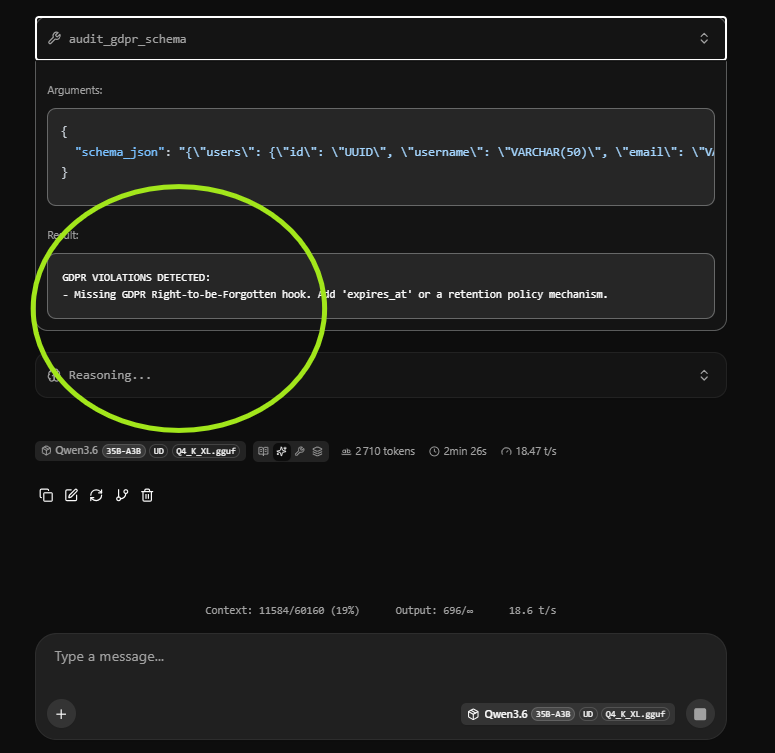
  6. When I read AI industry leaders complaining about GDPR being too difficult, I'm thinking : EITHER their products are useless, because it would be perfect for th

    An AI industry observer suggests that complaints about GDPR difficulty from AI leaders either indicate useless products or a disregard for privacy. The observer claims to have successfully developed a GDPR-ready and secure AI model, even on older hardware with limited VRAM, though it requires human oversight. AI

    When I read AI industry leaders complaining about GDPR being too difficult, I'm thinking : EITHER their products are useless, because it would be perfect for th

    IMPACT Suggests that AI products may be overstating their capabilities or neglecting privacy concerns in their development.

  7. Designing Nvidia-Grade Ising Quantum AI Models for Robust Qubit Calibration

    Nvidia has released open-source Ising quantum AI models designed to automate and improve the calibration of quantum processors. These models, which include a vision-language model for proposing calibration actions and CNNs for error correction decoding, are intended to be integrated into existing quantum control stacks. By treating calibration as an AI inference problem, similar to how LLMs are deployed, Nvidia aims to enhance the speed, accuracy, and robustness of quantum hardware operations, while also emphasizing the need for governance and security protocols. AI

    Designing Nvidia-Grade Ising Quantum AI Models for Robust Qubit Calibration

    IMPACT Enables more robust and automated calibration for quantum hardware, potentially accelerating quantum computing development.

  8. Spam is getting EXTREMELY aggressive and EXTREMELY annoying, thanks to AI. # spam # privacy # ai # llm # gdpr # email

    AI is significantly increasing the volume and sophistication of spam, making it more aggressive and annoying for users. This rise in AI-generated spam poses challenges for privacy and email security, prompting discussions around regulations like GDPR. AI

    Spam is getting EXTREMELY aggressive and EXTREMELY annoying, thanks to AI. # spam # privacy # ai # llm # gdpr # email

    IMPACT Increased AI-driven spam may necessitate new filtering technologies and stricter data privacy enforcement.

  9. Chrome downloads a 4GB AI file without user consent, researcher alleges

    Google Chrome has been found to be silently downloading a 4GB AI model, Gemini Nano, onto users' devices without explicit consent. Security researcher Alexander Hanff discovered that the file, named "weights.bin," is installed in hidden directories and automatically re-downloads if deleted, unless AI features are disabled or Chrome is uninstalled. This practice has raised concerns about user privacy, potential violations of EU regulations like GDPR, and significant environmental impact due to widespread distribution. AI

    Chrome downloads a 4GB AI file without user consent, researcher alleges

    IMPACT Raises significant concerns about user consent and privacy for AI features integrated into widely used software, potentially influencing future regulatory actions.

  10. "Two weeks ago I wrote about Anthropic silently registering a Native Messaging bridge in seven Chromium-based browsers on every machine where Claude Desktop was

    A security vulnerability has been discovered in Chrome that could allow browsers to be incorporated into botnets without user suspicion. Separately, Anthropic and Google have been found to be installing large AI model files on user machines via Chromium-based browsers without explicit consent. This practice raises significant privacy concerns, particularly regarding data handling and user awareness. AI

    "Two weeks ago I wrote about Anthropic silently registering a Native Messaging bridge in seven Chromium-based browsers on every machine where Claude Desktop was

    IMPACT Concerns over silent AI model installations and browser vulnerabilities highlight risks for users and potential policy implications for AI deployment.