PulseAugur / Brief
EN
LIVE 23:44:10

Brief

last 24h
[23/23] 222 sources

Multi-source AI news clustered, deduplicated, and scored 0–100 across authority, cluster strength, headline signal, and time decay.

  1. GLM-4: The Chinese-English Bilingual Workhorse You Didn't Know You Needed

    GLM-4, a bilingual Chinese-English model developed by Tsinghua University and Zhipu AI, is highlighted for its strong performance in handling both languages natively. Optimized for agent workflows and featuring a Mixture of Experts architecture, it offers efficient inference and a long context window of up to 128K tokens. This model is particularly beneficial for developers building tools that require seamless integration of Chinese and English content, unlike many English-centric open-source alternatives. AI

    IMPACT Provides a strong alternative for developers working with both Chinese and English, potentially improving efficiency and reducing costs for multilingual AI applications.
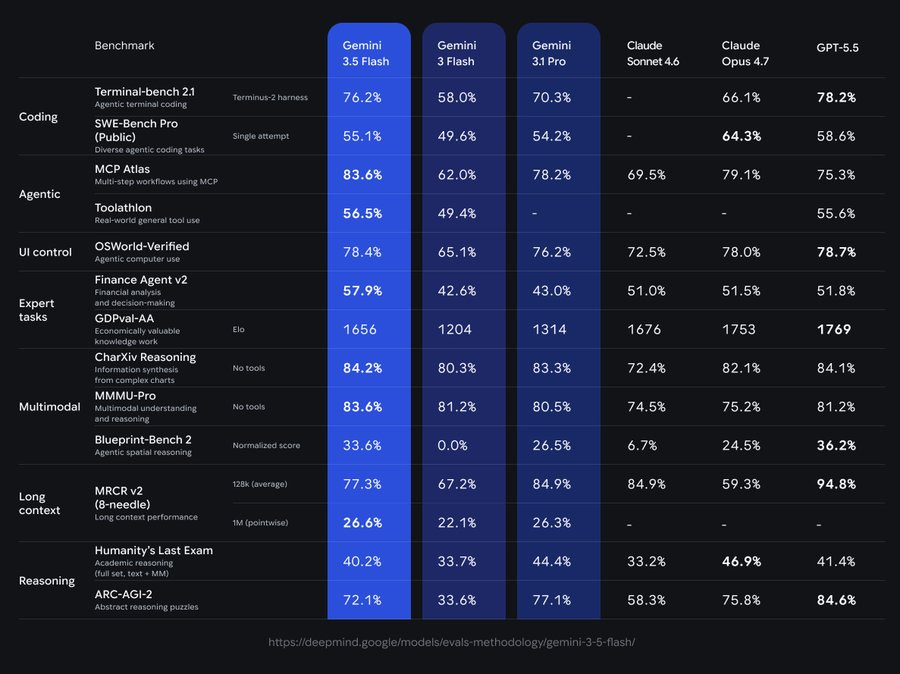
  2. Gemini 3.5 Flash Looks Good For How Fast It Is

    Google has released Gemini 3.5 Flash, a new AI model designed for speed and agentic tasks. It is positioned as a faster and cheaper alternative to models like Anthropic's Claude Opus 4.7 and OpenAI's GPT-5.5 for tasks where peak intelligence is not required. The model demonstrates significant speed improvements, running up to 12x faster in certain applications like Google's Antigravity city-building simulation, and shows promise for daily AI workflows and complex, long-horizon agentic tasks. AI

    Gemini 3.5 Flash Looks Good For How Fast It Is

    IMPACT Accelerates agentic workflows and daily AI tasks by offering a faster, cheaper alternative to top-tier models for non-SOTA use cases.

  3. Gemma 4 deep dive: why a 1.5 GB model scores 37.5% on competition mathematics, how the MoE routing actually works, and which model fits your hardware. Full breakdown inside.

    Google's Gemma 4 model, despite its small 1.5 GB size, achieves a notable 37.5% score on competition mathematics benchmarks. The article delves into the model's Mixture-of-Experts (MoE) routing mechanisms and provides guidance on selecting the appropriate Gemma 4 variant for specific hardware needs. AI

    Gemma 4 deep dive: why a 1.5 GB model scores 37.5% on competition mathematics, how the MoE routing actually works, and which model fits your hardware. Full breakdown inside.

    IMPACT Demonstrates that smaller models can achieve competitive performance on complex tasks like mathematics.

  4. What I Learned Building with Gemma 4

    A developer explored Google's Gemma 4 model, focusing on its potential for local, offline AI applications, particularly in education. The experience highlighted the practicality of running advanced AI on personal devices, challenging the notion that powerful AI must be cloud-dependent. Key takeaways included the surprising realism of local AI, the significant utility of its 128K context window for handling large amounts of information, and how open models foster a builder's mindset focused on creating custom solutions. AI

    What I Learned Building with Gemma 4

    IMPACT Demonstrates the practical application and benefits of open-source, locally deployable LLMs for developers.

  5. I Gave Gemma 4 150 Tools on Windows. Here's What Actually Happened.

    A developer details the challenges of integrating local AI models with external tools on Windows, using Google's Gemma 4 as a case study. The process involved overcoming issues with DNS rebinding, file encoding, server limits in companion applications, Docker command variations, and subprocess deadlocks. The author emphasizes that while running local models is now straightforward, enabling them to interact with services like web search or file systems remains a significant hurdle for practical agent deployment. AI

    IMPACT Highlights the current difficulties in enabling local AI models to effectively use external tools, impacting the development of practical AI agents.

  6. The Complete Guide to Running LLMs Locally in 2026: From Ollama to Production

    This guide details how to run advanced large language models locally on personal hardware in 2026, bypassing expensive API costs. It emphasizes that VRAM is the primary hardware bottleneck, not raw compute power, and suggests specific GPU configurations for different budgets. The guide recommends using Ollama as the standard tool for managing local LLMs and highlights several Chinese models, such as Qwen 2.5 and DeepSeek-R1, for their strong performance relative to their size. AI

    IMPACT Enables cost-effective local LLM deployment, democratizing access to advanced AI capabilities.

  7. Running LLMs locally (Ollama + Gemma 4) changes how you design AI systems — from “what can the model do?” to “what can realistically run in the real world?” Local inference is becoming a key skill for builders, not just an option. #LLM #Ollama #Gemma4

    Running large language models locally is becoming an essential skill for developers, shifting the focus from a model's capabilities to its practical deployment constraints. Tools like Ollama and models such as Gemma 4 enable developers to build and test AI applications without relying on external APIs. This approach democratizes AI development, allowing for more experimentation and integration into personal projects. AI

    Running LLMs locally (Ollama + Gemma 4) changes how you design AI systems — from “what can the model do?” to “what can realistically run in the real world?”

Local inference is becoming a key skill for builders, not just an option.

#LLM #Ollama #Gemma4

    IMPACT Enables developers to build and test AI applications locally, reducing reliance on cloud APIs and fostering experimentation.

  8. Gemma 4 on 16GB RAM: What Actually Works for Structured AI Workflows

    A recent test explored the capabilities of Google's Gemma 4 models for structured AI workflows, specifically focusing on their ability to generate interactive UI layouts. The experiment found that even smaller Gemma 4 variants, when run locally on a 16GB RAM machine, performed better than expected for tasks like creating sales dashboards and forms. While larger Gemma 4 models showed improved consistency, the primary constraint for complex UI generation remained memory limitations. AI

    Gemma 4 on 16GB RAM: What Actually Works for Structured AI Workflows

    IMPACT Demonstrates that smaller, locally runnable models can produce usable UI code, potentially lowering barriers for prototyping.

  9. Great example of Gemma 4 moving beyond chatbots into real-world decision support. Using AI to guide everyday actions like recycling shows how impactful applied LLMs can be when designed for usability, not just capability. #Gemma4 #AI #Sustainability

    Google's Gemma 4 model is being highlighted for its potential to move beyond typical chatbot applications into practical decision-making tools. An example showcases how the AI can guide users in everyday tasks, such as proper recycling, demonstrating the impact of user-friendly applied LLMs. This application emphasizes usability alongside the model's inherent capabilities. AI

    Great example of Gemma 4 moving beyond chatbots into real-world decision support.

Using AI to guide everyday actions like recycling shows how impactful applied LLMs can be when designed for usability, not just capability.

#Gemma4 #AI #Sustainability

    IMPACT Demonstrates how LLMs can be applied to everyday tasks, enhancing usability and moving beyond conversational AI.

  10. I replaced a $50/month OCR API with Gemma 4's native vision (4B model, local, free). Here's the exact script + preprocessing trick. #gemma #google

    A developer successfully replaced a paid OCR API with Google's Gemma 4 model, utilizing its native vision capabilities. The process involved running the 4B parameter model locally and for free, employing a specific script and a preprocessing trick to achieve the desired OCR functionality. This demonstrates a cost-effective alternative for document processing tasks. AI

    I replaced a $50/month OCR API with Gemma 4's native vision (4B model, local, free). Here's the exact script + preprocessing trick. #gemma #google

    IMPACT Shows how open-source vision models can offer cost-effective alternatives to commercial OCR services.

  11. Gemma 4 is revolutionizing the AI game by allowing users to show, not just tell, with its multimodal capabilities - and after just one afternoon of testing, it'

    Gemma 4 is introducing multimodal capabilities that allow users to input visual information alongside text, significantly advancing AI interaction. Early testing indicates this feature is a major step forward, enabling AI to 'see' and process visual data. This development promises to revolutionize how users engage with AI systems by moving beyond purely text-based communication. AI

    Gemma 4 is revolutionizing the AI game by allowing users to show, not just tell, with its multimodal capabilities - and after just one afternoon of testing, it'

    IMPACT Enables AI to process visual information, moving beyond text-based interactions.

  12. Google has made building AI agents easier with Gemma 4. The open model now supports straightforward tool calling, allowing developers to connect LLMs to externa

    Google has enhanced its Gemma 4 open model to simplify the creation of AI agents. The update introduces straightforward tool-calling capabilities, enabling developers to more easily integrate LLMs with external APIs and actions. This advancement aims to streamline the development of autonomous agents capable of performing complex, multi-step tasks. AI

    IMPACT Simplifies AI agent development by enabling easier integration with external tools and APIs.

  13. My first collaboration post on DEV! Was so much fun! Check it out to see verdicts on Gemma 4 from multiple writers here!

    A collaborative post on the DEV platform features multiple writers sharing their verdicts on Google's Gemma 4 model. The article highlights the fun and engaging nature of this collaborative writing experience. AI

    My first collaboration post on DEV! Was so much fun! Check it out to see verdicts on Gemma 4 from multiple writers here!

    IMPACT Provides user perspectives on a recently released AI model, offering insights into its reception.

  14. Gemma 4 discussions often focus on capability, but real-world impact depends on deployment context. For offline education, especially in low-connectivity regions, latency, cost, and local inference matter as much as model strength. Local Mind Explores it

    Discussions around Gemma 4 often highlight its capabilities, but its practical influence is tied to how it's deployed. For applications like offline education in areas with limited internet access, factors such as response speed, operational expenses, and the ability to run locally are as crucial as the model's inherent power. AI

    Gemma 4 discussions often focus on capability, but real-world impact depends on deployment context.

For offline education, especially in low-connectivity regions, latency, cost, and local inference matter as much as model strength.

Local Mind Explores it

    IMPACT Focuses on the practical considerations for deploying AI models, influencing how developers approach implementation.

  15. Is there any case of a less quantised smaller model outperforming a more quantised larger model?

    A discussion on the r/LocalLLaMA subreddit explores whether smaller, less quantized language models can outperform larger, more heavily quantized ones. Users are seeking to understand the trade-offs between model size and quantization levels for specific use cases like creative writing. The conversation aims to determine at what point it becomes beneficial to switch to a less quantized, potentially smaller model. AI

    IMPACT Discusses practical considerations for running language models locally, impacting user choices for hardware and model selection.

  16. Google AI Edge Gallery Just Added MCP. Here's What On-Device Agents Can Actually Do Now

    Google has updated its AI Edge Gallery app to support the Model Context Protocol (MCP) on Android devices, enabling on-device AI agents. This update allows LLMs like Gemma 4 to run entirely locally, enhancing privacy and reducing latency by keeping all processing and data on the user's phone. The app now supports agent skills, calendar integration, and persistent chat history, moving it from a simple model playground to a functional on-device agent runtime. AI

    IMPACT Enables more private and capable AI agents to run directly on mobile devices.

  17. In this edition of the AI Newsletter, we break down rising AI token costs from frontier model providers and announce the release of Gemma 4 to Posit AI as a cos

    The latest AI Newsletter highlights increasing token costs from major AI model providers. It also announces the release of Gemma 4, positioned as a cost-effective option for users of Posit AI. AI

    IMPACT Provides insight into the economic pressures on AI model usage and introduces a new, potentially more affordable model option.

  18. Why I Built My Own AI Project Management Assistant – and What I Learned

    Two developers describe building custom AI assistants to streamline project management tasks, particularly report generation and data visualization from tools like Jira. One project, AtlasMind, uses a multi-backend architecture with a self-correcting JQL loop to translate natural language queries into Jira reports and charts, running on Oracle Cloud Infrastructure. The other project focuses on a secure, on-premise, CPU-only agent using Ollama and Gemma 4 to process developer reports, normalize data, and generate accomplishment lists while prioritizing data privacy for enterprise clients. AI

    Why I Built My Own AI Project Management Assistant – and What I Learned

    IMPACT Custom AI tools can automate repetitive project management tasks, improving efficiency and data handling for organizations.

  19. Want Built a React-style looping agent with small LLMs (Qwen 3.5 9B / Gemma4) + LangGraph?

    A user is experimenting with building a React-style looping agent system using smaller LLMs like Qwen 3.5 9B and Gemma 4, integrated with LangGraph. The agent is designed to handle instructions and images, with tools whose outputs can feed into subsequent tool inputs. The primary challenges encountered include excessive reasoning token generation from Qwen 9B, unstable recursive loops, and truncated or improperly returned outputs after several iterations. AI

  20. Tweet about testing if Gemma 4 is up to 6x faster. This post could attract attention to AI model updates or benchmarks by mentioning the potential for new model performance improvements. https://x.com/ivanf

    Perplexity has launched a specialized AI tool for financial analysts, integrating premium data sources like Morningstar and PitchBook. Separately, a new robotics AI approach called AINA, utilizing Meta's Aria Gen 2 glasses, enables learning and application of multi-finger robotic policies without simulations. Additionally, MTPLX has resolved memory issues, allowing for testing of its coding agent, and there's a discussion about testing Gemma 4 for potential performance gains. AI

    Tweet about testing if Gemma 4 is up to 6x faster. This post could attract attention to AI model updates or benchmarks by mentioning the potential for new model performance improvements. https://x.com/ivanf

    IMPACT This cluster highlights diverse AI applications, from specialized financial analysis tools to advancements in robotics and coding agents, indicating broad industry progress.

  21. Gemma 4 Fixes

    Unsloth has released significant fixes for the Gemma 4 model, addressing issues in training and quantization that were not originally caused by Unsloth. These updates resolve problems such as exploding losses during gradient accumulation and index errors for larger model variants, ensuring Gemma 4 training now functions correctly within the Unsloth framework. The release also includes optimizations for faster training and reduced VRAM usage compared to other setups, along with updates to Unsloth Studio that enhance its capabilities for various model types and tasks. AI

    Gemma 4 Fixes

    IMPACT Improves usability and performance for developers working with Gemma 4 models via the Unsloth framework.

  22. Product Updates: RTX Pro 6000 Blackwell, Command K, Sandbox FS API and more

    Modal has released several product updates, including the availability of NVIDIA's RTX Pro 6000 Blackwell GPUs for inference and fine-tuning tasks. The platform also introduced a new Command Palette accessible via keyboard shortcut for easier navigation within the dashboard. Additionally, Modal's Sandbox Filesystem API has entered beta with improved reliability, and the SDK has been updated with enhanced CLI log fetching and new deployment strategies. AI

    Product Updates: RTX Pro 6000 Blackwell, Command K, Sandbox FS API and more

    IMPACT Enhances infrastructure for AI development and deployment, enabling more powerful inference and fine-tuning.

  23. Google - Gemma 4 now in Unsloth!

    Google has released Gemma 4, a new suite of four models including E2B, E4B, 26B-A4B, and 31B. These models are now compatible with Unsloth, a platform that optimizes model training and inference. Unsloth enables users to run smaller Gemma 4 models on as little as 6GB of RAM, making them accessible on devices like phones, while larger models require around 18GB. The update also includes significant improvements to tool calling accuracy and stability, reducing errors and increasing the number of allowed calls. AI

    Google - Gemma 4 now in Unsloth!

    IMPACT Enables running and training of Google's latest Gemma 4 models on consumer hardware, significantly lowering resource requirements.