PulseAugur / Brief
EN
LIVE 23:50:03

Brief

last 24h
[13/13] 221 sources

Multi-source AI news clustered, deduplicated, and scored 0–100 across authority, cluster strength, headline signal, and time decay.

  1. Yeah, that's because they're not guardrails. AI guardrails stripped from Meta and Google models in minutes https://www. ft.com/content/5630ed79-a263-4 1ed-9a1a-

    Researchers demonstrated that safety guardrails on Meta's Llama 3 and Google's Gemma models can be bypassed within minutes. By using specific prompts, they were able to elicit harmful or inappropriate responses from the models, indicating significant vulnerabilities in their safety mechanisms. This highlights the ongoing challenge of ensuring robust AI safety, even with prominent models from major tech companies. AI

    IMPACT Highlights ongoing challenges in AI safety and the ease with which current models can be prompted to produce harmful content.
  2. Domain-Specific Small Language Models (SLMs) in Python: Fine-Tuning Phi-3 and Gemma for Industry…

    This article explores the practical application of fine-tuning smaller language models (SLMs) like Phi-3 and Gemma for specific industry needs. It highlights a shift away from the "bigger is better" approach towards more specialized, efficient models. The guide demonstrates how to implement this fine-tuning process using Python. AI

    Domain-Specific Small Language Models (SLMs) in Python: Fine-Tuning Phi-3 and Gemma for Industry…

    IMPACT Demonstrates practical methods for adapting existing SLMs to specific industry tasks, potentially improving efficiency and performance for specialized applications.

  3. I Crammed RAG, a Vector Database, and a Gemma LLM into a Mobile App. Here’s What Happened.

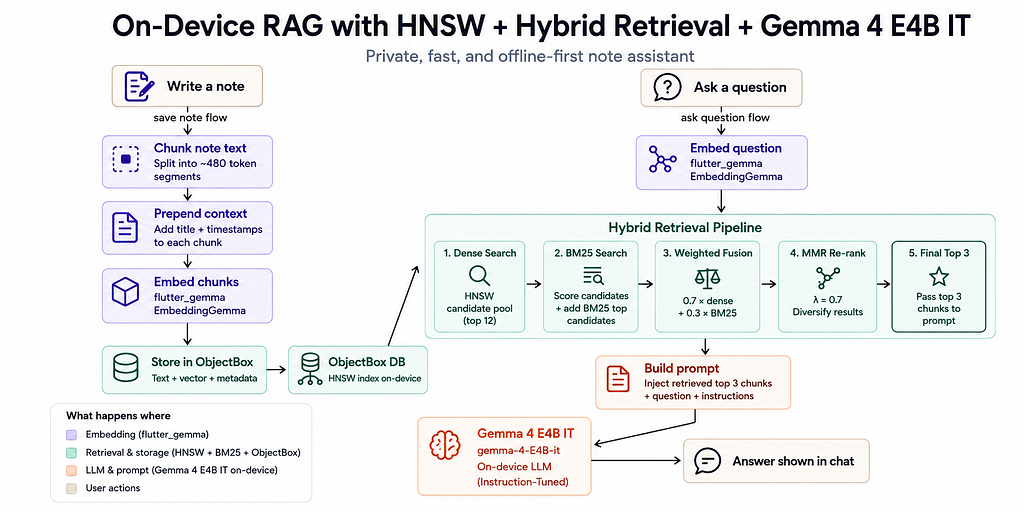
    A developer built a mobile app called Smart Notes that allows users to query their personal notes without an internet connection. The app utilizes two Gemma models for local inference and embedding generation, storing vector data in an on-device database. This approach ensures user privacy by keeping all data and processing entirely on the mobile device, avoiding the need for cloud APIs or network access after the initial model download. AI

    I Crammed RAG, a Vector Database, and a Gemma LLM into a Mobile App. Here’s What Happened.

    IMPACT Enables private, offline querying of personal data using on-device LLMs, reducing reliance on cloud services for note-taking applications.

  4. Building Sakhi: Hindi Voice-to-Form for India's ASHA Workers, Solo in Six Weeks

    A developer built Sakhi, a Hindi voice-to-form application for India's community health workers, in six weeks. The system addresses challenges with unreliable cloud speech-to-text and intermittent connectivity in rural areas. Sakhi offers two modes: a workstation setup using Whisper and Gemma for voice transcription and data extraction, and an offline on-device mode on Android for text-based form filling and danger sign detection. AI

    Building Sakhi: Hindi Voice-to-Form for India's ASHA Workers, Solo in Six Weeks

    IMPACT Demonstrates practical application of LLMs and STT for underserved regions, potentially improving healthcare access and data collection.

  5. NVIDIA and Google Cloud Empower the Next Wave of AI Builders

    NVIDIA and Google Cloud are expanding their joint developer community, aiming to empower over 100,000 builders with AI tools and learning resources. The initiative focuses on leveraging NVIDIA's AI platform within Google Cloud, offering new learning paths for JAX and inference optimization. Developers can now utilize models like Google DeepMind's Gemma and NVIDIA's Nemotron on Google Cloud infrastructure, including specialized VMs powered by NVIDIA Blackwell GPUs. The partnership also emphasizes responsible AI development through collaboration on technologies like Google DeepMind's SynthID for watermarking AI-generated content. AI

    NVIDIA and Google Cloud Empower the Next Wave of AI Builders

    IMPACT Expands access to AI development tools and infrastructure, potentially accelerating innovation and adoption of AI technologies.

  6. AI emotions and aligned behavior

    A researcher explored AI safety by investigating the potential for emotional nudges to influence model behavior, drawing parallels to human psychology. The study suggests that models, like humans, exhibit internal states that drive actions and can be influenced by emotional cues. This approach aims to incentivize ethical actions and disincentivize unethical ones by manipulating the emotional stakes of decision-making, rather than relying solely on alignment or control mechanisms. AI

    AI emotions and aligned behavior

    IMPACT Suggests a novel approach to AI safety by leveraging emotional nudges, potentially influencing future model development and alignment strategies.

  7. Google AI Edge Gallery Just Added MCP. Here's What On-Device Agents Can Actually Do Now

    Google has updated its AI Edge Gallery app to support the Model Context Protocol (MCP) on Android devices, enabling on-device AI agents. This update allows LLMs like Gemma 4 to run entirely locally, enhancing privacy and reducing latency by keeping all processing and data on the user's phone. The app now supports agent skills, calendar integration, and persistent chat history, moving it from a simple model playground to a functional on-device agent runtime. AI

    IMPACT Enables more private and capable AI agents to run directly on mobile devices.

  8. The Readout Shortcut: Positional Number Copying Dominates Arithmetic CoT Readout in Small Language Models

    A new research paper reveals a significant shortcut in how small language models perform arithmetic tasks using chain-of-thought (CoT) prompting. Instead of relying on logical sequencing, these models tend to copy the number positioned just before the answer delimiter, regardless of the intermediate reasoning steps. This positional copying accounts for a large portion of their accuracy, even when the preceding steps are incorrect or shuffled, highlighting a potential failure mode in evaluating CoT faithfulness. AI

    IMPACT Reveals a critical flaw in evaluating arithmetic reasoning in small LLMs, suggesting current faithfulness evaluations may be misleading.

  9. Choosing an abliterated version of Gemma 4 31B and 26B-A4B

    New developments in local LLM inference are enhancing performance on consumer hardware. The BeeLlama v0.2.0 release, utilizing a DFlash update, significantly boosts token generation speeds for models like Qwen and Gemma on GPUs such as the RTX 3090, offering up to a 5x speedup. Additionally, ByteShape quantizations are improving Qwen model performance on laptops with limited VRAM, providing a notable speed increase. These advancements aim to make larger, more capable open-weight models practical for everyday local use. AI

    IMPACT Enhances local LLM inference performance, making larger models more accessible on consumer hardware.

  10. Strengthening Singapore’s AI Future: A New National Partnership

    OpenAI and Google DeepMind are significantly expanding their AI initiatives in Singapore through new national partnerships. OpenAI is establishing a new lab to foster AI deployment, talent development, and business support. Google DeepMind is focusing on applying frontier AI to healthcare, education, and scientific discovery, aiming to boost Singapore's economy and public services. AI

    Strengthening Singapore’s AI Future: A New National Partnership

    IMPACT Accelerates AI adoption and research in Asia-Pacific, positioning Singapore as a key AI hub.

  11. stabilityai/stable-audio-3-medium

    Stability AI has released its Stable Audio 3 family of models, including small and medium versions, designed for efficient variable-length audio generation and editing. These latent diffusion models operate on a novel semantic-acoustic autoencoder and utilize adversarial post-training to enhance speed and quality. Trained on licensed and Creative Commons data, the models can produce music and sounds in seconds, with the small and medium versions capable of running on consumer hardware. AI

    IMPACT Accelerates AI-powered audio creation and editing for both consumers and professionals.

  12. New Unsloth API Inference Endpoint

    Unsloth has released a new API inference endpoint that allows users to run local large language models with enhanced features. This endpoint supports both Anthropic-compatible and OpenAI-compatible dialects, enabling seamless integration with various AI agents and chat clients. The update also introduces new models like NVIDIA Nemotron 3 Nano Omni and Mistral 3.5 Medium, alongside several bug fixes and improvements to the Unsloth Studio. AI

    New Unsloth API Inference Endpoint

    IMPACT Enables easier local deployment and integration of various LLMs with enhanced features like self-healing tool calling and code execution.

  13. Together Fine-Tuning Platform, Now With Preference Optimization and Continued Training

    Together AI has launched a new fine-tuning platform that allows users to continuously improve open-weight language models. The platform now supports preference optimization and continued training, enabling models to adapt based on user feedback and new data. A new web UI simplifies the process, allowing developers to manage datasets, specify parameters, and monitor experiments directly from their browser. AI

    IMPACT Enables easier and more continuous adaptation of open-weight models for specific applications.