PulseAugur / Brief
EN
LIVE 23:21:07

Brief

last 24h
[7/7] 221 sources

Multi-source AI news clustered, deduplicated, and scored 0–100 across authority, cluster strength, headline signal, and time decay.

  1. NEW! Recently, some generative AI tools have been launching vertical solutions. Here's one of the latest.

    Google has launched Gemini for Science, a new generative AI tool aimed at scientific research. This specialized version of Gemini is currently in a labs phase and is available for users to test. The tool is designed to provide vertical solutions within the rapidly evolving field of generative AI. AI
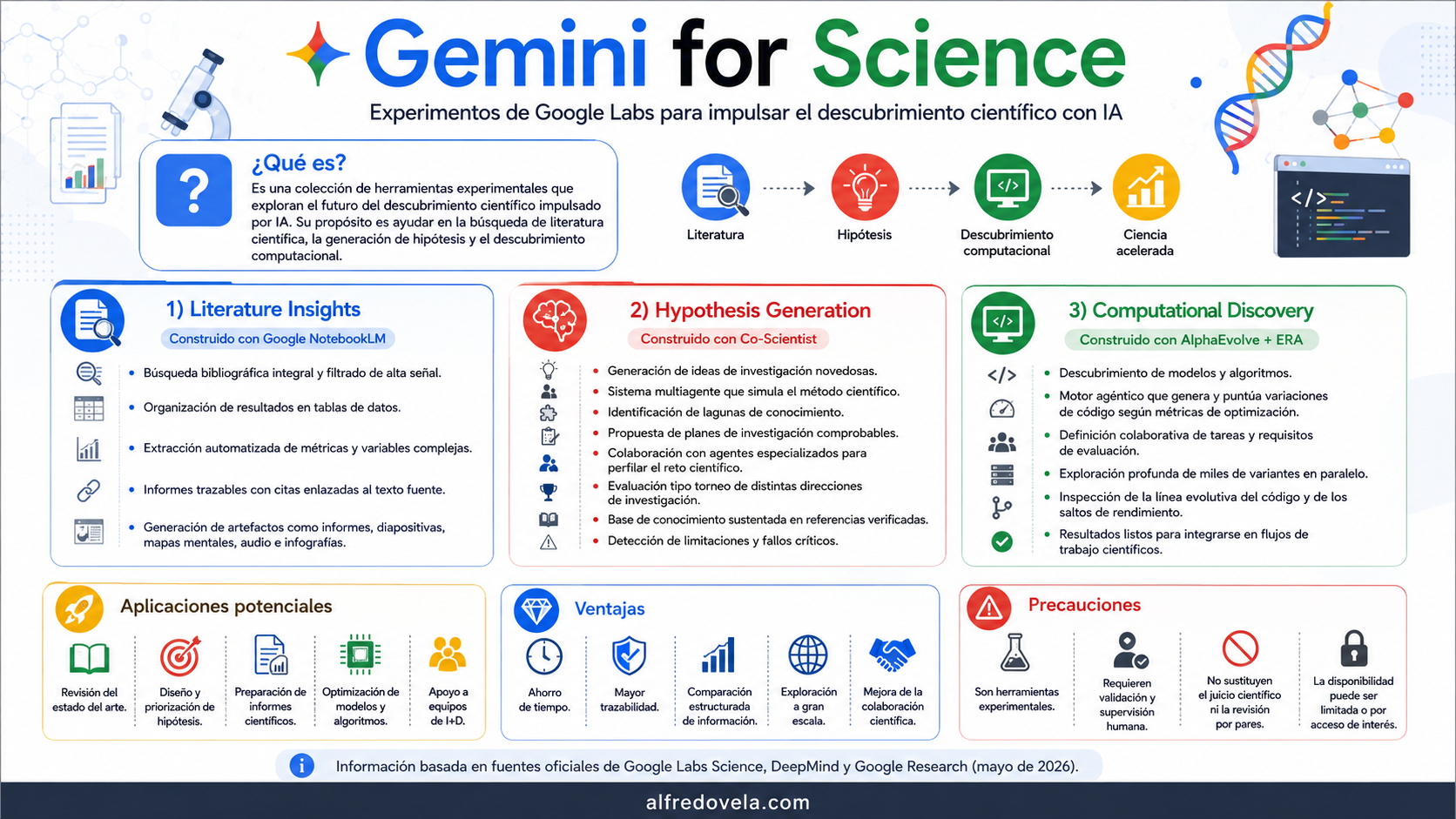
    NEW! Recently, some generative AI tools have been launching vertical solutions. Here's one of the latest.

    IMPACT This specialized AI tool could accelerate scientific discovery by providing tailored solutions for researchers.
  2. Google debuts AI-powered tools to optimize scientific research workflows

    Google has introduced a new suite of AI-powered tools called Gemini for Science, designed to streamline and enhance scientific research. This collection includes features for generating hypotheses by analyzing vast amounts of scientific literature, an agentic search engine for rapidly designing and testing thousands of experiments, and a chat interface to summarize complex research papers into digestible formats. Additionally, a Science Skills tool will automate intricate workflows by extracting insights from major life science databases. AI

    Google debuts AI-powered tools to optimize scientific research workflows

    IMPACT Streamlines scientific discovery by automating hypothesis generation, experimental design, and literature review.

  3. ‘Solve all diseases,’ you say?

    Google DeepMind CEO Demis Hassabis announced Gemini for Science at Google I/O, a suite of AI tools aimed at accelerating scientific discovery, particularly in medicine. While Hassabis stated the company's hope to "solve all diseases," the article clarifies this refers to dramatically reducing the time for medical breakthroughs rather than an immediate cure. The tools build upon existing projects like AlphaFold, which aids in understanding protein structures, and AlphaGenome, which predicts DNA mutations, though ethical and practical limitations remain. AI

    ‘Solve all diseases,’ you say?

    IMPACT Accelerates AI's role in medical research, potentially speeding up drug discovery and disease understanding.

  4. Empirical Research Assistance (ERA): From Nature publication to catalyzing Computational Discovery

    Google Research has developed Empirical Research Assistance (ERA), an AI tool designed to help scientists write and optimize code for computational experiments. Published in Nature, ERA utilizes Gemini to search scientific literature, generate code, and evaluate solutions, demonstrating expert-level performance across various scientific disciplines. This technology is being integrated into a new experimental tool called Computational Discovery, which is rolling out through Gemini for Science, aiming to accelerate scientific discovery by improving the efficiency of testing and refining computational models. AI

    Empirical Research Assistance (ERA): From Nature publication to catalyzing Computational Discovery

    IMPACT Accelerates scientific discovery by automating and optimizing complex coding tasks for researchers.

  5. The Download: coding’s future, the ‘Steroid Olympics,’ and AI-driven science

    Anthropic's Code with Claude is demonstrating a future where developers increasingly rely on AI for coding tasks, with many admitting to shipping AI-generated code without thorough review. Google's recent I/O event highlighted a shift in AI-driven science, moving towards agentic, LLM-based systems like Gemini for Science, potentially reducing reliance on specialized tools. This trend is also reflected in the growing momentum behind 'world models' in AI research, aiming to imbue systems with a deeper understanding of the physical environment. AI

    The Download: coding’s future, the ‘Steroid Olympics,’ and AI-driven science

    IMPACT AI is increasingly automating coding tasks and driving new approaches in scientific research, potentially accelerating discovery and changing developer workflows.

  6. We’re rolling out 3 new experimental tools to help scientists skip the busywork and focus on big ideas:

    Google AI has announced Gemini for Science, a new initiative aimed at accelerating scientific discovery. This project involves collaboration with over 100 institutions and a community of trusted testers. Additionally, Google AI is launching "Science Skills," a specialized bundle that integrates insights from numerous life science models and databases with agentic platforms. Three new experimental tools are also being rolled out to assist scientists by automating tedious tasks. AI

    IMPACT Accelerates scientific research by integrating advanced AI models and tools, potentially speeding up discovery across various fields.

  7. Demis Hassabis said this might be the ‘foothills of the singularity.’ What?

    Google DeepMind CEO Demis Hassabis has stated that humanity is in the "foothills of the singularity," suggesting that AGI could arrive within a few years. This prediction, made at Google I/O, contrasts with the views of some researchers, like Alexander Lerchner, who argue that AI systems can simulate but not truly instantiate consciousness due to their lack of biological embodiment and inherent meaning-making capabilities. Hassabis's earlier timeline prediction of a 50% chance of AGI by 2030 is also noted, alongside the broader industry trend of framing AI as a tool for scientific advancement and human ingenuity. AI

    Demis Hassabis said this might be the ‘foothills of the singularity.’ What?

    IMPACT Hassabis's 'foothills of the singularity' claim fuels debate on AGI timelines and the nature of AI consciousness, influencing industry sentiment and research direction.